

News & activities
 News releases
2015-08-25
President Ma awards posthumous citation to Chinese-American author Iris Chang
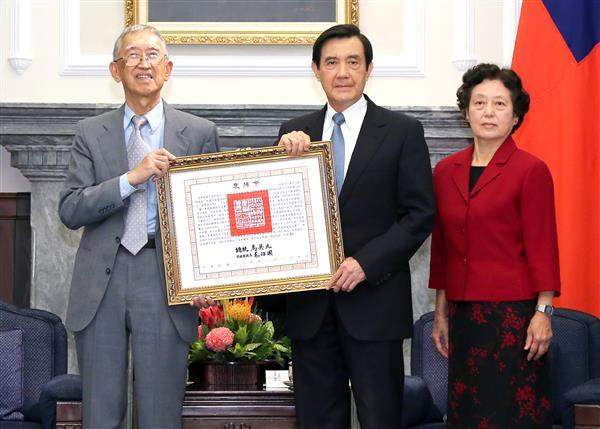
President Ma Ying-jeou on the morning of August 25 personally awarded a posthumous citation to Chinese-American author Iris Chang (張純如). Ms. Chang's father, Shau-Jin Chang, PhD. (張紹進,) accepted the honor on his daughter's behalf. The president expressed his gratitude, and recognized the importance of Ms. Chang's book The Rape of Nanking: The Forgotten Holocaust of World War II, which kindled renewed interest in the tragedy of the Nanjing massacre. He also reiterated that in the ROC's relationship with Japan, the government's attitude is to uphold "fact-based objectivity, human empathy, and clarity about historical events, both positive and negative."
In remarks, the president stated that he was deeply honored to present this citation on behalf of the ROC government. He went on to say that this citation, 11 years overdue, stands as a symbol of the gratitude, admiration, and deep memories that Ms. Chang inspires in the government and people of the ROC. Iris Chang, he said, long concerned herself with human rights-related issues, and The Rape of Nanking: The Forgotten Holocaust of World War II features her incisive, yet fluid writing style, which brought renewed attention by the international community to the atrocities committed by the Japanese military in Nanjing in 1937 during the War of Resistance Against Japan.
The president said that Ms. Chang's writing about the atrocities of the Japanese in Nanjing was not only deep, detailed, and fluid, but that The Rape of Nanking: The Forgotten Holocaust of World War II was the first book written in English describing that incident. It was on the New York Times Bestsellers List for Nonfiction for 10 weeks, and had 15 printings, selling over 500,000 copies. The book resonated throughout the international community, and is an important testament to the history of the ROC in the War of Resistance, he said.
The president emphasized that Ms. Chang unearthed various archival materials, graphically portrayed the historical tragedy of the Rape of Nanjing, and gave voice to a sense of justice that, 50 years on, is still heart-stirring. These appeals to historical truth, and the global public's heightened awareness of World War II history, are the main reasons why there is still an audience for her work so many years later.
Discussing the attitude of governments throughout the world in facing history, President Ma pointed out that the German government spent over 20 years following World War II recognizing its wrongs, apologizing, and providing compensation. In facing the harm caused by Nazism, Germany even created a word—Vergangenheitsbewaltigung—that means "bidding farewell to the past and correcting wrongs; emerging from the haze and moving towards the future." At the same time, the German government has also educated the public about Nazi history in schools, places of worship, and social groups. Most of the constituent states of Germany have also formulated curriculum and arranged for schoolchildren to tour the sites of concentration camps, while victims or their family members were also invited to schools to speak. It is hoped that these steps will enable the public to remember the lessons of history so that tragedies of this sort will not be repeated. In addition, President Ma noted that a German chancellor was willing to go to a former concentration camp located in Poland, and also to Israel, apologize to the public, and kneel and present flowers at monuments commemorating historic events. The president remarked that these steps by the German government have gone a long way toward helping to heal the wounds of countries that were victims of Nazi aggression during World War II.
The president commented that Japan's attitude in facing its history of wartime atrocities and its method of handling related matters differ from Germany's, and has frequently become the focus of international discussion. This is also a factor behind current tensions in East Asia, he said. On the 15th of this month, 70 years after the war ended, the emperor of Japan expressed the deep remorse arising from "profound self-reflection" about the war for the first time. The ROC, the president said, sincerely hopes that the Japanese government will continue to face the facts of history, and take a sincere, forward-looking, and responsible attitude toward adopting concrete measures that will forge reconciliation with its neighbors, and develop friendly and cooperative relationships. He also hopes that all sectors within Taiwan will look objectively at the history of this period of colonialism and aggression, and that the people of the two sides of the Taiwan Strait who suffered so deeply during the war to be able to face history truthfully, and bravely move into the future.
President Ma stated that in the decade following World War II, the 228 Incident and the White Terror occurred in Taiwan, and in 1989 the June 4 Tiananmen Incident took place in mainland China. In recent years, the ROC government has consistently embraced the spirit of "fact-based objectivity, human empathy, and clarity about historical events, both positive and negative." The government has openly faced the errors of the 228 Incident and repeatedly recognized its wrongs and apologized for them. It has also provided compensation, established memorials, sought to heal wounds, and established a national holiday to commemorate what happened, hoping to comfort victims and their families. The president sincerely hopes that the government's attitude of facing history squarely will gradually restore mutual trust and harmony in Taiwan society. Mainland China, however, has never taken action to face the June 4th Incident, and the president expressed his regret in this regard.
Commenting on the relationship between Taiwan and Japan, the president stated that historically, there have been many engagements and entanglements between ethnic Chinese and Japanese, both positive and negative. He said that he has always upheld the principles of "fact-based objectivity, human empathy, and clarity about historical events, both positive and negative." The president then quoted the opening paragraph of the Sino-Japanese Peace Treaty of 1952: "Considering their mutual desire for good neighborliness in view of their historical and cultural ties and geographical proximity; realizing the importance of their close cooperation to the promotion of their common welfare and to the maintenance of international peace and security….," adding that since he took office in 2008 the ROC government has preserved the spirit of that treaty, designating the relationship between Taiwan and Japan as a special partnership. As of the end of last year the ROC and Japan had signed a total of 58 agreements, the president said, with 25 of those agreements, or 43%, signed during his term as president, including the Taiwan-Japan Bilateral Investment Arrangement and a fisheries agreement. ROC-Japan relations, he remarked, are currently the best they have ever been since formal diplomatic relations were severed in 1972. That relationship, however, has not influenced this year's expanded commemorations marking the 70th anniversary of victory in the War of Resistance and Taiwan's retrocession.
The president stressed that "expansionist aggression is a mistake that may be forgiven, but the history of blood and tears cannot be forgotten." The essence of friendship, he said, is to uphold the principles of "fact-based objectivity, human empathy, and clarity about historical events, both positive and negative." Only by embracing these principles can the ROC and Japan, along with the Chinese and Japanese peoples, establish a broad and sustainable friendship, the president stated. As a result, since he took office he has lauded the contributions of Japanese citizens to Taiwan such as the Japanese hydraulic engineer Yoichi Hatta, for whom a memorial park was established to recognize his contributions in designing the Chianan Canal irrigation system. The people of Taiwan also made generous donations to Japan following the March 11, 2011 Great East Japan Earthquake and tsunami and Fukushima nuclear accident, for which the people of Japan are still grateful to this day. President Ma said that ethnic Chinese show goodwill to all, but they are also clear about the past, both positive and negative; they can forgive the historical past, but cannot forget it. The president hopes that the Japanese government can squarely face history, thus fostering a deeper level of humane self-reflection regarding the World War II period.
After the president completed his remarks, Iris Chang's father, Mr. Shau-Jin Chang, shared some background about his daughter's career as a writer. He said he had often described details of his daily life during World War II for his daughter, and this subsequently became the motive behind her work. Mr. Chang said he told his daughter that, "As long as you do what you enjoy, you'll be great at it." That idea made Ms. Chang, who originally wanted to be a math and computer science major, determined to change her major to journalism. Later on, Ms. Chang saw pictures of the horrific atrocities of the Japanese military in a seminar. She then spent two years, day and night, writing her book so that the world could understand this period of history. Mr. Chang expressed his pride in his daughter, and his gratitude to President Ma for the posthumous citation he presented to her.
Ying-Ying Chang, PhD. (張盈盈), Iris Chang's mother, then remarked that, in American history, more attention is given to the European theatre than the Asian battlefield. The ROC's sacrifices during that period were regularly neglected, she said. After The Rape of Nanking: The Forgotten Holocaust of World War II was published, however, much more research and many books on Word War II's Asian theatre came to light, which she said pleases her. She also mentioned that Germany has continued to take the initiative in apologizing for its acts, but Japan has not, even downplaying that period in history in their education system. She said that Japan should adopt a more forthcoming attitude and issue a formal apology, because only by facing the past can we avoid repeating the same mistakes and achieve peace.
Following is a translation of the presidential citation in full:
Ms. Iris Chang was a Chinese-American writer of great intelligence, perseverance, and character who received a bachelor's degree in journalism from the University of Illinois at Urbana-Champaign and a master's degree from Johns Hopkins University. Uniquely talented, she was the author of several popular books, including Thread of the Silkworm and The Chinese in America.
Ms. Chang also wrote The Rape of Nanking: The Forgotten Holocaust of World War II, which meticulously exposed the truth behind the appalling atrocities committed following the Japanese invasion of the Chinese capital in 1937. Providing rare cultural background and showing a deep concern for human rights, the book, based on extensive research, gives a detailed account of what actually transpired. Her descriptions, although painful to read, allow readers around the world to gain a better understanding of this historic incident. The first English-language monograph focusing on the Nanjing massacre, The Rape of Nanking remained on the New York Times nonfiction best seller list for 10 weeks, went through 16 printings, and sold over 500,000 copies. It received wide international acclaim, and triggered a new global wave of critical analysis concerning the war crimes of the Japanese army during the Second World War. The book also serves as a chronicle of the ROC soldiers and civilians who died in the conflict.
Later in life, Iris Chang continued to work diligently as a writer, publishing articles in newspapers and magazines including the New York Times, the Los Angeles Times, and Newsweek, and appearing on television shows such as Nightline and Good Morning America. Defying intimidation and threats by right-wing forces, she was a thoughtful and powerful spokesperson for peace, justice, and righteousness, and her keen insight was universally praised.
Ms. Chang received numerous honors including the John D. and Catherine T. MacArthur Foundation's Program on Peace and International Cooperation Award, and the Woman of the Year award from the Organization of Chinese Americans, now known as the Asian Pacific American Advocates. She was also granted honorary doctorates by the College of Wooster in Ohio and California State University, East Bay, highlighting her impeccable reputation and outstanding writing.
Sadly, Ms. Chang passed away suddenly at a young age. The ROC government issues this tribute to convey its profound appreciation for her principled idealism and moral integrity.
In remarks, the president stated that he was deeply honored to present this citation on behalf of the ROC government. He went on to say that this citation, 11 years overdue, stands as a symbol of the gratitude, admiration, and deep memories that Ms. Chang inspires in the government and people of the ROC. Iris Chang, he said, long concerned herself with human rights-related issues, and The Rape of Nanking: The Forgotten Holocaust of World War II features her incisive, yet fluid writing style, which brought renewed attention by the international community to the atrocities committed by the Japanese military in Nanjing in 1937 during the War of Resistance Against Japan.
The president said that Ms. Chang's writing about the atrocities of the Japanese in Nanjing was not only deep, detailed, and fluid, but that The Rape of Nanking: The Forgotten Holocaust of World War II was the first book written in English describing that incident. It was on the New York Times Bestsellers List for Nonfiction for 10 weeks, and had 15 printings, selling over 500,000 copies. The book resonated throughout the international community, and is an important testament to the history of the ROC in the War of Resistance, he said.
The president emphasized that Ms. Chang unearthed various archival materials, graphically portrayed the historical tragedy of the Rape of Nanjing, and gave voice to a sense of justice that, 50 years on, is still heart-stirring. These appeals to historical truth, and the global public's heightened awareness of World War II history, are the main reasons why there is still an audience for her work so many years later.
Discussing the attitude of governments throughout the world in facing history, President Ma pointed out that the German government spent over 20 years following World War II recognizing its wrongs, apologizing, and providing compensation. In facing the harm caused by Nazism, Germany even created a word—Vergangenheitsbewaltigung—that means "bidding farewell to the past and correcting wrongs; emerging from the haze and moving towards the future." At the same time, the German government has also educated the public about Nazi history in schools, places of worship, and social groups. Most of the constituent states of Germany have also formulated curriculum and arranged for schoolchildren to tour the sites of concentration camps, while victims or their family members were also invited to schools to speak. It is hoped that these steps will enable the public to remember the lessons of history so that tragedies of this sort will not be repeated. In addition, President Ma noted that a German chancellor was willing to go to a former concentration camp located in Poland, and also to Israel, apologize to the public, and kneel and present flowers at monuments commemorating historic events. The president remarked that these steps by the German government have gone a long way toward helping to heal the wounds of countries that were victims of Nazi aggression during World War II.
The president commented that Japan's attitude in facing its history of wartime atrocities and its method of handling related matters differ from Germany's, and has frequently become the focus of international discussion. This is also a factor behind current tensions in East Asia, he said. On the 15th of this month, 70 years after the war ended, the emperor of Japan expressed the deep remorse arising from "profound self-reflection" about the war for the first time. The ROC, the president said, sincerely hopes that the Japanese government will continue to face the facts of history, and take a sincere, forward-looking, and responsible attitude toward adopting concrete measures that will forge reconciliation with its neighbors, and develop friendly and cooperative relationships. He also hopes that all sectors within Taiwan will look objectively at the history of this period of colonialism and aggression, and that the people of the two sides of the Taiwan Strait who suffered so deeply during the war to be able to face history truthfully, and bravely move into the future.
President Ma stated that in the decade following World War II, the 228 Incident and the White Terror occurred in Taiwan, and in 1989 the June 4 Tiananmen Incident took place in mainland China. In recent years, the ROC government has consistently embraced the spirit of "fact-based objectivity, human empathy, and clarity about historical events, both positive and negative." The government has openly faced the errors of the 228 Incident and repeatedly recognized its wrongs and apologized for them. It has also provided compensation, established memorials, sought to heal wounds, and established a national holiday to commemorate what happened, hoping to comfort victims and their families. The president sincerely hopes that the government's attitude of facing history squarely will gradually restore mutual trust and harmony in Taiwan society. Mainland China, however, has never taken action to face the June 4th Incident, and the president expressed his regret in this regard.
Commenting on the relationship between Taiwan and Japan, the president stated that historically, there have been many engagements and entanglements between ethnic Chinese and Japanese, both positive and negative. He said that he has always upheld the principles of "fact-based objectivity, human empathy, and clarity about historical events, both positive and negative." The president then quoted the opening paragraph of the Sino-Japanese Peace Treaty of 1952: "Considering their mutual desire for good neighborliness in view of their historical and cultural ties and geographical proximity; realizing the importance of their close cooperation to the promotion of their common welfare and to the maintenance of international peace and security….," adding that since he took office in 2008 the ROC government has preserved the spirit of that treaty, designating the relationship between Taiwan and Japan as a special partnership. As of the end of last year the ROC and Japan had signed a total of 58 agreements, the president said, with 25 of those agreements, or 43%, signed during his term as president, including the Taiwan-Japan Bilateral Investment Arrangement and a fisheries agreement. ROC-Japan relations, he remarked, are currently the best they have ever been since formal diplomatic relations were severed in 1972. That relationship, however, has not influenced this year's expanded commemorations marking the 70th anniversary of victory in the War of Resistance and Taiwan's retrocession.
The president stressed that "expansionist aggression is a mistake that may be forgiven, but the history of blood and tears cannot be forgotten." The essence of friendship, he said, is to uphold the principles of "fact-based objectivity, human empathy, and clarity about historical events, both positive and negative." Only by embracing these principles can the ROC and Japan, along with the Chinese and Japanese peoples, establish a broad and sustainable friendship, the president stated. As a result, since he took office he has lauded the contributions of Japanese citizens to Taiwan such as the Japanese hydraulic engineer Yoichi Hatta, for whom a memorial park was established to recognize his contributions in designing the Chianan Canal irrigation system. The people of Taiwan also made generous donations to Japan following the March 11, 2011 Great East Japan Earthquake and tsunami and Fukushima nuclear accident, for which the people of Japan are still grateful to this day. President Ma said that ethnic Chinese show goodwill to all, but they are also clear about the past, both positive and negative; they can forgive the historical past, but cannot forget it. The president hopes that the Japanese government can squarely face history, thus fostering a deeper level of humane self-reflection regarding the World War II period.
After the president completed his remarks, Iris Chang's father, Mr. Shau-Jin Chang, shared some background about his daughter's career as a writer. He said he had often described details of his daily life during World War II for his daughter, and this subsequently became the motive behind her work. Mr. Chang said he told his daughter that, "As long as you do what you enjoy, you'll be great at it." That idea made Ms. Chang, who originally wanted to be a math and computer science major, determined to change her major to journalism. Later on, Ms. Chang saw pictures of the horrific atrocities of the Japanese military in a seminar. She then spent two years, day and night, writing her book so that the world could understand this period of history. Mr. Chang expressed his pride in his daughter, and his gratitude to President Ma for the posthumous citation he presented to her.
Ying-Ying Chang, PhD. (張盈盈), Iris Chang's mother, then remarked that, in American history, more attention is given to the European theatre than the Asian battlefield. The ROC's sacrifices during that period were regularly neglected, she said. After The Rape of Nanking: The Forgotten Holocaust of World War II was published, however, much more research and many books on Word War II's Asian theatre came to light, which she said pleases her. She also mentioned that Germany has continued to take the initiative in apologizing for its acts, but Japan has not, even downplaying that period in history in their education system. She said that Japan should adopt a more forthcoming attitude and issue a formal apology, because only by facing the past can we avoid repeating the same mistakes and achieve peace.
Following is a translation of the presidential citation in full:
A Tribute to Ms. Iris Chang
Ms. Iris Chang was a Chinese-American writer of great intelligence, perseverance, and character who received a bachelor's degree in journalism from the University of Illinois at Urbana-Champaign and a master's degree from Johns Hopkins University. Uniquely talented, she was the author of several popular books, including Thread of the Silkworm and The Chinese in America.
Ms. Chang also wrote The Rape of Nanking: The Forgotten Holocaust of World War II, which meticulously exposed the truth behind the appalling atrocities committed following the Japanese invasion of the Chinese capital in 1937. Providing rare cultural background and showing a deep concern for human rights, the book, based on extensive research, gives a detailed account of what actually transpired. Her descriptions, although painful to read, allow readers around the world to gain a better understanding of this historic incident. The first English-language monograph focusing on the Nanjing massacre, The Rape of Nanking remained on the New York Times nonfiction best seller list for 10 weeks, went through 16 printings, and sold over 500,000 copies. It received wide international acclaim, and triggered a new global wave of critical analysis concerning the war crimes of the Japanese army during the Second World War. The book also serves as a chronicle of the ROC soldiers and civilians who died in the conflict.
Later in life, Iris Chang continued to work diligently as a writer, publishing articles in newspapers and magazines including the New York Times, the Los Angeles Times, and Newsweek, and appearing on television shows such as Nightline and Good Morning America. Defying intimidation and threats by right-wing forces, she was a thoughtful and powerful spokesperson for peace, justice, and righteousness, and her keen insight was universally praised.
Ms. Chang received numerous honors including the John D. and Catherine T. MacArthur Foundation's Program on Peace and International Cooperation Award, and the Woman of the Year award from the Organization of Chinese Americans, now known as the Asian Pacific American Advocates. She was also granted honorary doctorates by the College of Wooster in Ohio and California State University, East Bay, highlighting her impeccable reputation and outstanding writing.
Sadly, Ms. Chang passed away suddenly at a young age. The ROC government issues this tribute to convey its profound appreciation for her principled idealism and moral integrity.