
Details
2024-08-08
President Lai presides over first meeting of National Climate Change Committee
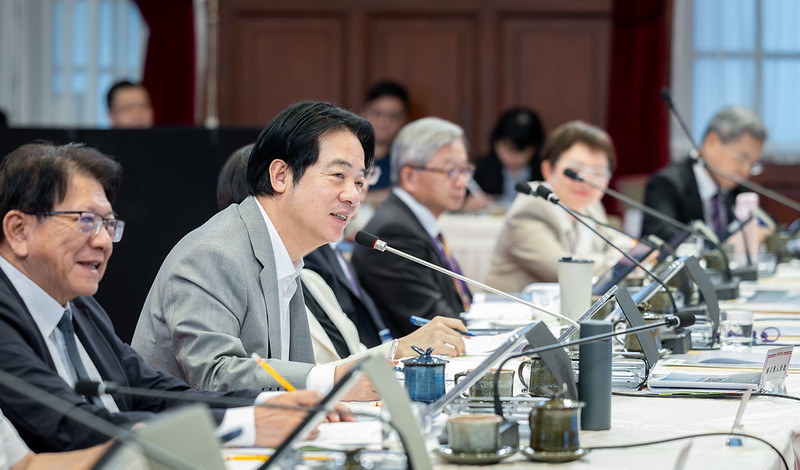
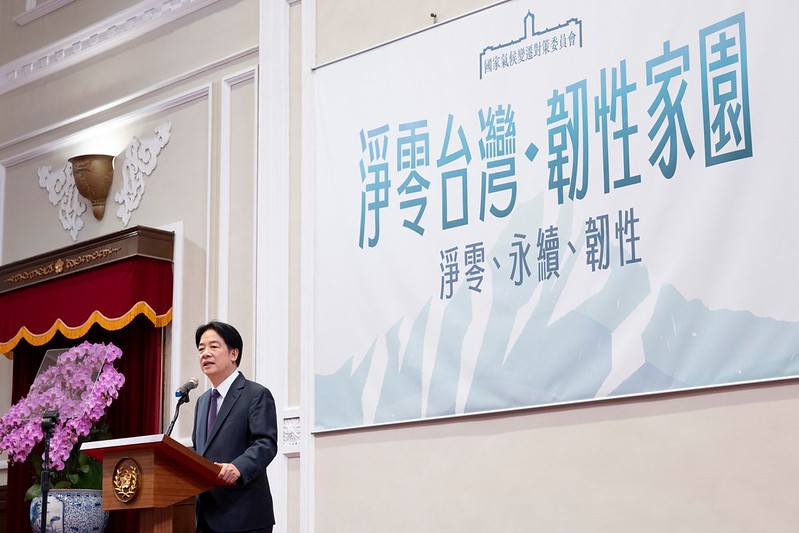
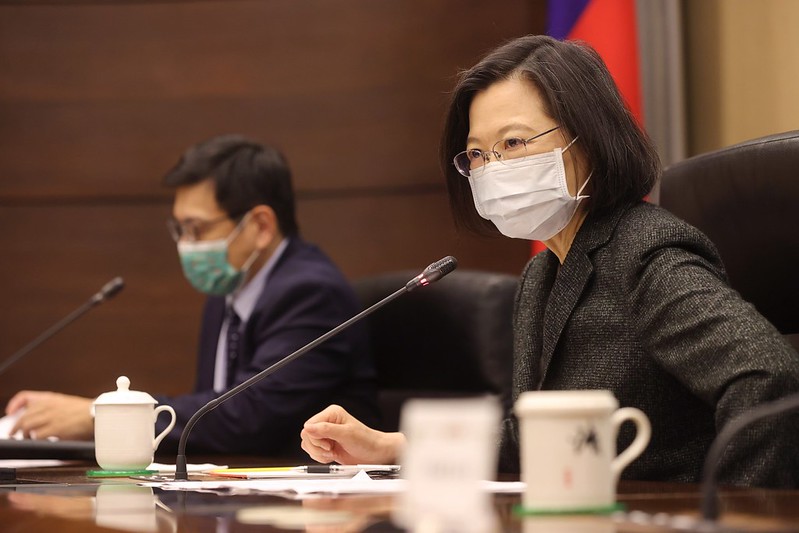
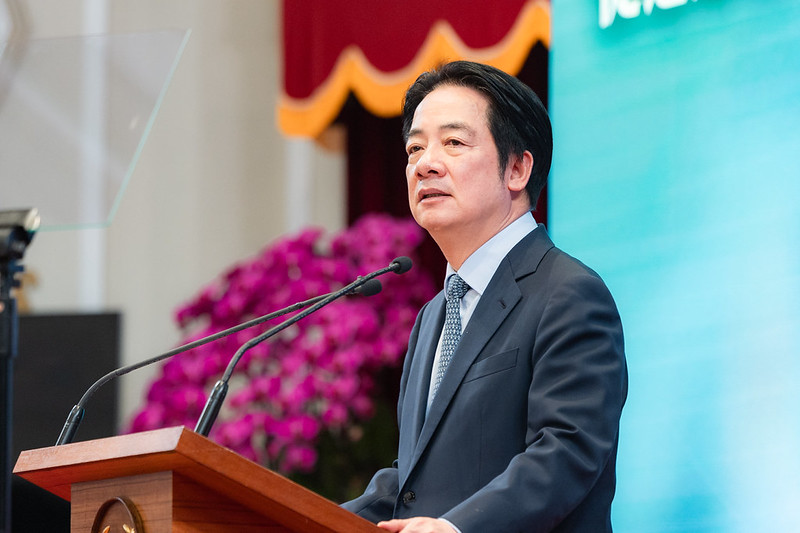
On the afternoon of August 8, President Lai Ching-te presided over the first meeting of the National Climate Change Committee. As the committee’s convener, the president presented committee members with their letters of appointment, and explained that, in line with the principle of equity, the committee has drawn its members from a diverse range of disciplines, generations, and perspectives. This demonstrates the government’s determination, he said, to forge a social consensus through diversified dialogue, and to unite the public in addressing the major challenges to future global and domestic development.
President Lai emphasized that energy issues are complex and not simply a black-and-white matter of being for or against nuclear energy. Every strategic national policy decision, he said, is bound to present multiple-choice questions complicated by the fact that more than one right answer may be possible. The president stated that he aims to address issues honestly, propose solutions pragmatically, and resolve problems practically through the committee’s discussions, with the goal of formulating strategies for the nation’s sustainable development so that Taiwan society can forge a consensus and the nation can indeed develop sustainably.
A translation of President Lai’s opening statement follows:
Today is Father’s Day, so first I want to wish fathers around the world a happy Father’s Day. I also want to thank everyone for taking the time to participate in today’s meeting, especially on this holiday.
There are many fathers here today, and Committee Member Huang Pin-han (黃品涵), who recently gave birth and is still in postpartum care, insisted on attending. Let’s give her a warm round of applause.
I also want to thank all our friends watching the live broadcast, who are joining us in showing their concern for the nation’s future and development.
To respond to the impacts of global climate change, global infectious diseases, and the challenges posed by shifting global geopolitics, I announced the establishment of three committees at the Presidential Office one month after my inauguration: the National Climate Change Committee, Healthy Taiwan Promotion Committee, and Whole-of-Society Defense Resilience Committee.
I hope these three committees will fulfill three major functions of serving as platforms for social engagement, bridges for communication within society, and engines for policy effectiveness.
This demonstrates the government’s determination to forge a social consensus through diversified dialogue and unite the public to address the major challenges of future global and domestic development.
In line with the principle of equity, the members of these three committees are drawn from a diverse range of disciplines, generations, and perspectives.
For example, the National Climate Change Committee includes eight cabinet ministers and commission heads, with Minister of Environment Peng Chi-ming (彭啓明) serving as the executive secretary.
National climate governance, however, involves broad and profound issues, requiring the public and private sectors to join forces and work together. As a result, 65 percent of this committee’s members are not government officials. In addition, 28.5 percent of members are women.
There are six representatives from the industrial sector, and we want to express our gratitude to enterprise representatives Paul Peng (彭双浪), Lai Po-szu (賴博司), Terry Tsao (曹世綸), Sophia Cheng (程淑芬), Lydia Hsiao-mei Lin (林筱玫), and Taipower Company Chairman Tseng Wen-sheng (曾文生) for their participation. Their involvement will extend Taiwan’s strategic thinking about climate and energy across traditional sectors, fields, and high-tech industries, account for the needs of emerging industries of the new era such as AI and international green finance, and ensure that we look ahead to the future and align with international trends.
The number of our representatives from the civil society sector is equal to that of the industrial sector, with six pioneers of environmental movements representing multiple generations invited to participate: Shih Shin-min (施信民), Lee Ken-cheng (李根政), Chao Chia-wei (趙家緯), Ho Tsung-hsun (何宗勳), Huang Pin-han (黃品涵), and Chen Hui-ping (陳惠萍).
They all represent efforts at the frontlines of environmental movements. We are deeply grateful for your participation and look forward to jointly expanding dialogue with civil society, working together to achieve greater depth and breadth in systemic change.
Of course, we also invited scholars and experts from various disciplines to join. We are very grateful to Lin Tze-luen (林子倫), Chou Kuei-tien (周桂田), Tseng Chung-jen (曾重仁), and Su Huey-jen (蘇慧貞) for their participation. Their respective backgrounds in the humanities, science and engineering, environmental health, medicine, and public health will help us gain a more comprehensive understanding of climate change issues.
The committee is meeting for the first time today, and we are beginning by discussing issues that are the focus of particular concern to our society. First, we will hear a report from the Ministry of Environment assessing the impacts of climate change on both the globe and Taiwan. Following that, Chairman Tseng will deliver a report on the transition and challenges related to power supply and demand in Taiwan.
Due to the impacts of extreme weather, more and more experts are warning that each summer from now on is likely to be “one of the coolest summers of the rest of our lives.”
Increasingly, what were once considered “once-in-a-century” droughts and storms are occurring in rapid succession. Over the past eight years under the Democratic Progressive Party (DPP) administration, the government had to establish two emergency response centers at least 19 times, either in close succession or simultaneously – one to address drought and the other to manage flooding.
Late last month, Typhoon Gaemi brought disastrous rainfall in Chiayi and three other counties and municipalities south of it. Single-day precipitation levels in both the lowlands and mountainous areas were comparable to those brought by Typhoon Morakot in 2009, and in some areas even exceeded Morakot. Statistics from the Ministry of Agriculture indicate that nationwide losses from damage to agricultural property and private facilities are already in the billions of New Taiwan Dollars.
Extreme precipitation caused by global extreme weather, as well as heat waves and other such disasters pose formidable challenges to all countries.
A sudden natural disaster is like an acute cold, while climate change is more like a chronic disease. But no matter which type of problem we’re facing, we all have a responsibility to continue strengthening Taiwan’s ability to adapt to the risks associated with extreme weather, and to continually make our nation more sustainable and more resilient.
Of course, I realize that the stability of Taiwan’s power supply is a matter of concern not only to us in Taiwan. It’s also important to international supply chains. There has recently been widespread discussion regarding the issue of nuclear power.
Twenty-plus years ago, back when I was a member of the Legislative Yuan, working across party lines I co-sponsored a draft version of the Basic Environment Act. The Act has come to be known as Taiwan’s “environmental constitution,” and it is the first law in Taiwan to incorporate the concept of a “nuclear-free homeland.” Article 23 of the Act reads that the government shall formulate a plan to progressively achieve the goal of a nuclear-free homeland.
Although the DPP was the ruling party at that time within the executive branch, we did not have a legislative majority. The fact that we were able to get the Basic Environment Act passed by reaching a consensus between the ruling and opposition parties is proof that the concept of a nuclear-free homeland is not just an ideological stance of the DPP. Sustainable development is a goal that we all agree upon, regardless of party affiliation, and one that we’re all working together to achieve.
I hope that through this committee, everyone can realize that energy issues are complex and not simply a black-and-white matter of being for or against nuclear energy. Every strategic national policy decision is bound to present multiple-choice questions complicated by the fact that more than one right answer may be possible. That’s the only way we can address issues honestly, propose solutions pragmatically, and resolve problems practically.
Therefore, I want to say to every one of you, that to have differing positions is typical in a democracy. Having diverse opinions is, in fact, the best thing about democracy.
I hope that the committee’s discussions will impress upon the 23 million people of Taiwan that we can all have our different viewpoints, but we only have one Taiwan. We can all have our different stances, but we still have one goal that we all agree upon, and that is our nation’s sustainable development.
Our shared mission is to think flexibly and brainstorm among a broad range of people, with the goal of formulating strategies for the nation’s sustainable development so that Taiwan society can forge a consensus. Once again, I want to thank everyone for your willingness to take on such an important task. I’ll soon ask each of you to actively share your thoughts, professional expertise, and experience with us, to help us resolve problems and to help Taiwan keep moving forward. Thank you.
Following his statement, President Lai presented letters of appointment to the committee members, heard a report assessing the impacts of climate change on both the globe and Taiwan presented by Minister Peng, and a report on the transition and challenges related to power supply and demand in Taiwan presented by Chairman Tseng. Afterward, President Lai exchanged views with the committee members regarding the content of the two reports and the Rules of Procedure for Meetings of the Office of the President National Climate Change Committee.
Details
2021-12-09
President Tsai meets senior delegation from SEMI and renewable energy sector
On the morning of December 9, President Tsai Ing-wen met with a senior delegation of representatives from the industry association SEMI and the renewable energy sector. During the meeting, President Tsai stated that the government will continue working to achieve its goal of 20 gigawatts of installed solar capacity by 2025, and will release additional offshore wind power capacity for development each year in order to build a more flexible and resilient power grid. The president also asked the business community for its support in these government efforts, so that we can lay a solid foundation for Taiwan's future global competitiveness.
A translation of President Tsai's remarks follows:
It was just yesterday that we met at the Energy Taiwan expo. And it is a pleasure to welcome you all to the Presidential Office today for a more in-depth exchange of views and to hear your valued opinions.
First of all, I want to thank SEMI for its longstanding focus on the development of Taiwan's semiconductor sector. Its annual SEMICON Taiwan exhibition is a major event for the global semiconductor industry, as well as an important platform for our homegrown firms to connect with their international counterparts. Let me take this opportunity to wish SEMI all success with the upcoming SEMICON Taiwan exhibition, which will be held at the end of the month.
This year, the value of Taiwan's semiconductor industry is expected to exceed NT$4 trillion, breaking previous records. One important task we have in maintaining our nation's global leadership in this sector is the development of green energy, so we can address the demand for green energy from semiconductor firms.
Since 2016, cooperation between our government and all of you, as industry leaders, has yielded notable progress in Taiwan's solar and wind power sectors. And last year, the Ministry of Economic Affairs established a platform for trading green energy, speeding up efforts to coordinate green energy demand and supply in the private sector.
Going forward, as we pursue our goal of 20 gigawatts of installed solar capacity by 2025, I will be closely following the MOEA's evaluation of additional areas for potential solar power project development. In addition, we have already announced details of the bidding process and localization requirements for the third phase of our offshore wind power development plan, as part of which 1.5 gigawatts of capacity will be up for bidding each year from 2026 to 2031.
Moreover, to facilitate the integration of renewable energy into Taiwan's power supply grid, Taipower has set a goal of installing more than 1,000 megawatts of energy storage capacity by 2025, through a combination of direct construction as well as private tenders. Our administration will continue to work to ensure the stability of our power grid by developing more flexible and resilient systems.
Energy transition is a key policy priority for our government, and we have a clear roadmap for how to overcome the challenges ahead of us and meet our goals. Your cooperation and support for our government's efforts are important to us. Together, we can help lay a firm foundation for Taiwan's future competitiveness.
Among the members of the visiting delegation were SEMI Global Chief Marketing Officer and SEMI Taiwan President Terry Tsao (曹世綸), SEMI PV Committee Chairman Andy Shen (沈維鈞), SEMI Wind Energy Committee Vice Chairman Julian Kuo (郭世榮), SEMI Energy Storage Committee Chairman Paul Ai (艾祖華); United Renewable Energy Co. (URE) Chairman Sam Hong (洪傳獻); TSEC Corp. Chairman Liao Kuo-jung (廖國榮); ASE Technology Holding Co. Corporate Administration Officer Dtuang Wang (汪渡村); Yuen Foong Yu Group Chairman Hui-Jean Liu (劉慧瑾); Copenhagen Infrastructure Wind Power Development Taiwan Co. Managing Director Marina Hsu (許乃文); Ørsted Asia Pacific President Matthias Bausenwein; Siemens Gamesa Offshore Asia-Pacific General Manager Niels Steenberg; AUO Optronics Corp. Vice President of Energy Business T.Y. Lin (林恬宇); and Enel X Taiwan Co. General Manager Chen Wei-ting (陳威廷).
Details
2021-12-08
President Tsai attends 2021 Energy Taiwan opening ceremony
On the morning of December 8, President Tsai Ing-wen attended the opening ceremony of the 2021 Energy Taiwan exhibition. In remarks, President Tsai stated that by 2025 domestic construction of wind and solar power installations is set to generate NT$1.7 trillion in investments, more than NT$2 trillion in output value, and 160,000 job opportunities. The president also said that the government is making every effort to make Taiwan the green energy hub of Asia, while speeding up and expanding our green energy rollout so that Taiwan's energy sector will be an indispensable link in the international green energy supply chain.
A translation of President Tsai's remarks follows:
We're all aware that one of the key issues at last month's COP26 was the goal of net-zero emissions by 2050. This goal has become a global consensus, and, going forward, countries around the world will be working toward reducing their carbon emissions. Transforming our energy sector is the key to reducing carbon emissions, and today's Energy Taiwan exhibition highlights Taiwan's determination and ability to develop renewable energy.
Each of you here is an important partner to our government in our joint effort to promote Taiwan's energy transition. I have participated in this exhibition's opening ceremony for four consecutive years, not just to show how important energy issues are for this administration, but also to thank all of you in person. Because of your efforts, Taiwan has been able to engage with the international community and contribute more to the world.
Climate change is a global challenge, and Taiwan is joining the global response. The Environmental Protection Administration is currently working on amendments to our nation's Greenhouse Gas Reduction and Management Act, including writing the 2050 net-zero goal into law. And the Executive Yuan has set up a task force to evaluate possible paths toward net-zero emissions and draft a blueprint for our energy transition.
Today's exhibition is our domestic green energy industry's largest platform for exchange. I want everyone to know that our government is making every effort to realize our vitally important goal of making Taiwan the green energy hub of Asia.
In the future, global industrial demand for green energy will only continue to grow. This year, Taiwan began to implement provisions that will spur major power consumers to increase the proportion of renewable energy they use within five years. The EU Carbon Border Adjustment Mechanism will also subject the carbon footprints of export products to more rigorous inspections. As such, many international enterprises have joined the RE100 initiative, under which they have committed to using 100-percent renewable energy in the future. Here, TSMC and UMC are among the companies which have joined RE100 and have acted on their green energy commitments.
I'm sure you all noticed that last week, SEMI released new data showing that Taiwan's firms spent over US$7.3 billion on semiconductor manufacturing equipment in the third quarter, setting a domestic record and making Taiwan the world's largest market for such equipment. This year, the output value of Taiwan's semiconductor industry is projected to surpass NT$4 trillion for the first time ever. Our semiconductor industry is indeed thriving. To meet urgent industry demand for green energy, our government is speeding up and expanding our green energy rollout, and is helping make Taiwan's energy sector an indispensable link in the international green energy supply chain.
I also want to share with you that Taiwan's solar energy installed capacity has grown by a factor of 4.7 over the past five years, and our second offshore wind farm has also started operation. We expect that, through 2025, wind and solar power construction projects in Taiwan will generate NT$1.7 trillion in investments, more than NT$2 trillion in output value, and 160,000 job opportunities.
To further progress and develop, Taiwan must continue to promote the transformation of our energy sector. To reach our long-term goal of net-zero emissions, we need to use natural gas in this transitional period and build a more flexible and responsive power supply network. Building the third liquefied natural gas import terminal will help relieve the imbalance created by generating power for northern Taiwan in central and southern Taiwan, and will also reduce air pollution in central and southern Taiwan. This facility is crucial to Taiwan's energy sector and to achieving net-zero emissions.
We all know how important energy is to our nation's economic development, industrial competitiveness, and people's everyday lives. So, however difficult this energy transition may be, our government will continue to engage with people throughout society to jointly resolve any issues we might encounter. I hope we can combine our collective strengths and resolutely forge ahead on this path.
In closing, I want to thank the organizer and co-organizers for their efforts to expand the scope of this exhibition every year. I also want to congratulate today's award winners, and thank each of you for your contributions to transforming Taiwan's energy sector. Let's continue to work together toward this goal. Thank you, and I wish you all a successful exhibition.
Following her address, President Tsai presented the SEMI Taiwan Industry Contribution Awards, Taiwan Excellent PV Awards, Top Solar Awards, and PVGSA Renewable PV Power System Promotion Awards to awardees and firms. The president also visited the Copenhagen Infrastructure Partners, United Renewable Energy, and Taiwan Solar Energy Corporation exhibition booths and listened to presentations introducing their products.
Also in attendance at the exhibition were Vice Minister of Economic Affairs Lin Chuan-neng (林全能), Chairman of the Taiwan External Trade Development Council James C. F. Huang (黃志芳), SEMI Taiwan President Terry Tsao (曹世綸), and members of the diplomatic corps stationed in Taiwan.
Details
2021-04-22
President Tsai attends forum on environmental sustainability
On the morning of April 22, President Tsai Ing-wen attended the opening ceremony of the 2021 Social Design Action Forum, entitled "Sustainability—The Solutions for Our Earth." In her remarks at the event, President Tsai noted that we all have a common goal: to cut carbon emissions and slow climate change, thereby reducing the resulting impacts and giving humans and all living things a sustainable environment. At the same time, she said, carbon reduction will prompt profound economic changes. The president added that Taiwan is plotting a path to achieve net zero emissions by 2050, both via an ongoing energy transformation, and by developing systematic strategies to reduce emissions in sectors such as manufacturing, transportation, residential construction, and agriculture.
A translation of the president's remarks follows:
Today is Earth Day, a day when we come together to think about ways to promote sustainable development. We must recognize that humankind's only home, our earth, is now facing serious challenges. Taiwan is a key example of the challenges we face. Due to the effects of extreme weather, two or three years ago, we were worrying about flooding after torrential rains. And from last year until now, we have been experiencing our most severe drought in a century.
Although our proactive Forward-looking Infrastructure Development Program has strengthened our water distribution and the development of new water sources, the challenges that we face from extreme weather are still serious. We all hope that these extreme weather patterns will not become the new normal. We therefore have a responsibility to work even harder to resolve climate issues.
As everyone knows, a new international trend is emerging to respond to climate change. The European Union (EU) led the way by proposing a European Green Deal at the end of 2019, including a pledge to become carbon-neutral, which means achieving net zero emissions, by 2050. The EU is also expected to start imposing a carbon tax. In addition, in the Indo-Pacific region, Japan, Korea, and China have all come out since last year to propose target dates for reaching net zero emissions. Our key partner, the United States, is also following suit, and today, President Joe Biden will convene a climate summit. The United States will play a key role in addressing global carbon reduction.
The world is changing rapidly, and so far, over 120 countries have announced plans to achieve net zero emissions before 2050. Many multinational brands such as Apple, Google, and Microsoft have also made commitments to reach net zero emissions.
Everyone has a common goal: to cut carbon emissions and slow climate change, thereby reducing the resulting impacts and giving humans and all living things a sustainable environment. At the same time, carbon reduction will prompt profound economic changes. Whoever can take the lead in developing new technologies and creating new economic models will cement their status in a new global order.
Taiwan will not be left to chase this international trend. During my first term in office, we launched the 5+2 industrial innovation plan, as part of which we are now engaged in an all-out effort to develop green energy and a circular economy. In my New Year's address this past January, I said that we would consult widely to identify the future sustainable development methods most appropriate for Taiwan, while turning the challenges of carbon reduction into new opportunities for industrial development and job creation.
Most countries around the world are talking about achieving net zero carbon emissions by 2050, and Taiwan is actively preparing to take steps toward this goal. Under the coordination of our Executive Yuan, our government has already begun evaluating what Taiwan needs to do to reduce CO2 emissions. In addition to the ongoing transformation of our energy sector, we also need to devise systematic strategies to reduce emissions in manufacturing, transportation, residential construction, and agriculture.
Some regard these things as a challenge, but I firmly believe that many of our friends in industry see the transformation to net zero as an opportunity. Thinking must change on both the supply and demand sides of the market, so that we can seize new business opportunities and make Taiwan an even stronger competitor in global supply chains. Taiwan Semiconductor Manufacturing Company (TSMC), for example, has joined the RE100 renewable energy initiative, which promotes 100-percent reliance on green energy. And many companies have joined the Taiwan Circular Economy 100, an alliance of firms seeking to move away from the linear economy toward a circular economy. These are excellent examples of the willingness of industry to adapt to these emerging trends.
I was also very happy to see domestic media organizations, corporations, and civil society groups launch the 2021 Social Design Action Forum, held in collaboration with the American Institute in Taiwan, to expand space for international exchange focused on innovation. Kevin Yang (楊振甫), the CEO of 5% Design Action and the curator of today's event, said that "The battle for sustainability isn't one you can fight alone." The cover of the latest issue of
TIME magazine clearly states: "Climate Is Everything." Putting a stop to global warming is one of the key challenges of our generation. As I said earlier, Taiwan cannot sit on the sidelines of this challenge; we must seek out opportunities to cooperate with other countries and create mutually beneficial outcomes.
In closing, I want to thank the organizers of this summit for their thoughtful arrangements, as well as the many people concerned about climate change in attendance. I wish you all success over the coming three days, as everyone pools their collective wisdom to come up with creative new solutions.
Details
2020-11-18
President Tsai attends 3rd Global Corporate Sustainability Forum and Taiwan Corporate Sustainability Awards ceremony
President Tsai Ing-wen attended the Third Global Corporate Sustainability Forum and Taiwan Corporate Sustainability Awards ceremony on the morning of November 18. She explained the government's sustainable development policies, and expressed hope that government and business will learn from each other and explore the viability of various action plans together so that we can actively share Taiwan's experiences with our global partners
A translation of President Tsai's remarks follows:
I am delighted to be here for the Global Corporate Sustainability Forum with so many leading figures from the business community. First, I want to congratulate all the enterprises that have won a "Taiwan Corporate Sustainability Award" or "Global Corporate Sustainability Award." Thank you all for showing a strong sense of corporate social responsibility. I also want to thank Ambassador Eugene Chien (簡又新). Under his leadership, the Corporate Sustainability Awards are now in their 13th year, leading more and more companies to make sustainable development part of their business DNA.
In an international evaluation last year, Taiwan enterprises ranked third in the world for Environment, Social & Governance (ESG) information disclosure transparency. So your efforts have produced excellent results.
Over the last three years the Alliance for Sustainable Development Goals, jointly founded by the government and private sector, has not only presented "Global Corporate Sustainability Awards" to enterprises around the world. It has also created Asia's largest corporate sustainability forum. In spite of COVID-19's impact this year, our success in containing the pandemic has allowed us to hold this important platform for international exchange.
Everyone's efforts complement Taiwan's key international development strategies. To address the current global pandemic, we have put the "Taiwan Can Help" spirit into practice by providing disease prevention materials and sharing our disease prevention experience. And we should also contribute our capabilities and experience to address post-pandemic global challenges like climate change, and economic and social transformation.
Of course, to contribute to the world, first we have to keep improving ourselves. Over the past few years, the government began by consulting the United Nations Sustainable Development Goals to continuously make sustainable development one of our key policy implementation goals. Through the adoption of our "Taiwan Sustainable Development Goals," we have mapped out national sustainable development policy directions and established the corresponding targets.
We have also included key industries such as green energy and the circular economy in our "5+2 Innovative Industries Program" and "Six Core Strategic Industries" initiative to encourage enterprises to use clean renewable energy. This will enable them to adopt sustainable development values in the process of industrial upgrading and transformation.
The government also hopes to give enterprises even more encouragement to focus seriously on sustainable development. So beginning in August this year, we launched the "Green Finance Action Plan 2.0" and "Corporate Governance 3.0—Sustainable Development Roadmap." These initiatives draw on the power of financial institutions to encourage enterprises to apply Responsible Investment principles as they influence supply chains and consumers, and thereby work together to contribute to sustainable development.
We are also sharing our experiences with international partners. Early this month, for example, representatives from Taiwan, the United States, Japan, and the Netherlands exchanged circular economy and marine conservation experiences through the Global Cooperation and Training Framework. These examples show that Taiwan has done a lot in the field of sustainable development, and we want to continue and do even more. More important, we want to bring the "Taiwan Can Help" spirit to global sustainable development issues.
Recently, many countries have been giving careful consideration to linking their green policies in response to climate change and post-pandemic economic stimulus measures with sustainable development goals to create a "green stimulus" effect. I hope that the "Global Corporate Sustainability Forum" will give government and business a chance to learn from each other and explore the viability of various action plans together. We can also actively share Taiwan's experiences with our global partners.
Once again, I want to thank everyone here today for your efforts to promote sustainable development. Let's join forces and continue to make even greater contributions to Taiwan and the world.
Following her remarks, the president personally presented the awards to the representatives from award-winning enterprises, recognizing their efforts to achieve sustainable development.
Also in attendance were Minister of Foreign Affairs Joseph Wu (吳釗燮), Vice Minister of Economic Affairs Lin Chuan-neng (林全能), Financial Supervisory Commission Vice Chairperson Hsu Yung-chin (許永欽), Alliance for Sustainable Development Goals Chairperson Ambassador Eugene Chien, and Head of the European Economic and Trade Office Filip Grzegorzewski.
Details
2025-12-04
President Lai interviewed by The New York Times DealBook Summit
In a recent interview via videoconference with The New York Times for its DealBook Summit, President Lai Ching-te responded to questions from host Andrew Ross Sorkin on topics including Taiwan’s national defense, cross-strait relations, Taiwan-US relations, the Russia-Ukraine war, and the semiconductor industry. The interview was broadcast in the early morning of December 4.
The DealBook Summit is a major annual event held by The New York Times aimed at facilitating dialogue among leaders from various sectors and sharing their insights and analyses on international affairs. This year’s summit was held on December 3 (US EST) in New York, and included such speakers as Israeli Prime Minister Benjamin Netanyahu, United States Treasury Secretary Scott Bessent, California Governor Gavin Newsom, Palantir CEO Alex Karp, and Turning Point USA CEO and Chair of the Board Erika Kirk.
The following is the full text of the interview:
Q: Here’s where I want to start the conversation. You’ve just announced this past week that you’re introducing a US$40 billion special budget for military spending to buy more weapons from the US to try to deter China from invading Taiwan. What indicators, and perhaps new indicators, are you looking at that shows an increased threat to Taiwan?
President Lai: We can see that China’s military drills targeted at Taiwan are becoming increasingly frequent and intense. They have even moved beyond the first island chain into the second, affecting the wider Indo-Pacific region. At the same time, China’s united front influence campaigns against Taiwan are also becoming more serious. In order to safeguard national security and fulfill our responsibility to maintain peace and stability across the Taiwan Strait, we have announced this special defense budget.
We believe that peace is priceless, and war has no winners. While we aspire to peace, we cannot harbor illusions about it. Peace must be secured through strength. This is why we are increasing our defense budget and strengthening our national defense capabilities, while also cutting back our economic dependence on China. This includes improving our economic resilience. In 2010, 83.8 percent of Taiwan’s outbound investment went to China; last year, that figure had dropped to around 7 percent. We are also working side-by-side with other democracies to reinforce deterrence. Robust preparations are the best way to avoid war and achieve peace.
Q: Let me ask you this: President Xi has said that his goal for China’s military is to be capable of taking Taiwan by force by 2027. You said that Beijing is accelerating these preparations for an attempted invasion. So what do you think China’s timeline is now?
President Lai: We must ensure the best possible preparations for the worst-case scenarios. Whatever timeline the PLA may have, Taiwan’s fundamental principle is that we must be ready first – this is our basic principle.
I also want to use this opportunity to reiterate to the international community that Taiwan will do everything necessary to protect itself and to safeguard regional peace and stability. We are grateful to the international community, including the G7, the president of the United States, Japan’s political leaders, and many others for their interest in cross-strait peace and emphasizing that stability in the Taiwan Strait is essential to global security and prosperity. Their shared position greatly contributes to stability in Taiwan and peace in the region. We hope Taiwan can continue working with the international community to uphold the rules-based international order.
Q: Well, let me ask you about that because, Mr. President, last week you said the relationship between Taiwan and the US is rock-solid. How confident are you that the United States, and in particular President Trump, would come to the aid of Taiwan if China were to invade?
President Lai: Although Taiwan and the United States do not have official diplomatic relations, Taiwan is deeply grateful to the US Congress for passing the Taiwan Relations Act and to President Ronald Reagan for the Six Assurances. For decades, successive US administrations and both parties in Congress have strongly supported Taiwan based on this foundation. Our relationship truly is rock-solid. Since President Trump took office, cooperation with Taiwan has not only continued but even expanded. We look forward to working with the United States through tariff negotiations – not only to help address their trade deficit, but also to deepen bilateral economic relations and strengthen our friendship.
Q: We’ve all been watching what’s been happening play out in Ukraine between Ukraine and Russia. And there have been questions inside Ukraine about the support that the United States has provided or not in terms of how this ultimately gets settled. How do you view what’s happening in Ukraine right now and the role that the US is playing there?
President Lai: Taiwan stands with the people of Ukraine. We hope this irrational and illegitimate war will be over as soon as possible so that the Ukrainian people will no longer have to suffer. However, in ending this war, we also hope that Ukraine’s national dignity and the well-being of its people will be respected, and future conflict will be prevented.
Q: You talked about trade earlier. When you talk about the relationship between the US and Taiwan, one of the reasons that Taiwan is so valuable, such a strategic asset – and President Trump talks about it this way about Taiwan – is because of semiconductors. And one of the things that he says is that he hopes that the US is going to be manufacturing 40 to 50 percent of all semiconductors in the next couple of years with your help. Does that make Taiwan more valuable ultimately to the US or do you worry at all that it makes it less valuable to the US?
President Lai: Taiwan’s semiconductor industry plays a crucial role, especially as we enter the future AI era. But I want to emphasize, with humility, that Taiwan’s semiconductor sector is a global asset. The industry functions as an ecosystem: the US excels in R&D, design, and has the world’s largest market; Japan provides materials and equipment; the Netherlands makes advanced lithography systems; Taiwan specializes in logic chip manufacturing; and Korea leads in flash memory chips.
In other words, semiconductors are a global ecosystem – it requires worldwide cooperation to be effective. This is why our government supports TSMC and other Taiwanese semiconductor firms as they invest in the US, Japan, Europe, or wherever they believe is needed. This contributes to global progress and prosperity.
As a result, we remain supportive as President Trump seeks investments from Taiwanese semiconductor companies and suppliers in the US. We hope Taiwan can support the reindustrialization of the US. President Trump wants the US to become the world center for AI, and we are willing to assist in this.
As I said earlier, we hope Taiwan-US tariff negotiations will not only help reduce the US trade deficit, but also deepen bilateral economic cooperation, further integrate Taiwan’s industries with the American economic structure, and strengthen the Taiwan-US relationship. This will contribute to global prosperity and development.
Q: Do you think that President Trump’s timeline, this idea that 40 to 50 percent of all semiconductors could be manufactured in the United States in the next two or three years, is realistic?
President Lai: We understand President Trump’s sense of urgency; he wants the United States to maintain an edge in global competition. Whether this target of 40 to 50 percent can be achieved within this timeframe depends not only on Taiwan’s support but also on the US government’s ability to facilitate land acquisition, water and electricity supply, workforce and talent development, and investment incentives. If the US government manages to do this well and effectively, then this goal becomes much more achievable.
Q: There’s a big debate in the United States right now about whether companies like Nvidia should be allowed to sell their most advanced chips to China. And there has not been a real answer yet here in the US. I’m curious what you think about that. Do you think that the most advanced chips should be allowed to be exported to China?
President Lai: As Taiwan’s president, it would not be appropriate for me to comment on US domestic policy. But I can share an experience: Around the year 2000, Taiwan faced a similar debate about whether our advanced chip manufacturing capabilities should move to mainland China. There was an extensive and thorough discussion across society and among different political parties. The consensus was that it would be unwise and should not happen. Looking back, that decision was correct. Had Taiwan allowed its most advanced manufacturing to relocate to China, Taiwan would not be what it is today.
Q: Final question for you. Your economy is red hot right now, in large part because of the AI boom. It’s a two-part question. I wonder whether you’re worried about an AI boom being an AI bubble. And I’m also curious how you think about the Chinese economy today and how that relates to how President Xi even views Taiwan, and when and if it would consider either invading or, through using the gray zone, trying to effectively cut off or control Taiwan.
President Lai: There are many different views in the tech and economic communities. Some say AI could become a bubble; others say it may not. As a political leader, I believe the AI era will bring greater convenience to people’s lives, stimulate economic development, and contribute to global prosperity. That is why we must take steps to prevent AI from becoming a bubble.
In other words, leaders around the world – especially those from countries with AI-related industries – should work together and take necessary measures to ensure AI develops sustainably and has a soft landing, so that it can drive long-term global growth.
China’s economy is indeed struggling. Taiwan’s growth rate this year is projected to reach 7.37 percent, while international financial institutions estimate China’s growth to be only a little above 4 percent. We sincerely hope that as China faces economic pressures, President Xi Jinping will focus not on territorial expansion but on improving the well-being of the Chinese people. Taiwan is willing to help and to cooperate in addressing these economic challenges.