
To the central content area
:::
:::

News & activities

News releases

2020-10-15
President Tsai meets senior offshore wind industry executives and diplomatic representatives to Taiwan

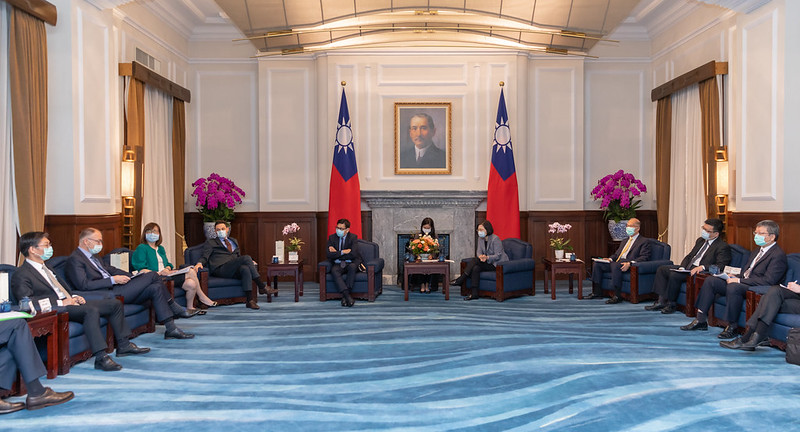
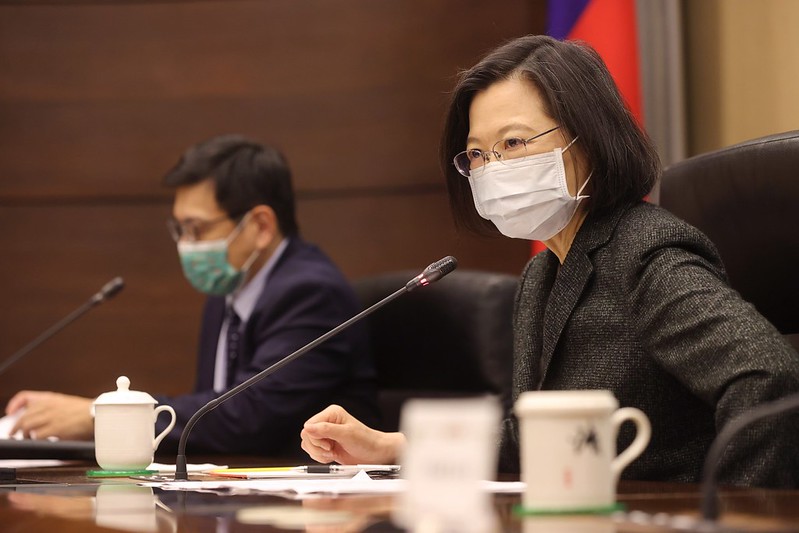
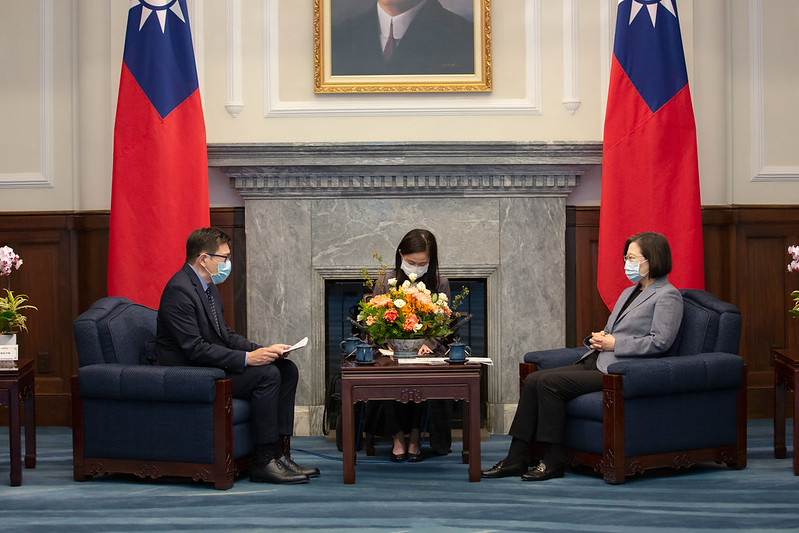
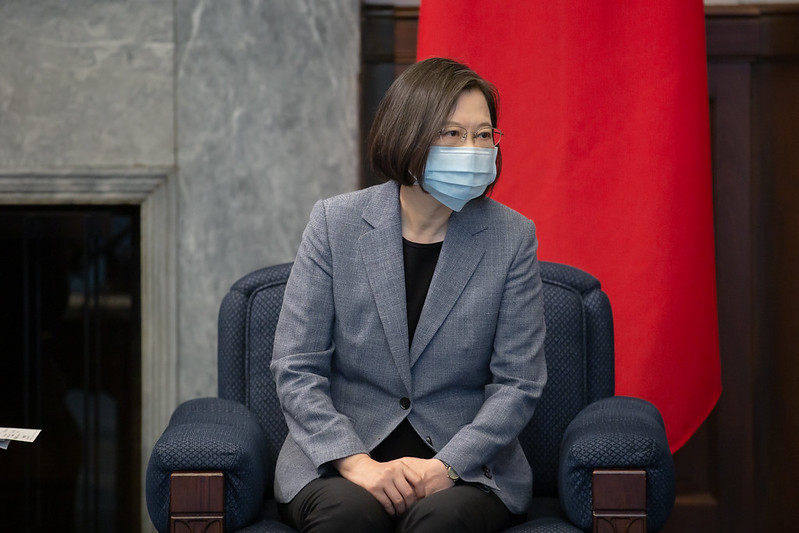
President Tsai Ing-wen met with senior executives from the offshore wind industry and diplomatic representatives to Taiwan on the morning of October 15. She stated that we look forward to joining forces with experienced wind power developers and system operators to penetrate markets in Asian countries and work together to become an integral part of international green energy supply chains.

A translation of President Tsai's remarks follows:

Welcome to the Presidential Office. Taiwan's semiconductor industry has world-class production clusters, and SEMI is an important channel connecting Taiwanese manufacturers with the world. I want to thank SEMI once again for bringing many green energy industry leaders to Taiwan. This shows that SEMI and the diplomatic representatives here today see the importance of investing in Taiwan's offshore wind industry, and are determined to do so.

This is a critical moment, and Taiwan is determined to comprehensively develop our green energy industry. Many of you come from European countries that have been developing advanced offshore wind power for a long time, and have accumulated impressive technologies and experience. I am confident that strengthening cooperative mechanisms with all of you will help Taiwan and Europe's leading wind power countries and be mutually beneficial for everyone involved.

Our 2025 energy transition goal is to have green energy account for 20% of Taiwan's energy mix, and we are working to increase installed offshore wind power capacity to 5.7GW.

Taiwan's first offshore wind farm was completed late last year, and has already been commissioned. The commissioning of this wind farm has attracted groups from Japan and Korea to visit Taiwan and study our success model. This shows that Taiwan has become an offshore wind power development pioneer in Asia, and we are also on our way to becoming Asia's green energy hub. By becoming a green energy hub, Taiwan can cooperate with the advanced wind power nations of Europe and become a force in international markets together.

We look forward to establishing stronger cooperation with all of you, bringing in more international capital, and joining forces with experienced wind power developers and system operators to penetrate markets in Asian countries, and work together to become an integral part of international green energy supply chains.

The Taiwan Power Company is building a demonstration offshore wind farm that is scheduled for completion by the end of this year. They are also hard at work on potential second-phase wind farms at other locations including the Formosa 2 and OWF Yunlin.

We are currently preparing mechanisms to implement Phase 3 zonal development. Between 2026 and 2035, a total of 10 gigawatts is scheduled to come online. By implementing these plans, we can establish local offshore wind farms and create long-term, stable market demand. This approach will also drive the sustainable development of localized supply chains.

I am sure that you are all concerned about our Phase 3 zonal development release model. I guarantee that the government will be most efficient in setting up more stable cooperation mechanisms to strengthen long-term joint development with all of our international partners.

In addition to our renewable energy projects, we are also committed to creating a more globalized work environment in Taiwan, which includes providing employment gold cards for foreign professionals. Taiwan is also becoming more internationalized. My colleagues have told me that the number of foreign nationals in Changhua is increasing, while taxi drivers and seafood restaurant owners in the area can now speak some English.

So in Taiwan, we are creating a more comfortable environment for international friends, which is significant for promoting our bilingual policy. We hope this will allow our government institutions and banks to communicate in English, and that by reaching our goal and becoming a bilingual country by 2030, Taiwan will be an even friendlier place for those in the international community.

Also in attendance were SEMI Taiwan President Terry Tsao (曹世綸), Ørsted Asia Pacific President Matthias Bausenwein, wpd Taiwan Chairperson Yuni Wang (王雲怡), Copenhagen Infrastructure Partners CEO for the Changfang and Xidao offshore wind projects in Taiwan Dennis Sanou, Swancor Renewable Energy CEO Lucas Lin (林雍堯), EnBW Asia Pacific Managing Director Markus Wild, Head of Business Development for RWE Renewables in Taiwan Yu-Foong Chong, JERA Energy Taiwan Chairman & CEO Koichi Tamura, Macquarie Capital Taiwan Chairman Jeffrey Chen (陳明信), EPCI Director for Hai Long Offshore Wind (Northland Power) Felipe Montero, Yushan Energy President and CEO Tsung Hua Chen (陳聰華), Foxwell Energy President Eric Hsieh (謝承哲), Trade Council of Denmark in Taipei Director Bo Mønsted, Head of European Economic and Trade Office Filip Grzegorzewski, and Japan-Taiwan Exchange Association Taipei Office Deputy Representative Mitsuaki Hoshino.
Related News
Details
2025-10-30
President Lai presides over fifth meeting of National Climate Change Committee  
On the afternoon of October 30, President Lai Ching-te presided over the fifth meeting of the National Climate Change Committee. In his opening statement, the president stated that Taiwan has been actively promoting the circular economy and energy transition policies in recent years. Just last week, he said, the Ministry of Environment (MOENV) unveiled a draft Taiwan Circular Economy Roadmap, and is also promoting amendments to laws and regulations governing resource recycling. He pointed out that the added value of Taiwan’s green technology industries exceeded NT$500 billion last year, proving that “green growth” is a powerful driving force for overall national development. President Lai emphasized that we must continue to increase this momentum and achieve government leadership and a unified public to create a new landscape for net-zero transition. We will also need to integrate more private sector forces, gradually enhance our ability to face disasters, establish more complete climate adaptation mechanisms, enhance the resilience of cities and towns, and build a “resilience corridor” in Taiwan to respond to various types of challenges. A translation of President Lai’s remarks follows: Today is the fifth meeting of the National Climate Change Committee and the formal launch of the second-term committee. To begin the meeting, on behalf of the government I want to thank all the members of the first-term committee for their professional contributions and suggestions over the past year or so, helping the government accomplish many key tasks such as setting national carbon reduction targets and integrating the actions of various ministries and agencies, thereby establishing an important foundation for Taiwan’s net-zero transition. The nation’s net-zero transition is now poised to enter the accelerated implementation stage. Today, we welcome two new committee members: one is Distinguished Professor Lin Tzu-ping (林子平) from National Cheng Kung University, and the other is Lei Ya-chi (雷雅淇), executive director of the Science Media Center Taiwan and member of the Executive Yuan’s youth advisory group. In response to administrative team changes, Executive Yuan Secretary-General Chang Tun-han (張惇涵) and Minister of Environment Peng Chi-ming (彭啓明) will now jointly serve as this committee’s executive secretaries, while Deputy Secretary-General to the President Cheng Chun-sheng (鄭俊昇) will serve as deputy executive secretary. In addition, due to reassignments, National Development Council Minister Yeh Chun-hsien (葉俊顯) and Minister of Economic Affairs Kung Ming-hsin (龔明鑫) will now serve as committee members. Thank you all for joining the committee, and I look forward to working together to achieve great things. In the past few months, Taiwan was struck back-to-back by Typhoon Danas and Typhoon Ragasa, causing severe damage in Yunlin, Chiayi, Tainan, and Hualien. But in the midst of each challenge, we have seen the kindness and resilience of Taiwan’s society. Once again, I want to thank all the front-line personnel for faithfully manning their posts, as well as the superheroes of disaster relief from all walks of life and from around the country. The central government will continue to cooperate with local governments to complete all recovery tasks. In addition to damage from wind and floods, the entire island has been unusually hot. High temperatures that continued into October were a very clear warning, and this kind of weather disaster will only become more frequent and severe in the future. From the torrential rains in Asia and heat waves in Europe to the forest fires in the Americas, extreme weather has become the “new normal” around the globe, and it continues to impact the society and economy of every nation. Meanwhile, the global trade landscape is undergoing a dramatic reorganization, and new tariff barriers and emerging green supply chain requirements present complex challenges for export-oriented Taiwan. The double pressure of climate and economic changes has also caused social unease and increased uncertainty about the future. But the government’s stance is clear: We will definitely provide support for the public and industry, and we remain committed to transition so that Taiwan can meet challenges, make a successful transition, and steadily engage with the world. The government will do its utmost to maintain a stable supply of electricity, and ensure that power demands for people’s livelihoods and industry are met. The government will also continue to provide assistance in various forms to industries impacted by the international situation, especially micro-, small-, and medium-sized enterprises, so that we can overcome challenges together. It is precisely due to the severity of external challenges that we must be more dedicated to internal transition. A Taiwan that is more resilient and more adaptable to climate change is a more economically self-reliant, stronger, and prosperous Taiwan. Taiwan is now on the path of transition, and is making great strides. Just last week, the MOENV unveiled a draft Taiwan Circular Economy Roadmap. We expect to officially publish the 2050 Circular Economy Roadmap as early as next year, and are also promoting amendments to laws and regulations governing resource recycling. Last year, the added value of Taiwan’s green technology industries exceeded NT$500 billion, accounting for 2 percent of GDP. Of which, the value added from the circular economy, renewable energy systems, and energy efficiency fields accounted for 73 percent of the green technology industry, demonstrating the key status of those sectors. These are the concrete results of Taiwan’s active promotion of the circular economy and our energy transition policies in recent years, proving that “green growth” is a powerful driving force for overall national development. We must continue to increase this momentum, allowing the opportunities afforded by the transition to spread throughout society. Therefore, in the accelerated implementation stage, the key issue is achieving government leadership and a unified public to create a new landscape for the net-zero transition. In addition to drawing on the expertise of all committee members, we can also rely on Advisor Eugene Chien’s (簡又新) macro perspective, which he will share with us momentarily, to give us encouragement and reminders, making our public-private sector cooperation better and more thorough. All of our efforts are aimed at improving people’s quality of life and protecting our homeland. Therefore, today’s meeting will focus on two major issues: First, is housing security for the people. A home that is more energy-efficient and resistant to the elements is the foundation of a resilient homeland. In a few moments, the Ministry of the Interior will deliver a report on the transition to and prospects for near-zero carbon buildings, including setting a goal for 35 percent reduction in carbon emissions in the residential sector by 2030, drawing a clearer blueprint for this important project. Second, is the people’s health. We are promoting net-zero policies not only to reduce carbon emissions, but also to have clean air. Later, the MOENV will deliver a report on opportunities for mutual benefit through reducing air pollution under the net-zero pathway, exploring ways to create win-win outcomes. The road of transition presents many challenges, but we cannot stray from the correct course because of current obstacles. Moving ahead, the government will continue to work hard and integrate more private sector forces, gradually enhance the ability of various locations throughout Taiwan to face disasters, establish more complete climate adaptation mechanisms, enhance the resilience of cities and towns, and build a “resilience corridor” in Taiwan to respond to various types of challenges. This is a total war with repercussions for the nation’s future; thus it requires the cooperation of government, industry, academia, and all sectors of society. Let us muster all our strength, turn challenges into opportunities, and jointly build a better, stronger, and more resilient Taiwan.  Following his statement, President Lai heard a speech on government leadership and a unified public in creating a new landscape for net-zero transition from Advisor Chien, a report on the transition to and prospects for near-zero carbon buildings from Deputy Minister of the Interior Tung Chien-hung (董建宏), and a report on opportunities for mutual benefit through reducing air pollution under the net-zero pathway from Minister Peng. Afterward, President Lai exchanged views with the committee members regarding the content of the reports.
Details
2022-04-22
President Tsai attends environmental sustainability forum
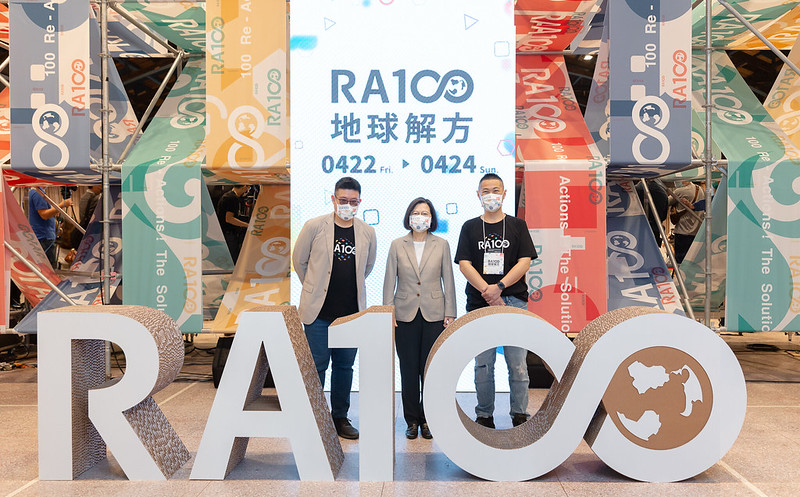
On the morning of April 22, Earth Day, President Tsai Ing-wen attended the 100 Re-Actions forum on environmental sustainability in Taipei. In remarks, President Tsai stated that the government will promote a broad transition across Taiwan's energy sector, industry, lifestyle, and society on the foundations of technology R&D and climate legislation, working together with the public to accelerate progress toward the goal of net-zero emissions by 2050.   A translation of President Tsai's remarks follows: One year ago today, on Earth Day last year, I attended this forum and announced that we would take a pragmatic and forward-looking approach in plotting a course toward net-zero emissions by 2050. After a year of planning and interagency efforts, the National Development Council (NDC) at the end of last month (March) officially published Taiwan's Pathway to Net-Zero Emissions in 2050, along with an explanation of our overall strategy. On the foundations of technology R&D and climate legislation, the government will promote a broad transition across Taiwan's energy sector, industry, lifestyle, and society in order to accelerate progress toward net-zero emissions.   Technological advances are a key driver of the global transition to net-zero. Whether it’s the net-zero roadmap set out by the International Energy Agency (IEA) or the roadmaps of other countries, long-term carbon reduction will rely on new technologies to deliver further breakthroughs. Taiwan has globally competitive technological advantages, and we must invest in the research and development of new sustainable energy technologies, taking a multi-pronged approach to comprehensively deploy the technologies needed for net-zero.  In terms of legislation, the Environmental Protection Administration has worked to amend the Greenhouse Gas Reduction and Management Act. In addition to changing the name of the act to the Climate Change Response Act, its proposed revisions would write the 2050 net-zero emissions goal into law while activating a carbon pricing mechanism and filling out procedures for carbon footprint verification. Yesterday, the Executive Yuan approved these draft revisions and forwarded them to the Legislative Yuan for review. Going forward, the government will continue to push for further revisions to three key energy-related laws, and will leverage the power of green finance to help our finance sector accelerate the pace of our transition.  Energy transition is at the heart of this work. Since 2016, the government has been actively developing our green energy industry and continues to increase our renewable energy generation capacity, transforming Taiwan into the green energy hub of Asia. The purpose of these efforts is to lay a strong foundation for our future energy transition.  Moving forward, we will invest in the research and development of emerging technologies, including in hydrogen energy, geothermal energy, and other alternative green energy sources. Moreover, to accompany growth in green energy, we will continue to advance the development of smarter electrical grids and energy storage equipment. We want to use the power of technology to drive and accelerate the pace of our energy transition, so that by 2050, renewable energy accounts for at least 60 percent of our generation capacity, hydrogen accounts for around 10 percent, and fossil fuel with carbon capture accounts for around 20 percent, thereby achieving a stable energy transition.  In industry, our government continues to collect recommendations from a range of agencies and develop systematic strategies for reducing carbon emissions. As a country with an export-oriented industrial sector, Taiwan needs to make structural adjustments in order to become a part of the global green supply chain, whether through the enhancement of production processes in our manufacturing sector, the electrification of vehicles, or other means. To achieve this, our public and private sectors will have to work together. I encourage our business leaders to follow our government's model of first working with major companies to lead the way for smaller companies, together reducing the potential impacts of this transition on business while also making Taiwanese industry more competitive internationally.  Our transition to reach net-zero by 2050 will touch every aspect of our lives. To help everyone make lifestyle adjustments, the relevant government agencies have been engaging the public in conversation to forge a broad consensus on this matter. In addition to rallying everyone in Taiwan toward a low-carbon lifestyle, we are working to incorporate this idea even more broadly in areas such as diet, transportation, and architecture.  When it comes to the transition for society at large, the most important thing is to take care in ensuring a fair process. The government is preparing to collaborate with the public to jointly establish a social support system that will assist disadvantaged groups from all sectors of society, helping them turn the challenges of this transition into opportunities while also ensuring public participation and a just process. It is our hope that the costs of this transformation will not be unfairly placed on disadvantaged groups, which is why the government will help them through this process.  Achieving Taiwan's goal of net-zero emissions by 2050 will be a massive challenge. Our government has already planned to invest NT$900 billion by 2030 to promote our transition plans and continue to fine-tune our efforts. We also look forward to industry, academia, and all sectors of society working together with our government, as this forum reminds us that sustainability cannot be achieved by working alone. We will combine our nation's strengths and resources to ensure that the international push for a transition to net-zero by 2050 helps power Taiwan's own development heading into this new era. The NDC's publication of Taiwan's Pathway to Net-Zero Emissions in 2050 and explanation of our overall strategy last month was just the beginning. Our government has received recommendations from industry and environmental organizations, and there will be many projects and work that will require collaboration among us all. We will soon begin the next phase of our dialogue with the public, and will continue to review and revise our plans on a rolling basis, so that the people and government can continue cooperation and take significant strides toward our goal of net-zero by 2050.
Details
2021-12-09
President Tsai meets senior delegation from SEMI and renewable energy sector
On the morning of December 9, President Tsai Ing-wen met with a senior delegation of representatives from the industry association SEMI and the renewable energy sector. During the meeting, President Tsai stated that the government will continue working to achieve its goal of 20 gigawatts of installed solar capacity by 2025, and will release additional offshore wind power capacity for development each year in order to build a more flexible and resilient power grid. The president also asked the business community for its support in these government efforts, so that we can lay a solid foundation for Taiwan's future global competitiveness. A translation of President Tsai's remarks follows: It was just yesterday that we met at the Energy Taiwan expo. And it is a pleasure to welcome you all to the Presidential Office today for a more in-depth exchange of views and to hear your valued opinions. First of all, I want to thank SEMI for its longstanding focus on the development of Taiwan's semiconductor sector. Its annual SEMICON Taiwan exhibition is a major event for the global semiconductor industry, as well as an important platform for our homegrown firms to connect with their international counterparts. Let me take this opportunity to wish SEMI all success with the upcoming SEMICON Taiwan exhibition, which will be held at the end of the month. This year, the value of Taiwan's semiconductor industry is expected to exceed NT$4 trillion, breaking previous records. One important task we have in maintaining our nation's global leadership in this sector is the development of green energy, so we can address the demand for green energy from semiconductor firms. Since 2016, cooperation between our government and all of you, as industry leaders, has yielded notable progress in Taiwan's solar and wind power sectors. And last year, the Ministry of Economic Affairs established a platform for trading green energy, speeding up efforts to coordinate green energy demand and supply in the private sector. Going forward, as we pursue our goal of 20 gigawatts of installed solar capacity by 2025, I will be closely following the MOEA's evaluation of additional areas for potential solar power project development. In addition, we have already announced details of the bidding process and localization requirements for the third phase of our offshore wind power development plan, as part of which 1.5 gigawatts of capacity will be up for bidding each year from 2026 to 2031. Moreover, to facilitate the integration of renewable energy into Taiwan's power supply grid, Taipower has set a goal of installing more than 1,000 megawatts of energy storage capacity by 2025, through a combination of direct construction as well as private tenders. Our administration will continue to work to ensure the stability of our power grid by developing more flexible and resilient systems. Energy transition is a key policy priority for our government, and we have a clear roadmap for how to overcome the challenges ahead of us and meet our goals. Your cooperation and support for our government's efforts are important to us. Together, we can help lay a firm foundation for Taiwan's future competitiveness. Among the members of the visiting delegation were SEMI Global Chief Marketing Officer and SEMI Taiwan President Terry Tsao (曹世綸), SEMI PV Committee Chairman Andy Shen (沈維鈞), SEMI Wind Energy Committee Vice Chairman Julian Kuo (郭世榮), SEMI Energy Storage Committee Chairman Paul Ai (艾祖華); United Renewable Energy Co. (URE) Chairman Sam Hong (洪傳獻); TSEC Corp. Chairman Liao Kuo-jung (廖國榮); ASE Technology Holding Co. Corporate Administration Officer Dtuang Wang (汪渡村); Yuen Foong Yu Group Chairman Hui-Jean Liu (劉慧瑾); Copenhagen Infrastructure Wind Power Development Taiwan Co. Managing Director Marina Hsu (許乃文); Ørsted Asia Pacific President Matthias Bausenwein; Siemens Gamesa Offshore Asia-Pacific General Manager Niels Steenberg; AUO Optronics Corp. Vice President of Energy Business T.Y. Lin (林恬宇); and Enel X Taiwan Co. General Manager Chen Wei-ting (陳威廷).
Details
2021-12-08
President Tsai attends 2021 Energy Taiwan opening ceremony
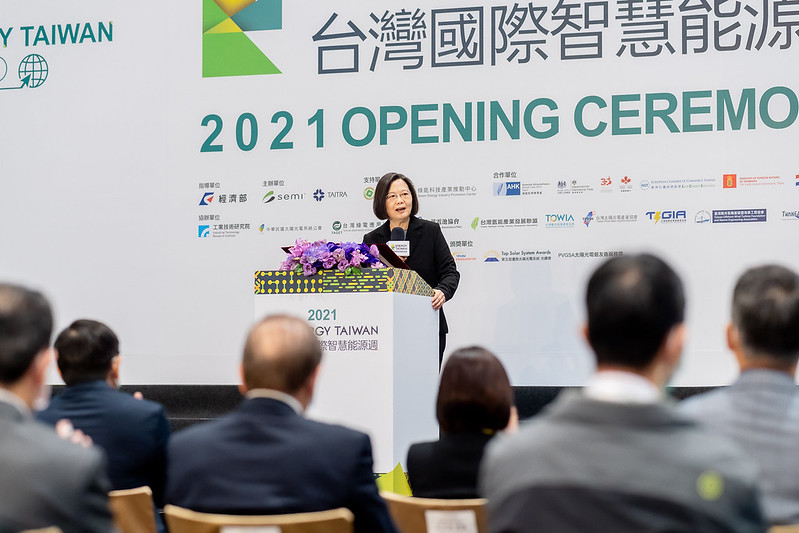
On the morning of December 8, President Tsai Ing-wen attended the opening ceremony of the 2021 Energy Taiwan exhibition. In remarks, President Tsai stated that by 2025 domestic construction of wind and solar power installations is set to generate NT$1.7 trillion in investments, more than NT$2 trillion in output value, and 160,000 job opportunities. The president also said that the government is making every effort to make Taiwan the green energy hub of Asia, while speeding up and expanding our green energy rollout so that Taiwan's energy sector will be an indispensable link in the international green energy supply chain. A translation of President Tsai's remarks follows: We're all aware that one of the key issues at last month's COP26 was the goal of net-zero emissions by 2050. This goal has become a global consensus, and, going forward, countries around the world will be working toward reducing their carbon emissions. Transforming our energy sector is the key to reducing carbon emissions, and today's Energy Taiwan exhibition highlights Taiwan's determination and ability to develop renewable energy. Each of you here is an important partner to our government in our joint effort to promote Taiwan's energy transition. I have participated in this exhibition's opening ceremony for four consecutive years, not just to show how important energy issues are for this administration, but also to thank all of you in person. Because of your efforts, Taiwan has been able to engage with the international community and contribute more to the world. Climate change is a global challenge, and Taiwan is joining the global response. The Environmental Protection Administration is currently working on amendments to our nation's Greenhouse Gas Reduction and Management Act, including writing the 2050 net-zero goal into law. And the Executive Yuan has set up a task force to evaluate possible paths toward net-zero emissions and draft a blueprint for our energy transition. Today's exhibition is our domestic green energy industry's largest platform for exchange. I want everyone to know that our government is making every effort to realize our vitally important goal of making Taiwan the green energy hub of Asia. In the future, global industrial demand for green energy will only continue to grow. This year, Taiwan began to implement provisions that will spur major power consumers to increase the proportion of renewable energy they use within five years. The EU Carbon Border Adjustment Mechanism will also subject the carbon footprints of export products to more rigorous inspections. As such, many international enterprises have joined the RE100 initiative, under which they have committed to using 100-percent renewable energy in the future. Here, TSMC and UMC are among the companies which have joined RE100 and have acted on their green energy commitments. I'm sure you all noticed that last week, SEMI released new data showing that Taiwan's firms spent over US$7.3 billion on semiconductor manufacturing equipment in the third quarter, setting a domestic record and making Taiwan the world's largest market for such equipment. This year, the output value of Taiwan's semiconductor industry is projected to surpass NT$4 trillion for the first time ever. Our semiconductor industry is indeed thriving. To meet urgent industry demand for green energy, our government is speeding up and expanding our green energy rollout, and is helping make Taiwan's energy sector an indispensable link in the international green energy supply chain. I also want to share with you that Taiwan's solar energy installed capacity has grown by a factor of 4.7 over the past five years, and our second offshore wind farm has also started operation. We expect that, through 2025, wind and solar power construction projects in Taiwan will generate NT$1.7 trillion in investments, more than NT$2 trillion in output value, and 160,000 job opportunities. To further progress and develop, Taiwan must continue to promote the transformation of our energy sector. To reach our long-term goal of net-zero emissions, we need to use natural gas in this transitional period and build a more flexible and responsive power supply network. Building the third liquefied natural gas import terminal will help relieve the imbalance created by generating power for northern Taiwan in central and southern Taiwan, and will also reduce air pollution in central and southern Taiwan. This facility is crucial to Taiwan's energy sector and to achieving net-zero emissions. We all know how important energy is to our nation's economic development, industrial competitiveness, and people's everyday lives. So, however difficult this energy transition may be, our government will continue to engage with people throughout society to jointly resolve any issues we might encounter. I hope we can combine our collective strengths and resolutely forge ahead on this path. In closing, I want to thank the organizer and co-organizers for their efforts to expand the scope of this exhibition every year. I also want to congratulate today's award winners, and thank each of you for your contributions to transforming Taiwan's energy sector. Let's continue to work together toward this goal. Thank you, and I wish you all a successful exhibition. Following her address, President Tsai presented the SEMI Taiwan Industry Contribution Awards, Taiwan Excellent PV Awards, Top Solar Awards, and PVGSA Renewable PV Power System Promotion Awards to awardees and firms. The president also visited the Copenhagen Infrastructure Partners, United Renewable Energy, and Taiwan Solar Energy Corporation exhibition booths and listened to presentations introducing their products. Also in attendance at the exhibition were Vice Minister of Economic Affairs Lin Chuan-neng (林全能), Chairman of the Taiwan External Trade Development Council James C. F. Huang (黃志芳), SEMI Taiwan President Terry Tsao (曹世綸), and members of the diplomatic corps stationed in Taiwan.
Details
2021-11-07
President Tsai addresses COP26 Taiwan Day event
On the afternoon of November 7 (morning of the same day in the UK), President Tsai Ing-wen addressed the Taiwan Day event held on the sidelines of the United Nations Framework Convention on Climate Change (UNFCCC) Conference of the Parties (COP26) via video. President Tsai stated that no single country can address the global climate crisis alone and that Taiwan should be included as part of the solution to this issue. The president also reiterated that Taiwan is willing and able to work side-by-side with our international partners to achieve our collective goal of net-zero emissions by 2050 and ensure a sustainable environment for future generations. A transcript of President Tsai's remarks follows: First, I want to extend a warm welcome to you all for your presence at COP26 Taiwan Day. While the COVID-19 pandemic continues to present tremendous challenges to the world, the effort to tackle the global climate crisis also requires our immediate and joint attention. In recent decades, the world has faced increasingly grave challenges from extreme weather and climate change. Taiwan, as an integral part of the global community, is looking to play a role and make greater contributions in this important endeavor, so we can leave a better world for our future generations. Therefore, on this critical issue of climate change, Taiwan is determined to join the world in working toward the goal of net-zero emissions by 2050. My administration has been aggressively implementing an energy transition plan since 2016, and is cultivating an even more aggressive plan to expedite our energy transition toward the net-zero goal. To demonstrate our commitment, we are also incorporating the target of "2050 Net-Zero Emissions" into our domestic law. Our government is also engaging the private sector to jointly develop green energy. Our collaboration has helped Taiwan's installed solar power capacity grow 450 percent over the past five years. And our first offshore wind farm began operation in 2019. Our effort doesn't stop here. We aim to do more than just to expedite our own energy transition. Taiwan is also working to become the Green Energy Hub in Asia. We also want to share our experience with neighboring countries to facilitate a more sustainable region. With the international community taking steps toward a zero-carbon economy, I am pleased to see so many experts from government agencies, industry, civil society, and academia gathered here today. This is a wonderful opportunity for us to discuss and exchange views on green energy and green finance with our friends from around the world. Let me take this opportunity to reiterate that Taiwan is willing and capable to work side-by-side with our international partners to achieve our collective goal of net-zero emissions by 2050. Taiwan regards attaining net-zero and mitigating crisis as our collective and generational responsibility. And for this very reason, Taiwan should be included as part of the solution to address the global climate crisis. No single country can do this alone. Only by being united can we ensure a sustainable environment for future generations. Thank you all again for your participation. I wish you all a productive and fruitful COP26 Taiwan Day. The UNFCCC COP26 meetings are being held in Glasgow, Scotland between October 31 and November 12. Taiwan held COP26 Taiwan Day on November 7 in Glasgow to show our nation's willingness and determination to work with international partners to address climate change and achieve net-zero emissions by 2050.
Details
2025-12-04
President Lai interviewed by The New York Times DealBook Summit
In a recent interview via videoconference with The New York Times for its DealBook Summit, President Lai Ching-te responded to questions from host Andrew Ross Sorkin on topics including Taiwan’s national defense, cross-strait relations, Taiwan-US relations, the Russia-Ukraine war, and the semiconductor industry. The interview was broadcast in the early morning of December 4. The DealBook Summit is a major annual event held by The New York Times aimed at facilitating dialogue among leaders from various sectors and sharing their insights and analyses on international affairs. This year’s summit was held on December 3 (US EST) in New York, and included such speakers as Israeli Prime Minister Benjamin Netanyahu, United States Treasury Secretary Scott Bessent, California Governor Gavin Newsom, Palantir CEO Alex Karp, and Turning Point USA CEO and Chair of the Board Erika Kirk. The following is the full text of the interview: Q: Here’s where I want to start the conversation. You’ve just announced this past week that you’re introducing a US$40 billion special budget for military spending to buy more weapons from the US to try to deter China from invading Taiwan. What indicators, and perhaps new indicators, are you looking at that shows an increased threat to Taiwan? President Lai: We can see that China’s military drills targeted at Taiwan are becoming increasingly frequent and intense. They have even moved beyond the first island chain into the second, affecting the wider Indo-Pacific region. At the same time, China’s united front influence campaigns against Taiwan are also becoming more serious. In order to safeguard national security and fulfill our responsibility to maintain peace and stability across the Taiwan Strait, we have announced this special defense budget. We believe that peace is priceless, and war has no winners. While we aspire to peace, we cannot harbor illusions about it. Peace must be secured through strength. This is why we are increasing our defense budget and strengthening our national defense capabilities, while also cutting back our economic dependence on China. This includes improving our economic resilience. In 2010, 83.8 percent of Taiwan’s outbound investment went to China; last year, that figure had dropped to around 7 percent. We are also working side-by-side with other democracies to reinforce deterrence. Robust preparations are the best way to avoid war and achieve peace. Q: Let me ask you this: President Xi has said that his goal for China’s military is to be capable of taking Taiwan by force by 2027. You said that Beijing is accelerating these preparations for an attempted invasion. So what do you think China’s timeline is now? President Lai: We must ensure the best possible preparations for the worst-case scenarios. Whatever timeline the PLA may have, Taiwan’s fundamental principle is that we must be ready first – this is our basic principle. I also want to use this opportunity to reiterate to the international community that Taiwan will do everything necessary to protect itself and to safeguard regional peace and stability. We are grateful to the international community, including the G7, the president of the United States, Japan’s political leaders, and many others for their interest in cross-strait peace and emphasizing that stability in the Taiwan Strait is essential to global security and prosperity. Their shared position greatly contributes to stability in Taiwan and peace in the region. We hope Taiwan can continue working with the international community to uphold the rules-based international order. Q: Well, let me ask you about that because, Mr. President, last week you said the relationship between Taiwan and the US is rock-solid. How confident are you that the United States, and in particular President Trump, would come to the aid of Taiwan if China were to invade? President Lai: Although Taiwan and the United States do not have official diplomatic relations, Taiwan is deeply grateful to the US Congress for passing the Taiwan Relations Act and to President Ronald Reagan for the Six Assurances. For decades, successive US administrations and both parties in Congress have strongly supported Taiwan based on this foundation. Our relationship truly is rock-solid. Since President Trump took office, cooperation with Taiwan has not only continued but even expanded. We look forward to working with the United States through tariff negotiations – not only to help address their trade deficit, but also to deepen bilateral economic relations and strengthen our friendship. Q: We’ve all been watching what’s been happening play out in Ukraine between Ukraine and Russia. And there have been questions inside Ukraine about the support that the United States has provided or not in terms of how this ultimately gets settled. How do you view what’s happening in Ukraine right now and the role that the US is playing there? President Lai: Taiwan stands with the people of Ukraine. We hope this irrational and illegitimate war will be over as soon as possible so that the Ukrainian people will no longer have to suffer. However, in ending this war, we also hope that Ukraine’s national dignity and the well-being of its people will be respected, and future conflict will be prevented. Q: You talked about trade earlier. When you talk about the relationship between the US and Taiwan, one of the reasons that Taiwan is so valuable, such a strategic asset – and President Trump talks about it this way about Taiwan – is because of semiconductors. And one of the things that he says is that he hopes that the US is going to be manufacturing 40 to 50 percent of all semiconductors in the next couple of years with your help. Does that make Taiwan more valuable ultimately to the US or do you worry at all that it makes it less valuable to the US? President Lai: Taiwan’s semiconductor industry plays a crucial role, especially as we enter the future AI era. But I want to emphasize, with humility, that Taiwan’s semiconductor sector is a global asset. The industry functions as an ecosystem: the US excels in R&D, design, and has the world’s largest market; Japan provides materials and equipment; the Netherlands makes advanced lithography systems; Taiwan specializes in logic chip manufacturing; and Korea leads in flash memory chips. In other words, semiconductors are a global ecosystem – it requires worldwide cooperation to be effective. This is why our government supports TSMC and other Taiwanese semiconductor firms as they invest in the US, Japan, Europe, or wherever they believe is needed. This contributes to global progress and prosperity. As a result, we remain supportive as President Trump seeks investments from Taiwanese semiconductor companies and suppliers in the US. We hope Taiwan can support the reindustrialization of the US. President Trump wants the US to become the world center for AI, and we are willing to assist in this. As I said earlier, we hope Taiwan-US tariff negotiations will not only help reduce the US trade deficit, but also deepen bilateral economic cooperation, further integrate Taiwan’s industries with the American economic structure, and strengthen the Taiwan-US relationship. This will contribute to global prosperity and development. Q: Do you think that President Trump’s timeline, this idea that 40 to 50 percent of all semiconductors could be manufactured in the United States in the next two or three years, is realistic? President Lai: We understand President Trump’s sense of urgency; he wants the United States to maintain an edge in global competition. Whether this target of 40 to 50 percent can be achieved within this timeframe depends not only on Taiwan’s support but also on the US government’s ability to facilitate land acquisition, water and electricity supply, workforce and talent development, and investment incentives. If the US government manages to do this well and effectively, then this goal becomes much more achievable. Q: There’s a big debate in the United States right now about whether companies like Nvidia should be allowed to sell their most advanced chips to China. And there has not been a real answer yet here in the US. I’m curious what you think about that. Do you think that the most advanced chips should be allowed to be exported to China? President Lai: As Taiwan’s president, it would not be appropriate for me to comment on US domestic policy. But I can share an experience: Around the year 2000, Taiwan faced a similar debate about whether our advanced chip manufacturing capabilities should move to mainland China. There was an extensive and thorough discussion across society and among different political parties. The consensus was that it would be unwise and should not happen. Looking back, that decision was correct. Had Taiwan allowed its most advanced manufacturing to relocate to China, Taiwan would not be what it is today. Q: Final question for you. Your economy is red hot right now, in large part because of the AI boom. It’s a two-part question. I wonder whether you’re worried about an AI boom being an AI bubble. And I’m also curious how you think about the Chinese economy today and how that relates to how President Xi even views Taiwan, and when and if it would consider either invading or, through using the gray zone, trying to effectively cut off or control Taiwan. President Lai: There are many different views in the tech and economic communities. Some say AI could become a bubble; others say it may not. As a political leader, I believe the AI era will bring greater convenience to people’s lives, stimulate economic development, and contribute to global prosperity. That is why we must take steps to prevent AI from becoming a bubble. In other words, leaders around the world – especially those from countries with AI-related industries – should work together and take necessary measures to ensure AI develops sustainably and has a soft landing, so that it can drive long-term global growth. China’s economy is indeed struggling. Taiwan’s growth rate this year is projected to reach 7.37 percent, while international financial institutions estimate China’s growth to be only a little above 4 percent. We sincerely hope that as China faces economic pressures, President Xi Jinping will focus not on territorial expansion but on improving the well-being of the Chinese people. Taiwan is willing to help and to cooperate in addressing these economic challenges.
Go Top