

News & activities
 News releases
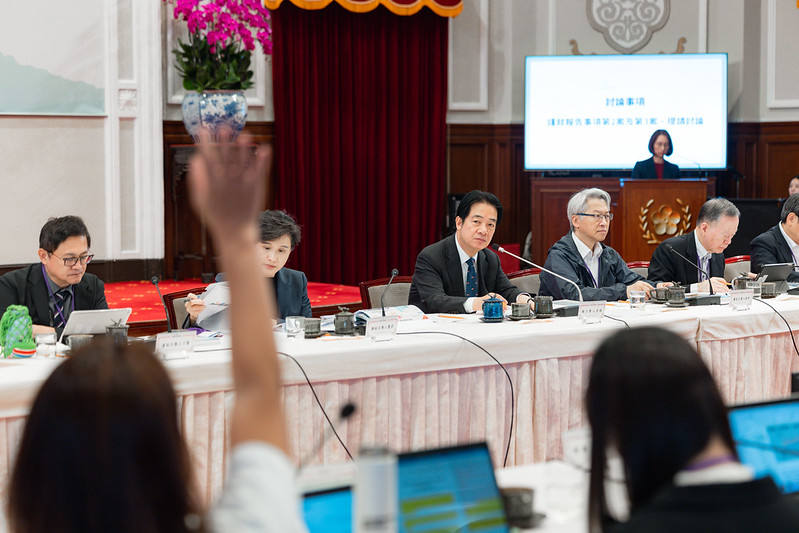
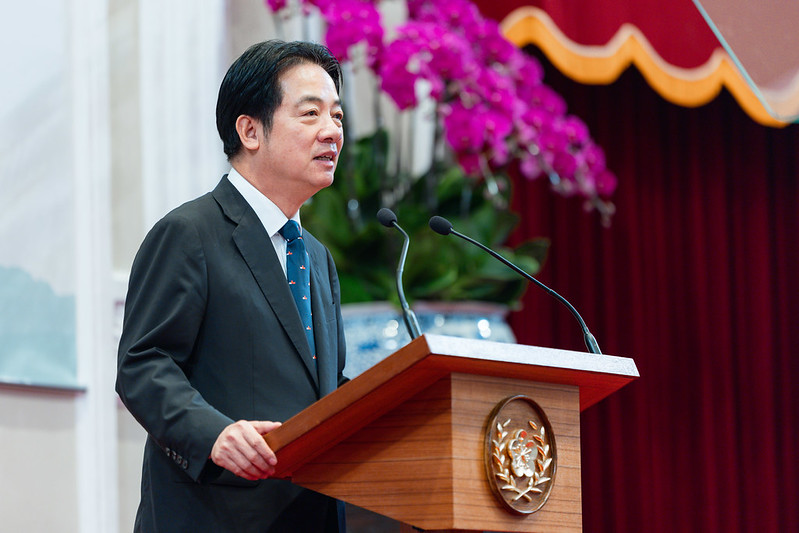
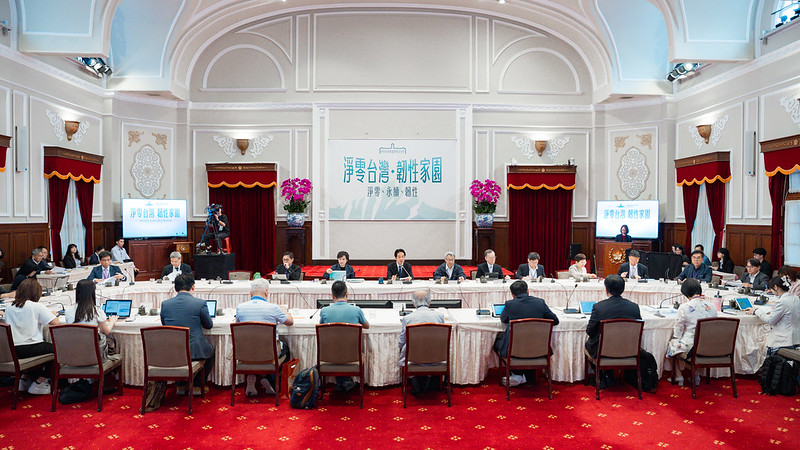
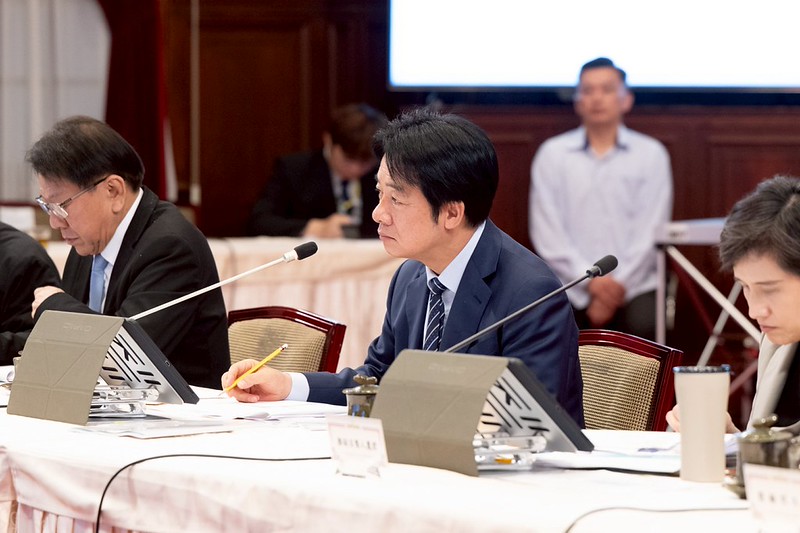
On the afternoon of October 30, President Lai Ching-te presided over the fifth meeting of the National Climate Change Committee. In his opening statement, the president stated that Taiwan has been actively promoting the circular economy and energy transition policies in recent years. Just last week, he said, the Ministry of Environment (MOENV) unveiled a draft Taiwan Circular Economy Roadmap, and is also promoting amendments to laws and regulations governing resource recycling. He pointed out that the added value of Taiwan’s green technology industries exceeded NT$500 billion last year, proving that “green growth” is a powerful driving force for overall national development.
President Lai emphasized that we must continue to increase this momentum and achieve government leadership and a unified public to create a new landscape for net-zero transition. We will also need to integrate more private sector forces, gradually enhance our ability to face disasters, establish more complete climate adaptation mechanisms, enhance the resilience of cities and towns, and build a “resilience corridor” in Taiwan to respond to various types of challenges.
A translation of President Lai’s remarks follows:
Today is the fifth meeting of the National Climate Change Committee and the formal launch of the second-term committee.
To begin the meeting, on behalf of the government I want to thank all the members of the first-term committee for their professional contributions and suggestions over the past year or so, helping the government accomplish many key tasks such as setting national carbon reduction targets and integrating the actions of various ministries and agencies, thereby establishing an important foundation for Taiwan’s net-zero transition.
The nation’s net-zero transition is now poised to enter the accelerated implementation stage. Today, we welcome two new committee members: one is Distinguished Professor Lin Tzu-ping (林子平) from National Cheng Kung University, and the other is Lei Ya-chi (雷雅淇), executive director of the Science Media Center Taiwan and member of the Executive Yuan’s youth advisory group.
In response to administrative team changes, Executive Yuan Secretary-General Chang Tun-han (張惇涵) and Minister of Environment Peng Chi-ming (彭啓明) will now jointly serve as this committee’s executive secretaries, while Deputy Secretary-General to the President Cheng Chun-sheng (鄭俊昇) will serve as deputy executive secretary. In addition, due to reassignments, National Development Council Minister Yeh Chun-hsien (葉俊顯) and Minister of Economic Affairs Kung Ming-hsin (龔明鑫) will now serve as committee members. Thank you all for joining the committee, and I look forward to working together to achieve great things.
In the past few months, Taiwan was struck back-to-back by Typhoon Danas and Typhoon Ragasa, causing severe damage in Yunlin, Chiayi, Tainan, and Hualien. But in the midst of each challenge, we have seen the kindness and resilience of Taiwan’s society.
Once again, I want to thank all the front-line personnel for faithfully manning their posts, as well as the superheroes of disaster relief from all walks of life and from around the country. The central government will continue to cooperate with local governments to complete all recovery tasks.
In addition to damage from wind and floods, the entire island has been unusually hot. High temperatures that continued into October were a very clear warning, and this kind of weather disaster will only become more frequent and severe in the future. From the torrential rains in Asia and heat waves in Europe to the forest fires in the Americas, extreme weather has become the “new normal” around the globe, and it continues to impact the society and economy of every nation.
Meanwhile, the global trade landscape is undergoing a dramatic reorganization, and new tariff barriers and emerging green supply chain requirements present complex challenges for export-oriented Taiwan.
The double pressure of climate and economic changes has also caused social unease and increased uncertainty about the future. But the government’s stance is clear: We will definitely provide support for the public and industry, and we remain committed to transition so that Taiwan can meet challenges, make a successful transition, and steadily engage with the world.
The government will do its utmost to maintain a stable supply of electricity, and ensure that power demands for people’s livelihoods and industry are met. The government will also continue to provide assistance in various forms to industries impacted by the international situation, especially micro-, small-, and medium-sized enterprises, so that we can overcome challenges together.
It is precisely due to the severity of external challenges that we must be more dedicated to internal transition. A Taiwan that is more resilient and more adaptable to climate change is a more economically self-reliant, stronger, and prosperous Taiwan.
Taiwan is now on the path of transition, and is making great strides. Just last week, the MOENV unveiled a draft Taiwan Circular Economy Roadmap. We expect to officially publish the 2050 Circular Economy Roadmap as early as next year, and are also promoting amendments to laws and regulations governing resource recycling.
Last year, the added value of Taiwan’s green technology industries exceeded NT$500 billion, accounting for 2 percent of GDP. Of which, the value added from the circular economy, renewable energy systems, and energy efficiency fields accounted for 73 percent of the green technology industry, demonstrating the key status of those sectors.
These are the concrete results of Taiwan’s active promotion of the circular economy and our energy transition policies in recent years, proving that “green growth” is a powerful driving force for overall national development.
We must continue to increase this momentum, allowing the opportunities afforded by the transition to spread throughout society. Therefore, in the accelerated implementation stage, the key issue is achieving government leadership and a unified public to create a new landscape for the net-zero transition.
In addition to drawing on the expertise of all committee members, we can also rely on Advisor Eugene Chien’s (簡又新) macro perspective, which he will share with us momentarily, to give us encouragement and reminders, making our public-private sector cooperation better and more thorough.
All of our efforts are aimed at improving people’s quality of life and protecting our homeland. Therefore, today’s meeting will focus on two major issues:
First, is housing security for the people. A home that is more energy-efficient and resistant to the elements is the foundation of a resilient homeland. In a few moments, the Ministry of the Interior will deliver a report on the transition to and prospects for near-zero carbon buildings, including setting a goal for 35 percent reduction in carbon emissions in the residential sector by 2030, drawing a clearer blueprint for this important project.
Second, is the people’s health. We are promoting net-zero policies not only to reduce carbon emissions, but also to have clean air. Later, the MOENV will deliver a report on opportunities for mutual benefit through reducing air pollution under the net-zero pathway, exploring ways to create win-win outcomes.
The road of transition presents many challenges, but we cannot stray from the correct course because of current obstacles.
Moving ahead, the government will continue to work hard and integrate more private sector forces, gradually enhance the ability of various locations throughout Taiwan to face disasters, establish more complete climate adaptation mechanisms, enhance the resilience of cities and towns, and build a “resilience corridor” in Taiwan to respond to various types of challenges.
This is a total war with repercussions for the nation’s future; thus it requires the cooperation of government, industry, academia, and all sectors of society. Let us muster all our strength, turn challenges into opportunities, and jointly build a better, stronger, and more resilient Taiwan.
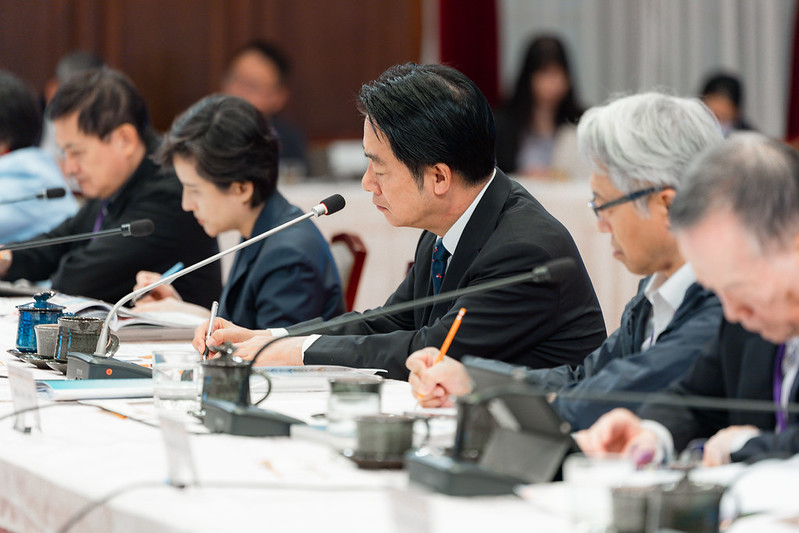
Following his statement, President Lai heard a speech on government leadership and a unified public in creating a new landscape for net-zero transition from Advisor Chien, a report on the transition to and prospects for near-zero carbon buildings from Deputy Minister of the Interior Tung Chien-hung (董建宏), and a report on opportunities for mutual benefit through reducing air pollution under the net-zero pathway from Minister Peng. Afterward, President Lai exchanged views with the committee members regarding the content of the reports.