
To the central content area
:::
:::

News & activities

News releases

2017-06-30
Press conference following second meeting of Presidential Office Indigenous Historical Justice and Transitional Justice Committee

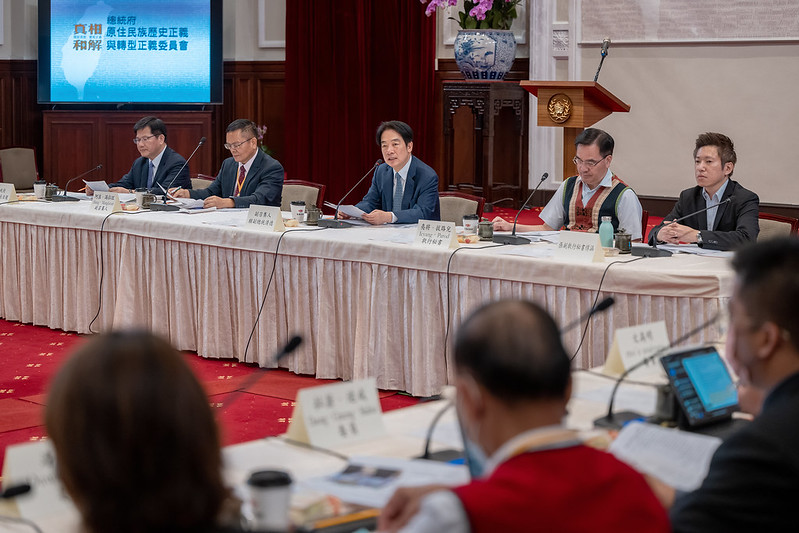
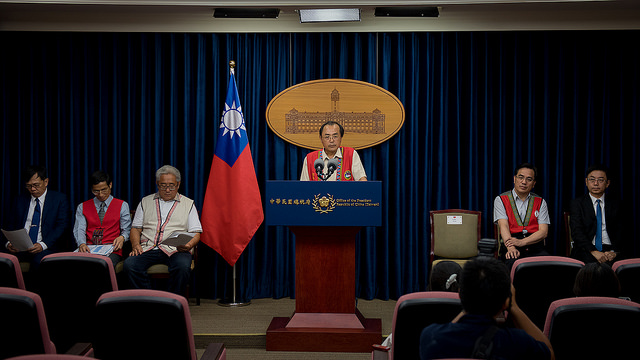
The Presidential Office Indigenous Historical Justice and Transitional Justice Committee held its second meeting on the afternoon of June 30, with convener President Tsai Ing-wen personally presiding. The meeting ran for about three hours and 20 minutes, after which a press conference was held to explain what transpired at the meeting and what matters were discussed. The press conference was held by Deputy Conveners Walis Perin (瓦歷斯‧貝林) and Pasuya Poiconu (浦忠成), Executive Secretary Yao Jen-to (姚人多), Deputy Executive Secretary Icyang Parod (夷將.拔路兒), Minister without Portfolio Lin Wan-i (林萬億), and Director General of the Council of Agriculture's Forestry Bureau Lin Hwa-ching (林華慶).

The press conference began with Deputy Convener Pasuya Poiconu discussing the reports submitted to the committee. The first report was presented by Minister without Portfolio Lin Wan-i regarding the Executive Yuan Investigative Task Force for Nuclear Waste Storage on Lanyu Island. His report highlighted the fact that, following President Tsai's apology to indigenous peoples on August 1, 2016, governmental agencies have made clear progress in researching matters of historical truth.

Deputy Convener Pasuya Poiconu noted that the second report was presented by Minister of the Council of Indigenous Peoples Icyang Parod regarding the work of the Executive Yuan's Indigenous Peoples Basic Law Promotion Committee. Committee members all lauded the efforts of the Executive Yuan and the Council of Indigenous Peoples. A number of members particularly noted their concern for the implementation status following passage of the Indigenous Languages Development Act, and made recommendations during the meeting. President Tsai further encouraged the Executive Yuan to continue holding meetings of the Promotion Committee on a regular basis in order to make efforts toward implementing the Indigenous Peoples Basic Law.

Deputy Convener Pasuya Poiconu indicated that the third report was on Reconciling for Coexistence and Moving Forward toward Sustainable Development, presented by Director General Lin Hwa-ching of the Forestry Bureau, in what could be considered a historic moment. In the past, there have been many conflicts between members of various tribes and the Forestry Bureau over land ownership and utilization of natural resources. So although some indigenous people feel enmity toward the bureau, that report represented the beginning of a more positive dialogue between the bureau and indigenous peoples.

Deputy Convener Pasuya Poiconu also noted that the work outlines of the five thematic subcommittees on land matters, culture, languages, history, and reconciliation had been passed during the meeting. President Tsai urged committee members to participate in the subcommittees and express their views; at the same time, to allow subcommittees work to proceed smoothly, she instructed Deputy Executive Secretary Icyang Parod to coordinate the efforts of related agencies to ensure that the necessary manpower and resources are available.

Deputy Convener Pasuya Poiconu mentioned that committee members had been very active in submitting proposals during the meeting, with a total of 21 formal proposals and 13 extemporaneous motions being put forward. Among them was President Tsai's instruction to continue discussions from the first meeting regarding the draft amendments to the Status Act for Indigenous Peoples, and to request that the Executive Yuan submit those amendments with all due speed to the Legislative Yuan for deliberation in response to requests by the Pingpu tribes.

Minister without Portfolio Lin Wan-i followed with a supplemental explanation of the process of policy formation in regard to establishing the Lanyu Storage Site, and the agencies and personnel that had been involved. He pointed out that from 1972-1978, policy decisions on the storage site were conducted by the related agencies on a classified basis, and that the members of the Yami /Tao tribe would have been unaware of them.

Director General Lin Hwa-ching of the Forestry Bureau further explained that the bureau shared with Taiwan's indigenous peoples the core principle of sustainability. He expressed hope that with greater understanding of traditional indigenous cultures, and more frequent exchanges and dialogue with indigenous tribes, respect for their traditional knowledge regarding their natural surroundings could be combined with modern science and technology for common management of natural resources. He pointed out that in the future, the Forestry Bureau would actively cooperate with the Subcommittee on Land Matters of the Presidential Office Indigenous Historical Justice and Transitional Justice Committee to undertake related surveys and identify and demarcate traditional indigenous regions. 

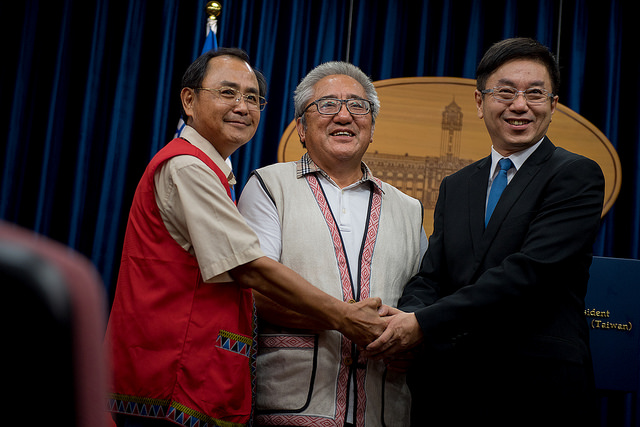
Following the press conference, the two deputy conveners, Walis Perin and Pasuya Poiconu, the Forestry Bureau's Director General Lin Hwa-ching, and Minister without Portfolio Lin Wan-i came down from the stage to shake hands, expressing the mutual desire of both government agencies and tribal members to pursue the truth, and their determination and desire to seek reconciliation.
Related News
Details
2024-05-10
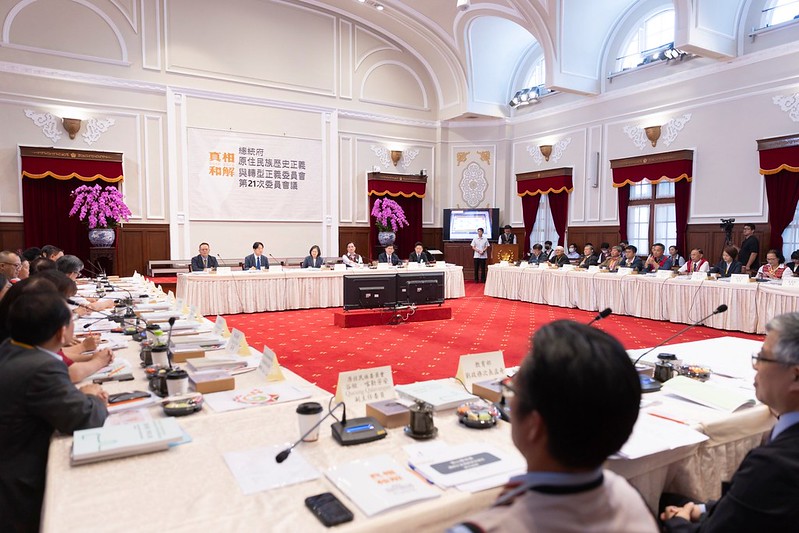
President Tsai presides over 21st meeting of Presidential Office Indigenous Historical Justice and Transitional Justice Committee
On the afternoon of May 10, President Tsai Ing-wen presided over the 21st meeting of the Presidential Office Indigenous Historical Justice and Transitional Justice Committee. In remarks, the president stated that as her term of office is drawing to a close, she wanted to thank all the previous committee members as well as all those involved for their dedication. Their efforts have helped us confront history and take responsibility for errors, she said, allowing transitional justice for indigenous peoples to take root in Taiwan. The president said that when we work together for historical and transitional justice for indigenous peoples, we not only protect equality and justice in Taiwan, but also give encouragement to indigenous peoples in other countries around the world, and this also highlights Taiwan’s democratic values.  The meeting began with a video outlining the committee’s achievements over the past eight years. After the video, President Tsai delivered remarks, stating that this was the 21st meeting of the committee, and the last meeting of the third-term committee. The president recalled that over seven years ago, she stood in the same place and issued an apology to Taiwan’s indigenous peoples on behalf of the government. After delivering the apology that day, she said, she accepted a sheaf of millet from Capen Nganaen, an elder of the Yami (Tao) people, symbolizing that the spirit of the government’s promotion of historical and transitional justice for indigenous peoples would, like millet, take root and flourish on this land. President Tsai said that the video they had just viewed reflected the collaborative achievements of the public and private sectors, tribes, and indigenous peoples, allowing everyone to see that the spirit of ethnic mainstreaming and discussion on the basis of equality has not only informed the committee’s dialogue, but has also gradually been assimilated by the government at all levels and civil society. But depending solely on the committee’s eight years of operations, the president said, is not enough. She stated that we must continue efforts to promote mutual understanding among different ethnic groups in society, and proactively address historical justice for indigenous peoples. President Tsai stated that historical and transitional justice for indigenous peoples are issues that we must confront together as a society. When we apply our collective efforts to that goal, she said, we not only protect equality and justice in Taiwan, but also give encouragement to indigenous peoples in other countries around the world, and this also highlights Taiwan’s democratic values. President Tsai then said that shortly, the committee would deliver a status report on its work from 2016 to 2024. We must illustrate the efforts we have made to seek equality and justice over the past eight years to the public, she said, and expressed hope that these accumulated achievements will allow us to take a more diversified approach, and contemplate how we can continue to promote and bring greater historical and transitional justice for indigenous peoples.  Noting that her term of office will come to a close on May 20, President Tsai expressed her deepest gratitude to all previous committee members, as well as all those involved. Thanks to their dedication, she said, we were able to confront history and take responsibility for errors, which allowed transitional justice for indigenous peoples to take root in Taiwan. President Tsai closed her remarks by thanking everyone once again for cooperating and sharing this journey with her and the government. With the holiday just two days away, she wished everyone a happy Mother’s Day in advance, and encouraged the committee members to share their perspectives and valuable suggestions.
Details
2023-12-04
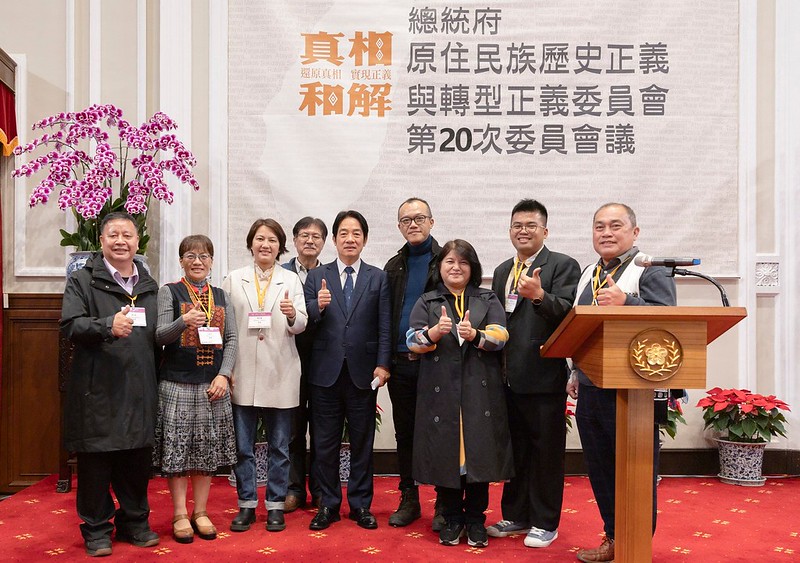
News release following 20th meeting of Presidential Office Indigenous Historical Justice and Transitional Justice Committee
On December 4, President Tsai Ing-wen convened and presided over the 20th meeting of the Presidential Office Indigenous Historical Justice and Transitional Justice Committee, where she was accompanied by Vice President Lai Ching-te, who attended the one-and-a-half-hour meeting as deputy convener. Meeting participants began by reviewing the minutes of the 19th meeting of the committee. The third-term chair of the Subcommittee on Reconciliation and Vice Minister of Culture Hsu Yi-chun (徐宜君) and chair of the Subcommittee on History and Deputy Minister of Education Lio Mon-chi (劉孟奇) delivered progress reports on the work of their respective subcommittees as well as reports on what they plan to work on moving forward. During the meeting, Committee Member Syamen Womzas (夏曼威廉斯), representative of the Yami/Tao tribe, mentioned the damage recently caused by Typhoon Koinu on Orchid Island and the issue of reconstruction. Icyang Parod, executive secretary of the committee and minister of the Council of Indigenous Peoples, responded that since Typhoon Koinu passed through, Executive Yuan Secretary-General Li Meng-yen (李孟諺) has periodically called inter-ministerial meetings to hear progress reports on reconstruction work. Regarding the repair of damaged housing, the issue that most concerns the Yami people of Orchid Island, the minister said that the Executive Yuan has approved over NT$160 million in subsidies for housing repairs for nearly 700 local home owners, each of whom is eligible to receive up to NT$220,000 in subsidies. The minister added that the Council of Indigenous Peoples will also disburse funds via the Taitung County Government so it can distribute the money to township government offices to fund home repairs. As many of the traditional tatala boats of the Tao people were damaged or lost due to the typhoon, the minister said, the Council of Indigenous Peoples will also set aside special funds to provide assistance. In response, Vice President Lai, presiding in lieu of President Tsai, said that the president was very concerned about the impact of Typhoon Koinu on the lives of the people on Orchid Island. Many central government agencies – including the Ministry of the Interior, Council of Indigenous Peoples, Ministry of Economic Affairs, Ministry of Education, Ministry of Agriculture, Ministry of Health and Welfare, Ministry of Environment, Public Construction Commission, National Development Council, and the Taiwan Power Company – are actively participating in and assisting with the reconstruction effort on Orchid Island. In addition, he said, Taiwan Power Company will spend NT$1 billion to move all of the island's power cables underground. The vice president said he hopes Committee Member Syamen Womzas will continue to tell the government about the problems they face, and that they will use this platform to keep engaging in dialogue. Vice President Lai said he hopes the current reconstruction work will help revitalize Orchid Island and make it a smart and green island where culture and technology coexist with traditional and modern civilization. He said he believes that, while reconstruction is a fundamental undertaking that must proceed, we must also have a vision that reaches higher and farther, that is, we must think about how Orchid Island can become an Orchid Island for Taiwan, and even for the world. Vice President Lai issued several directives on behalf of President Tsai Ing-wen. First, he thanked the Subcommittee on Reconciliation for its outstanding results in recording cultural heritage, recreating historical sites, and researching traditional knowledge. The vice president also noted that the subcommittee had provided guidance to various local indigenous cultural centers in their curation of five exhibits this year. He said that the subcommittee's work has enabled many members of the general public to learn about, understand, and develop a greater respect for indigenous cultures. Vice President Lai noted that the efforts of the Subcommittee on History have resulted in indigenous historical perspectives being presented in educational curricula, and the subcommittee's findings have been used in the education of those who teach indigenous transitional justice. Also, the subcommittee has conducted studies of major historical incidents, investigating and rectifying omissions. The vice president thanked colleagues from the various government agencies and private-sector groups for helping foster in the nation's citizens a more diverse historical perspective, and for demonstrating the richness of Taiwan's culture. Vice President Lai said that after the efforts of these past few years, more people have acquired a deeper understanding of the meaning of indigenous historical justice and transitional justice. He added that more and more people are coming to understand the concept of ethnic mainstreaming. Vice President Lai said he believes that consultations take place between the government and the indigenous peoples on an equal footing not only at meetings of the committee, but also through many other types of interactions and dialogues as well as in the course of government policymaking procedures. He said that this enables policies and laws and regulations to more closely address the viewpoints and needs of indigenous peoples while accelerating the pace of reconciliation between the state and indigenous peoples. Vice President Lai noted that President Tsai, in her opening remarks, had announced that the term of office for the members of the third-term committee had been extended to May 20, 2024. He said that President Tsai also asked the Council of Indigenous Peoples, Ministry of Education, Ministry of Culture, and other government agencies to continue cooperating closely to construct a discourse with respect to indigenous history to preserve indigenous education and cultures. He expressed hope that everyone will work together to ensure that indigenous history can manifest itself, whole and intact, within our society, and that Taiwan will keep moving toward the goals of equality, justice, reconciliation, and mutual well-being. In his closing remarks, Vice President Lai said he was very pleased to have the opportunity to help the president promote transitional justice for indigenous peoples, and that he was also pleased to be able to resolve several issues at this meeting. As a past member of the Legislative Yuan, he said, he had strongly supported passage of the Indigenous Peoples Basic Law, and during his time as premier he regularly presided over these committee meetings in accordance with that law, working with the representatives of the various indigenous peoples to implement the intent and the various work items of that law. And now, said the vice president, he is helping the president promote transitional justice for indigenous peoples in hopes of ensuring that people of all ethnicities can live in dignity, equality, and freedom in Taiwan. Vice President Lai pointed out that the indigenous peoples of Taiwan belong to the Austronesian language family, as everyone knows, so no individual or ethnic group should be regarded as somehow isolated from the others. He said that Taiwan's Pingpu ethnic groups are a branch of the Austronesian-speaking peoples, and that Taiwan Constitutional Court (TCC) judgment No. 17 clearly ruled that the Siraya people are indigenous. The vice president expressed hope that the Council of Indigenous Peoples can step up to ensure that the Siraya people enjoy the same respect as other indigenous peoples, and live with the same dignity that others enjoy here in Taiwan. Vice President Lai further stated that regardless of whether it is a meeting of the committee presided over by President Tsai, or any of various meetings on indigenous affairs that he presided over during his tenure as premier, such occasions have been more than just an opportunity to apologize to the indigenous peoples or restore their rights. He said that beyond that, the government has a responsibility to implement policies related to the indigenous peoples because the nation belongs to them as much as it does to the people of any other ethnic groups. Vice President Lai emphasized that the committee, beyond pursuing a range of undertakings designed to achieve transitional justice and reconciliation, also has a higher objective, which is to respect and affirm the indigenous peoples. In other words, he said, the government intends to ensure that the indigenous peoples can see hope for themselves on this land, and will make even bigger contributions to Taiwan. The vice president then called for us all to continue striving toward this objective.
Details
2023-12-04
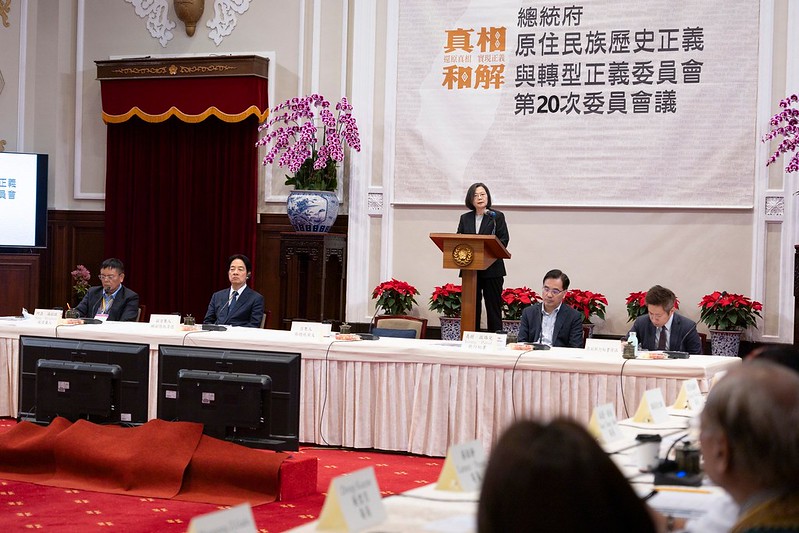
President Tsai presides over 20th meeting of Presidential Office Indigenous Historical Justice and Transitional Justice Committee
On the afternoon of December 4, President Tsai Ing-wen presided over the 20th meeting of the Presidential Office Indigenous Historical Justice and Transitional Justice Committee. In remarks, the president stated that work must continue with respect to transitional justice, development projects in indigenous communities, and ensuring the rights and interests of indigenous peoples, and that government agencies will continue to engage in dialogues with indigenous peoples. She also formally announced that the term of office for the members of the third-term committee has been extended to May 20, 2024, and asked the members to work together with her until her last day in office. The government is gradually implementing various policies in response to the aspirations of indigenous peoples, the president said. She expressed her hope that Taiwanese society understands that ethnic relations is an issue that involves us all, and that we must face historical truths together to move toward genuine reconciliation. In her opening remarks, President Tsai said that this was the committee's 20th meeting, and that we launched committee operations on August 1, 2016, the first Indigenous Peoples' Day after she took office. The president said that using this dialogue platform set up by the Presidential Office, the government, representatives from various indigenous communities, and experts and scholars have discussed historical and transitional justice for indigenous peoples, and jointly established policy directions. The president then thanked all the committee members for working with the government over the past few years to advance the rights of indigenous peoples.  President Tsai pointed out that according to the Guidelines for Establishment of the Presidential Office Indigenous Historical Justice and Transitional Justice Committee, the term of office for members of the third-term committee will expire on December 10 this year. However, she noted, work must continue with respect to transitional justice, development projects in indigenous communities, and ensuring the rights and interests of indigenous peoples, and government agencies must continue to engage in dialogues with indigenous peoples. She therefore asked all of the committee members to continue their joint efforts until her last day in office.  The president acknowledged that committee members still have issues they want the government to continue working on, and that there is still time before May 20 next year to finish such work. The president thanked the committee members for agreeing to extend their terms of office, and formally announced that the members of the third-term committee will be retained until May 20. She invited the committee members to keep working with her in promoting even more communication and discussions, and continue to realize transitional justice for indigenous peoples. Next year's budget for the Council of Indigenous Peoples, the president said, is NT$11.1 billion, a historical high. To implement development policies for indigenous peoples in urban areas, the president said, the government will build nine public service spaces and 17 cultural and ritual venues for indigenous peoples to facilitate diverse exchanges and greater mutual understanding among different ethnic groups.    In 2017 at the fourth committee meeting, the president mentioned, she invited the Taiwan Sugar Corporation (TSC) and indigenous peoples to engage in dialogue. After the two parties communicated, the government allocated a budget for next year to purchase TSC land and return it to tribal peoples, achieving the policy goal of ensuring land and historical justice for indigenous peoples.   In November this year, the president said, members of the Paiwan tribe from Mudan Township in southern Taiwan retrieved their ancestral remains from the UK's University of Edinburgh through a Paiwan traditional ceremony. This had great historical significance as it is the first case in which Taiwan's indigenous community lodged an international request for the return of ancestral remains.  President Tsai said that promoting historical and transitional justice for indigenous peoples is a long-term endeavor. But we are not alone, she said, as many partners have gotten involved and we have international support, so the government can gradually implement various policies in response to the aspirations of indigenous peoples.   The president once again expressed her deepest gratitude to all the committee members, and said she hopes that Taiwanese society understands that ethnic relations is an issue that involves us all, and we must face historical truths together to move toward genuine reconciliation. President Tsai then invited Vice President Lai Ching-te to preside over the rest of the day's meeting, and encouraged the committee members to actively share their perspectives and provide valuable suggestions.
Details
2023-07-28
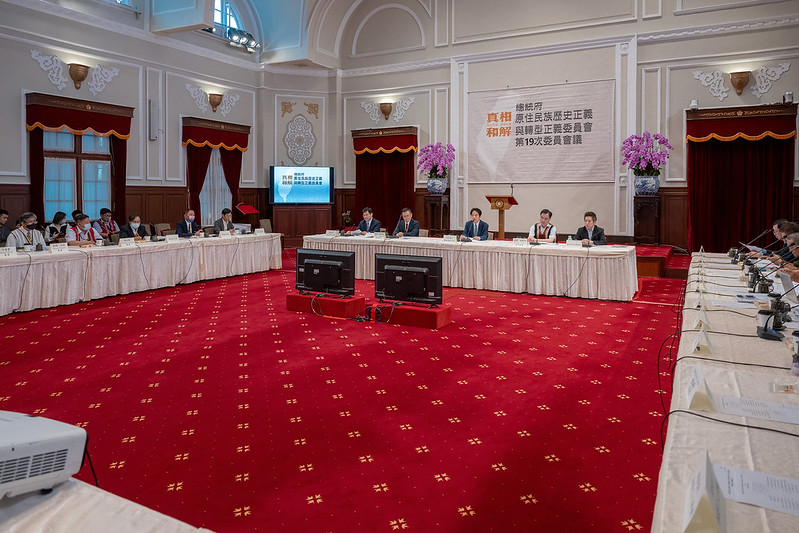
News release following 19th meeting of Presidential Office Indigenous Historical Justice and Transitional Justice Committee
The 19th meeting of the Presidential Office Indigenous Historical Justice and Transitional Justice Committee was convened on July 28 in a two-hour session that was presided over by the committee's deputy convener, Vice President Lai Ching-te. The meeting began with progress reports from the Subcommittee on Land Matters and the Subcommittee on History, and a report on Taiwan Constitutional Court (TCC) judgment No. 17 (111-Hsien-Pan-17 (2022) – the case on the indigenous peoples status for the Siraya people – and its subsequent handling. These reports were delivered respectively by Minister of the Council of Indigenous Peoples (CIP) Icyang Parod, Subcommittee on History Chair and Deputy Minister of Education Lio Mon-Chi (劉孟奇), and CIP Deputy Minister Calivat.Gadu (鍾興華). Vice President Lai issued several directives on behalf of President Tsai Ing-wen. First, he thanked the Subcommittee on Land Matters for their many years of hard work conducting research through a variety of approaches – including interviews, on-site investigations, and archival research – in order to gain a clearer historical understanding of how indigenous peoples' lands were lost. The vice president said the research results will be published late this year, and expressed confidence that beyond making up for past wrongs, this work will provide a foundation for consultations and reconciliation between the government and indigenous peoples. He added that the publication of these reports can help the public better understand the issue of land disputes by viewing it through the lens of transitional justice. The vice president also thanked the Subcommittee on History for its many years of public educational engagement. Through inter-agency cooperation, he said, the Ministry of Education has amended the Education Act for Indigenous Peoples and begun pursuing efforts to enhance awareness of and respect for indigenous peoples. He also noted that a CIP book on major incidents in the history of indigenous peoples has been incorporated into the 12-year school curriculum to enrich historical perspectives on indigenous peoples. The vice president mentioned that the Ministry of Culture is also actively promoting establishment of memorial spaces and maintenance of cultural assets to help indigenous peoples and local governments make the connections between collective memories and indigenous groups of different locations, thus bringing about greater understanding of and reflection on the past. The vice president said he hopes the Subcommittee on History will uphold its efforts to ensure that the spirit of indigenous historical justice and transitional justice continues to be instilled in both school and social education, so that people from all walks of life can together develop a deeper understanding of historical facts and learn from history. Regarding the report on TCC judgment No. 17 and its subsequent handling, the vice president stated that the Pingpu peoples have fought years for the rectification of their name and that this TCC judgment has cleared a pathway toward this recognition, which he believes is the result that everyone was hoping for. As the TCC's judgement stated that indigenous identity must be addressed before individual identity, the vice president said he has directed the CIP to handle subsequent legislative work with prudence and initiative, and within the specified time frame, so as to ensure that Pingpu peoples' right to indigenous identity is protected. After the Pingpu peoples have gained recognition of their indigenous status, the vice president said, the government must legally protect their rights and obligations based on two important principles: the objective needs of indigenous peoples and the allocation of national resources. The vice president stated that the proposals and comments put forward by committee members at the meeting will be further reviewed and considered by the relevant agencies, and then acted upon. In his closing remarks, the vice president said that our approach toward ethnic groups is one of respect for diversity; not of ethnic melting pot, adding that every ethnic group makes up part of our nation and the nation belongs to every individual. The government, he said, hopes that every citizen will be able to live with dignity in this land – a fundamental principle of our government. The vice president mentioned that he was a strong supporter of the Indigenous Peoples Basic Law when he was a member of the Legislative Yuan, and that during his time as premier he presided over many cabinet meetings about protecting the rights and interests of indigenous peoples. He pointed out that President Tsai has also presided over numerous meetings of the Presidential Office Indigenous Historical Justice and Transitional Justice Committee, so it is clear that when committee members express views at these meetings, regardless of who the individual may be or to which ethnic group they belong, the government always takes their views very seriously and takes action to resolve every issue that emerges. The vice president emphasized that the nation belongs to us all, and that everyone is working hard toward its development. He then expressed hope that everyone, across all ethnic groups, will continue working together in a spirit of unity.
Details
2023-07-28
Vice President Lai presides over 19th meeting of the Presidential Office Indigenous Historical Justice and Transitional Justice Committee
On the afternoon of July 28, Vice President Lai Ching-te presided over the 19th meeting of the Presidential Office Indigenous Historical Justice and Transitional Justice Committee, thanking the Subcommittee on Land Matters for clarifying how indigenous peoples lost their lands, and the Subcommittee on History for their efforts in the field of education. With regard to the rights and obligations of the Pingpu peoples after their indigenous identity is recognized, the vice president expressed his hope to assess and restore the relevant rights based on two important principles: the objective needs of various indigenous peoples and the allocation of national resources. He also said he looks forward to the government and the representatives of indigenous groups engaging in parity-based dialogue through the committee to promote more communication and discussion and find viable solutions together.  In his remarks the vice president said that this was the committee's 19th meeting, and that it was a pleasure to get together with all the committee members and continue to promote transitional justice for indigenous peoples.  Policy implementation and social promotion, the vice president said, are the goals of the third-term committee. During the meeting the Subcommittee on Land Matters and Subcommittee on History will deliver briefings on the achievements and changes resulting from efforts across ministries and agencies and the cooperation of indigenous community members. The vice president thanked the Subcommittee on Land Matters for undertaking several years of investigations to clarify the historical process by which indigenous peoples lost their lands. He said that he believes that the results of those investigations not only fill in gaps and rectify previous historical accounts, but can also become a foundation for subsequent discussions, negotiations, and reconciliation between the government and indigenous peoples. The vice president also thanked the Subcommittee on History for their efforts in the field of education, including working with the Ministry of Education to amend the Education Act for Indigenous Peoples and to incorporate a Council of Indigenous Peoples (CIP) book on major incidents in the history of indigenous peoples into the 12-year school curriculum to enrich historical perspectives on indigenous peoples. The vice president stated that Pingpu peoples' demand to rectify their official name is an issue of great concern. Last year, he said, the Taiwan Constitutional Court (TCC) issued its judgement No. 17 (TCC Judgment 111-Hsien-Pan-17 (2022)) – the case on the indigenous peoples status for the Siraya people, and he added that we must continue our efforts to forge a more concrete consensus based on this shared spirit and goal. Noting that the TCC's judgement states that indigenous identity must be addressed before individual identity, the vice president said he has directed the CIP to handle subsequent legislative work with prudence and initiative so as to ensure that Pingpu peoples' right to indigenous identity is protected.  Vice President Lai then addressed the rights and obligations of Pingpu groups after obtaining their identity as indigenous peoples, saying that the relevant rights must be assessed and restored based on two important principles: the objective needs of indigenous peoples and the allocation of national resources. Knowing that there is a diversity of expectations and opinions, the vice president expressed his hope that the government and the representatives of indigenous groups can engage in parity-based dialogue through the committee to promote more communication and discussion and find viable solutions together. The vice president said that Indigenous Peoples' Day on August 1 is just a few days away. Since 2016, all levels of government have held activities to commemorate the occasion, showing that ethnic mainstreaming has gradually been integrated into government operations. Noting that this is the millet harvest festival season, the vice president wished the indigenous communities smooth and successful harvest events and ceremonies. He then invited all the members of the committee to share their perspectives and provide their valuable suggestions. After his remarks, the vice president was briefed on the progress of the work of the Subcommittee on Land Matters and the Subcommittee on History, heard a report on TCC judgement No. 17 and its subsequent handling, and listened to committee member proposals and exchange of views to understand the committee's achievements and progress.
Details
2025-12-04
President Lai interviewed by The New York Times DealBook Summit
In a recent interview via videoconference with The New York Times for its DealBook Summit, President Lai Ching-te responded to questions from host Andrew Ross Sorkin on topics including Taiwan’s national defense, cross-strait relations, Taiwan-US relations, the Russia-Ukraine war, and the semiconductor industry. The interview was broadcast in the early morning of December 4. The DealBook Summit is a major annual event held by The New York Times aimed at facilitating dialogue among leaders from various sectors and sharing their insights and analyses on international affairs. This year’s summit was held on December 3 (US EST) in New York, and included such speakers as Israeli Prime Minister Benjamin Netanyahu, United States Treasury Secretary Scott Bessent, California Governor Gavin Newsom, Palantir CEO Alex Karp, and Turning Point USA CEO and Chair of the Board Erika Kirk. The following is the full text of the interview: Q: Here’s where I want to start the conversation. You’ve just announced this past week that you’re introducing a US$40 billion special budget for military spending to buy more weapons from the US to try to deter China from invading Taiwan. What indicators, and perhaps new indicators, are you looking at that shows an increased threat to Taiwan? President Lai: We can see that China’s military drills targeted at Taiwan are becoming increasingly frequent and intense. They have even moved beyond the first island chain into the second, affecting the wider Indo-Pacific region. At the same time, China’s united front influence campaigns against Taiwan are also becoming more serious. In order to safeguard national security and fulfill our responsibility to maintain peace and stability across the Taiwan Strait, we have announced this special defense budget. We believe that peace is priceless, and war has no winners. While we aspire to peace, we cannot harbor illusions about it. Peace must be secured through strength. This is why we are increasing our defense budget and strengthening our national defense capabilities, while also cutting back our economic dependence on China. This includes improving our economic resilience. In 2010, 83.8 percent of Taiwan’s outbound investment went to China; last year, that figure had dropped to around 7 percent. We are also working side-by-side with other democracies to reinforce deterrence. Robust preparations are the best way to avoid war and achieve peace. Q: Let me ask you this: President Xi has said that his goal for China’s military is to be capable of taking Taiwan by force by 2027. You said that Beijing is accelerating these preparations for an attempted invasion. So what do you think China’s timeline is now? President Lai: We must ensure the best possible preparations for the worst-case scenarios. Whatever timeline the PLA may have, Taiwan’s fundamental principle is that we must be ready first – this is our basic principle. I also want to use this opportunity to reiterate to the international community that Taiwan will do everything necessary to protect itself and to safeguard regional peace and stability. We are grateful to the international community, including the G7, the president of the United States, Japan’s political leaders, and many others for their interest in cross-strait peace and emphasizing that stability in the Taiwan Strait is essential to global security and prosperity. Their shared position greatly contributes to stability in Taiwan and peace in the region. We hope Taiwan can continue working with the international community to uphold the rules-based international order. Q: Well, let me ask you about that because, Mr. President, last week you said the relationship between Taiwan and the US is rock-solid. How confident are you that the United States, and in particular President Trump, would come to the aid of Taiwan if China were to invade? President Lai: Although Taiwan and the United States do not have official diplomatic relations, Taiwan is deeply grateful to the US Congress for passing the Taiwan Relations Act and to President Ronald Reagan for the Six Assurances. For decades, successive US administrations and both parties in Congress have strongly supported Taiwan based on this foundation. Our relationship truly is rock-solid. Since President Trump took office, cooperation with Taiwan has not only continued but even expanded. We look forward to working with the United States through tariff negotiations – not only to help address their trade deficit, but also to deepen bilateral economic relations and strengthen our friendship. Q: We’ve all been watching what’s been happening play out in Ukraine between Ukraine and Russia. And there have been questions inside Ukraine about the support that the United States has provided or not in terms of how this ultimately gets settled. How do you view what’s happening in Ukraine right now and the role that the US is playing there? President Lai: Taiwan stands with the people of Ukraine. We hope this irrational and illegitimate war will be over as soon as possible so that the Ukrainian people will no longer have to suffer. However, in ending this war, we also hope that Ukraine’s national dignity and the well-being of its people will be respected, and future conflict will be prevented. Q: You talked about trade earlier. When you talk about the relationship between the US and Taiwan, one of the reasons that Taiwan is so valuable, such a strategic asset – and President Trump talks about it this way about Taiwan – is because of semiconductors. And one of the things that he says is that he hopes that the US is going to be manufacturing 40 to 50 percent of all semiconductors in the next couple of years with your help. Does that make Taiwan more valuable ultimately to the US or do you worry at all that it makes it less valuable to the US? President Lai: Taiwan’s semiconductor industry plays a crucial role, especially as we enter the future AI era. But I want to emphasize, with humility, that Taiwan’s semiconductor sector is a global asset. The industry functions as an ecosystem: the US excels in R&D, design, and has the world’s largest market; Japan provides materials and equipment; the Netherlands makes advanced lithography systems; Taiwan specializes in logic chip manufacturing; and Korea leads in flash memory chips. In other words, semiconductors are a global ecosystem – it requires worldwide cooperation to be effective. This is why our government supports TSMC and other Taiwanese semiconductor firms as they invest in the US, Japan, Europe, or wherever they believe is needed. This contributes to global progress and prosperity. As a result, we remain supportive as President Trump seeks investments from Taiwanese semiconductor companies and suppliers in the US. We hope Taiwan can support the reindustrialization of the US. President Trump wants the US to become the world center for AI, and we are willing to assist in this. As I said earlier, we hope Taiwan-US tariff negotiations will not only help reduce the US trade deficit, but also deepen bilateral economic cooperation, further integrate Taiwan’s industries with the American economic structure, and strengthen the Taiwan-US relationship. This will contribute to global prosperity and development. Q: Do you think that President Trump’s timeline, this idea that 40 to 50 percent of all semiconductors could be manufactured in the United States in the next two or three years, is realistic? President Lai: We understand President Trump’s sense of urgency; he wants the United States to maintain an edge in global competition. Whether this target of 40 to 50 percent can be achieved within this timeframe depends not only on Taiwan’s support but also on the US government’s ability to facilitate land acquisition, water and electricity supply, workforce and talent development, and investment incentives. If the US government manages to do this well and effectively, then this goal becomes much more achievable. Q: There’s a big debate in the United States right now about whether companies like Nvidia should be allowed to sell their most advanced chips to China. And there has not been a real answer yet here in the US. I’m curious what you think about that. Do you think that the most advanced chips should be allowed to be exported to China? President Lai: As Taiwan’s president, it would not be appropriate for me to comment on US domestic policy. But I can share an experience: Around the year 2000, Taiwan faced a similar debate about whether our advanced chip manufacturing capabilities should move to mainland China. There was an extensive and thorough discussion across society and among different political parties. The consensus was that it would be unwise and should not happen. Looking back, that decision was correct. Had Taiwan allowed its most advanced manufacturing to relocate to China, Taiwan would not be what it is today. Q: Final question for you. Your economy is red hot right now, in large part because of the AI boom. It’s a two-part question. I wonder whether you’re worried about an AI boom being an AI bubble. And I’m also curious how you think about the Chinese economy today and how that relates to how President Xi even views Taiwan, and when and if it would consider either invading or, through using the gray zone, trying to effectively cut off or control Taiwan. President Lai: There are many different views in the tech and economic communities. Some say AI could become a bubble; others say it may not. As a political leader, I believe the AI era will bring greater convenience to people’s lives, stimulate economic development, and contribute to global prosperity. That is why we must take steps to prevent AI from becoming a bubble. In other words, leaders around the world – especially those from countries with AI-related industries – should work together and take necessary measures to ensure AI develops sustainably and has a soft landing, so that it can drive long-term global growth. China’s economy is indeed struggling. Taiwan’s growth rate this year is projected to reach 7.37 percent, while international financial institutions estimate China’s growth to be only a little above 4 percent. We sincerely hope that as China faces economic pressures, President Xi Jinping will focus not on territorial expansion but on improving the well-being of the Chinese people. Taiwan is willing to help and to cooperate in addressing these economic challenges.
Go Top