
Details
2025-04-10
President Lai pens Bloomberg News article on Taiwan’s response to US reciprocal tariffs
On April 10, an article penned by President Lai Ching-te entitled “Taiwan Has a Roadmap for Deeper US Trade Ties” was published by
Bloomberg News, explaining to a global audience Taiwan’s strategy on trade with the United States, as well as how Taiwan will engage in dialogue with the aim of removing bilateral trade barriers, increasing investment between Taiwan and the US, and reducing tariffs to zero.
The following is the full text of President Lai’s article:
Last month, the first of Taiwan’s 66 new F-16Vs rolled off the assembly line in Greenville, South Carolina. Signed during President Donald Trump’s first term, the $8 billion deal stands as a testament to American ingenuity and leadership in advanced manufacturing. Beyond its economic impact – creating thousands of well-paying jobs across the US – it strengthens the foundations of peace and stability in the Indo-Pacific.
This deal is emblematic of the close interests shared between Taiwan and the US. Our bond is forged by an unwavering belief in freedom and liberty. For decades, our two countries have stood shoulder-to-shoulder in deterring communist expansionism. Even as Beijing intensifies its air force and naval exercises in our vicinity, we remain resolute. Taiwan will always be a bastion of democracy and peace in the region.
This partnership extends well beyond the security realm. Though home to just 23 million people, Taiwan has in recent years become a significant investor in America. TSMC recently announced it will raise its total investment in the US to $165 billion – an initiative that will create 40,000 construction jobs and tens of thousands more in advanced chip manufacturing and R&D. This investment will bolster the emergence of a new high-tech cluster in Arizona.
Taiwan is committed to strengthening bilateral cooperation in manufacturing and innovation. As a trade-dependent economy, our long-term success is built on trade relationships that are fair, reciprocal and mutually beneficial. Encouraging Taiwanese businesses to expand their global footprint, particularly in the US, is a vital part of this strategy. Deepening commercial ties between Taiwanese and American firms is another.
These core principles will guide our response to President Trump’s reciprocal tariffs.
First, we will seek to restart trade negotiations with a common objective of reducing all tariffs between Taiwan and the US. While Taiwan already maintains low tariffs, with an average nominal rate of 6%, we are willing to further cut this rate to zero on the basis of reciprocity with the US. By removing the last vestiges to free and fair trade, we seek to encourage greater trade and investment flows between our two countries.
Second, Taiwan will rapidly expand procurement of American goods. Over the past five years, rising demand for semiconductors and AI-related components has increased our trade surplus. In response to these market trends, Taiwan will seek to narrow the trade imbalance through the procurement of energy, agriculture and other industrial goods from the US. These efforts will create thousands of new jobs across multiple sectors.
We’ll also pursue additional arms procurements that are vital to our self-defense and contribute to peace and stability over the Taiwan Strait. During President Trump’s first term, we secured $18 billion in arms deals, including advanced fighter jets, tanks and anti-ship missiles. Future purchases, which are not reflected in trade balances, build on our economic and security partnership while being essential to Taiwan’s “Peace Through Strength” approach.
Third, new investments will be made across the US. Already, Taiwanese firms support 400,000 jobs throughout all 50 states. Beyond TSMC, we also see emerging opportunities in electronics, ICT, energy and petrochemicals. We will establish a cross-agency “US Investment Team” to support bilateral trade and investment – and we hope that efforts will be reciprocated by the Trump administration.
Fourth, we are committed to removing non-tariff trade barriers. Taiwan will take concrete steps to resolve persistent issues that have long impeded trade negotiations. And finally, we will strongly address US concerns over export controls and improper transshipment of low-cost goods through Taiwan.
These steps form the basis of a comprehensive roadmap for how Taiwan will navigate the shifting trade landscape, transforming challenges in the Taiwan-US economic relationship into new opportunities for growth, resilience and strategic alignment. At a time of growing global uncertainty, underpinned by growing Chinese assertiveness, closer trade ties are more than sound economics; they are a critical pillar of regional security.
Our approach is long-term and principled, grounded in a lasting commitment to our friendship with the US, a firm belief in the benefits of fair and reciprocal trade, and an unwavering dedication to peace and stability across the Taiwan Strait. We are confident that our shared economic and security interests will not only overcome turbulence in the international trade environment – they will define the future of a free and open Indo-Pacific.
Details
2024-11-18
President Lai attends 2024 EU Investment Forum
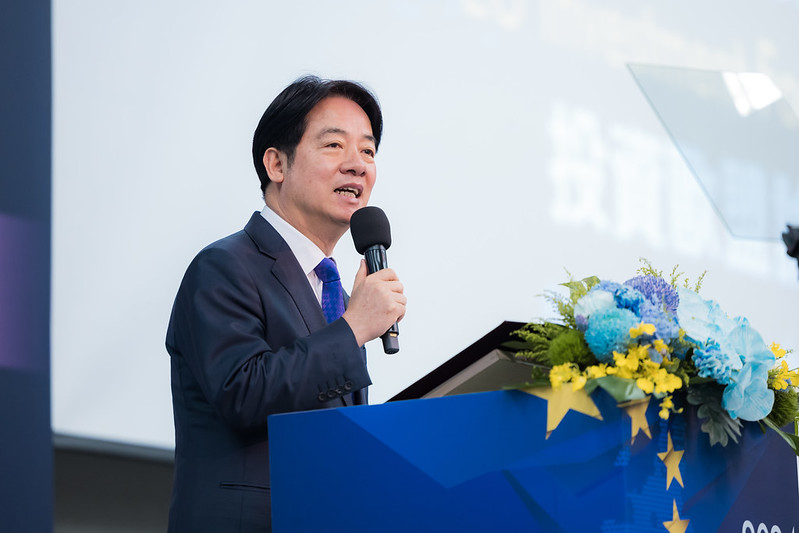
On the afternoon of November 18, President Lai Ching-te attended the opening of the 2024 European Union Investment Forum. In remarks at the event, President Lai stated that as we face the threat of expanding authoritarianism, Taiwan and the EU must form a strong democratic umbrella, and that, more than ever, we must come together to build supply chains for global democracies that are more secure and resilient. The president expressed hope for the signing of an economic partnership agreement (EPA) between Taiwan and the EU, which would make both our economies more resilient and secure and ensure the stable operation of global supply chains. He also expressed hope that Taiwan and Europe will continue to build on our bilateral ties and make every moment the best moment for Taiwan-EU relations.
A transcript of President Lai’s remarks follows:
I am honored to be here today with all of you, to witness the five-year milestone of the EU Investment Forum, an important platform for envisioning the future of collaboration between Taiwan and the EU. The forum has boosted Taiwanese investment in Europe, while helping the EU to remain Taiwan’s largest source of foreign investment over several years.
I would especially like to thank the EETO [European Economic and Trade Office], our Ministries of Foreign Affairs and Economic Affairs, and all the co-organizers for their combined efforts. I am sure that today’s forum will enrich the already fruitful cooperation between Taiwan and the EU.
Taiwan and the EU share the values of freedom and democracy, and each of us is an indispensable strategic partner. As we face the threat of expanding authoritarianism, Taiwan and the EU must form a strong democratic umbrella. And, more than ever, we must come together to build supply chains for global democracies that are more secure and resilient.
Building on this solid foundation, Taiwan will work to further expand cooperation with the EU. In recent years, we have promoted the Taiwan-Europe Connectivity Initiative, Central and Eastern Europe Credit Fund, and cooperation in the semiconductor industry. Each of these major policies reinforces the goals of the EU Investment Forum, and brings Taiwan and the EU into a much deeper partnership in high tech, green energy, and other sectors.
Last year, Taiwan initiated 22 new investment projects in the EU, totaling over US$4.9 billion – an impressive growth of 750 percent from 2022. We see many big-name Taiwanese enterprises expanding their presence in the EU market. And we hope to see many more European enterprises do the same by investing in Taiwan, which will benefit both of us, as we leverage our industrial strengths.
Looking to the future, Taiwan hopes to take an innovative approach toward the signing of an economic partnership agreement with the EU. Such an agreement would deepen our mutually beneficial partnership and set a sound institutional basis for further cooperation.
The EU released its European Economic Security Strategy last year, followed by a set of five initiatives this year to strengthen economic security. Both specifically emphasize “partnering with the broadest possible range of countries” to advance economic security interests.
Given this direction of policy, cooperation between Taiwan and the EU is essential. I believe that through an EPA, Taiwan and the EU can open up cooperation in fields including semiconductors, AI, digital tech, environmental protection, green energy, and more. This would not only make both our economies more resilient and secure, but also ensure the stable operation of global supply chains.
We share a common mission – to provide investment-friendly environments for our enterprises. We also share a common goal – to advance democracy, peace, and prosperity around the world.
I want to take this opportunity to express my appreciation to the EU and European nations for taking concrete action to safeguard freedom of navigation in the Taiwan Strait. I also want to thank the European External Action Service for the statements it issued when China launched military exercises this past May and October. These statements reaffirmed the Service’s unwavering stance on supporting peace and stability in the Taiwan Strait.
While the EU is actively engaged in Indo-Pacific affairs, Taiwan is doing its utmost to protect democratic values. We will continue to contribute humanitarian aid to Ukraine, and work hand in hand with European nations for mutual prosperity and growth.
To close, I want to thank the EETO once again for the invitation. Let’s continue to build on the ties between Taiwan and Europe, and make every moment the best moment for Taiwan-EU relations. I wish you all a very successful forum. Thank you.
Also in attendance at the event were EETO Head Lutz Güllner, European Commission Deputy Director-General for Trade Maria Martin-Prat, and members of the foreign diplomatic corps in Taiwan.
Details
2024-11-12
APEC envoy Lin Hsin-i delivers remarks before departing for 2024 APEC Economic Leaders’ Meeting
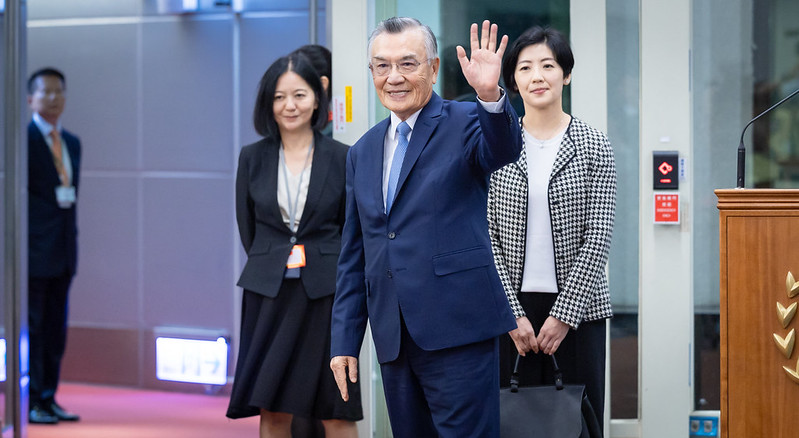
On the evening of November 12, ahead of his departure for Peru to attend the 2024 APEC Economic Leaders’ Meeting (AELM) from November 15 to 16 in Lima, APEC Leader’s Representative Lin Hsin-i (林信義) delivered remarks on his upcoming trip. Leader’s Representative Lin said that he hopes to convey to leaders’ representatives and delegations of other APEC economies that Taiwan is an important, stable, and indispensable force for the economic prosperity of the region. He also expressed confidence in his and his fellow delegation members’ ability to fulfill their mission.
In remarks, Leader’s Representative Lin first thanked everyone for making the trip to see him and his delegation off, and he thanked the members of the media for their concern and support. He said it is a great honor to represent the president in attending the AELM in Lima, adding that government agencies have practically been working around the clock in preparation for the trip. Over the past year, he said, senior officials, ministers, and people in business and industry have been working in a spirit of solidarity, attending meeting after meeting, accumulating an impressive body of achievements. Therefore, he underlined, he and his fellow delegation members are quite confident in their ability to fulfill their mission.
Leader’s Representative Lin mentioned that an especially large number of topics will be addressed in this year’s AELM proceedings, including inclusive digital transformation; twin green and digital transition; reduction of food loss and waste; improvement of human resource organizations and human capital; competitiveness of micro-, small- and medium-sized enterprises in the digital age; and increased participation of women’s groups and disadvantaged groups in economic development. As Taiwan is especially strong in the fields of digital medicine, agriculture, and small- and medium-sized enterprises, he said, the delegation will take the opportunity in AELM meetings to actively familiarize the leaders’ representatives and delegations of other APEC economies with Taiwan’s efforts, achievements, and contributions, so that everyone can understand Taiwan as an important, stable, and indispensable force for the economic prosperity of the region.
Leader’s Representative Lin once again thanked everyone for coming to show support for the delegation, which was greatly meaningful to them. He then wished everyone good health and happiness.
Details
2024-11-07
President Lai attends press conference before Taiwan’s delegation departs for 2024 APEC Economic Leaders’ Meeting
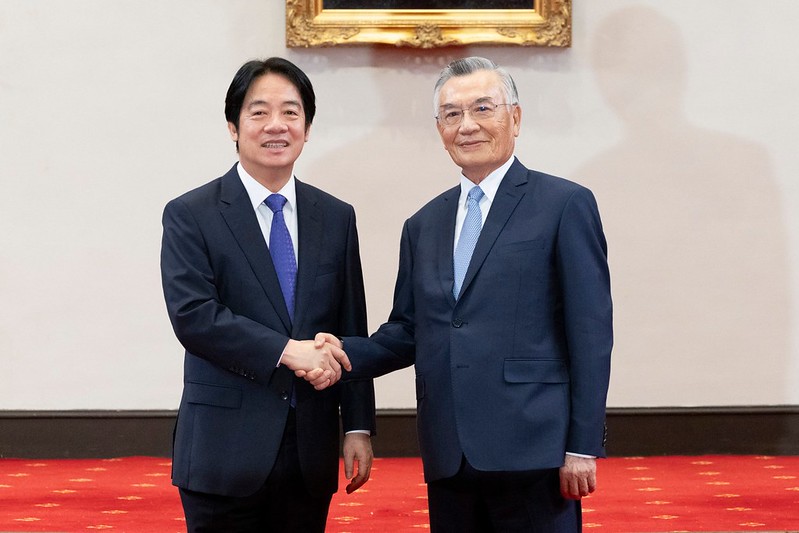
On the morning of November 7, President Lai Ching-te attended a press conference before Taiwan’s delegation departs for the 2024 APEC Economic Leaders’ Meeting (AELM). In remarks, President Lai thanked Senior Advisor to the President Lin Hsin-i (林信義) for acting as our leader’s representative to this year’s meeting.
President Lai remarked that the theme for APEC 2024 is Empower, Include, Grow. He expressed hope that Senior Advisor Lin and the members of the delegation will convey three major propositions during the meeting: that Taiwan is actively contributing to the international community, supports a fairer and more inclusive international trade order, and is willing to promote the development of digital trade among other economies. The president emphasized that Taiwan has the capabilities and is more than willing to promote digital trade among other economies and begin the relevant cooperation. He expressed confidence that given Senior Advisor Lin’s professional expertise and experience, he will accurately convey Taiwan’s voice and perspectives to the other APEC member economies.
A translation of President Lai’s remarks follows:
This year’s AELM will kick off on November 15 in Lima, Peru. I want to offer special thanks to Senior Advisor Lin for accepting my invitation to serve as our country’s APEC leader’s representative, and represent me at this year’s meeting.
Senior Advisor Lin has worked in both the public and private sectors, possesses extensive industry experience, and has successively served in important positions including minister of economic affairs, vice premier, and minister of the Council for Economic Planning and Development (now National Development Council) of the Executive Yuan. He not only combines practical experience with a high degree of professionalism, but also continues to serve as one of my senior advisors, an advisor on the Executive Yuan’s Economic Development Commission, and chairman of Taiwania Capital Management Corporation, contributing his outstanding expertise to the nation.
In 2000 and 2001, Senior Advisor Lin represented the nation at the APEC Annual Ministerial Meeting (AMM). In 2005, he also served as leader’s representative and led a delegation to the AELM hosted by Korea, and successfully accomplished his mission.
I am confident that given Senior Advisor Lin’s professional expertise and extensive experience, as well as his past participation in APEC-related meetings, he will accurately convey Taiwan’s voice and perspectives to the other APEC member economies.
APEC is the most important forum in the Asia-Pacific region for multilateral economic and trade cooperation. Its purpose is to spur regional economic integration, growth, and development through dialogue and negotiation.
The theme for APEC 2024 is Empower, Include, Grow. On that point, I have asked Senior Advisor Lin and the members of the delegation to convey Taiwan’s three major propositions during the meeting:
First, Taiwan is actively contributing to the international community.
I have asked Senior Advisor Lin and our AMM and APEC Business Advisory Council (ABAC) representatives to broadly raise awareness of Taiwan’s positive contributions to APEC, and in particular, give the various member economies a clear understanding of Taiwan’s developmental achievements and contributions over the years in fields including AI and digital medicine. Taiwan will continue to make such contributions.
Second, Taiwan supports a fairer and more inclusive international trade order.
APEC has long been concerned about the development of global free trade, including its impact on the rights of disadvantaged groups, and the hardships sustained by various countries due to unfair trade practices.
For many years, APEC has continuously worked to promote fair and inclusive trade, and I have asked the delegation to convey Taiwan’s support and commitment to all the member economies. Taiwan is willing to cooperate with our APEC partners to create a fairer, more inclusive international trade order.
Third, Taiwan is willing to promote the development of digital trade among other economies.
Among the current member economies, digital trade has already become an important component of overall trade, and we are confident that Taiwan’s digital capabilities can spur global economic development.
I hope that our delegation will take advantage of this opportunity to communicate with representatives from other member economies and show them that Taiwan has the capabilities and is more than willing to promote digital trade among other economies and begin the relevant cooperation.
In closing, I would like to thank Senior Advisor Lin and all of the members of the delegation once again. I am confident that under Senior Advisor Lin’s leadership, the delegation will successfully complete its mission, and I wish you all a smooth journey. Thank you.
Senior Advisor Lin then delivered remarks, first stating that he is very honored to be entrusted by the president with representing him at this year’s AELM to be held in Peru. Regarding the tasks and instructions laid out by President Lai, Senior Advisor Lin said that he and the entire delegation will spare no effort, and will not let down the people of Taiwan.
Senior Advisor Lin indicated that with the current international economic landscape changing rapidly, alongside geopolitical changes, Taiwan is presented with an abundance of opportunities on the international economic stage, yet many challenges as well. He said that after accepting this important mission, he heard briefings from across government agencies in the limited time that was available and thoroughly read information concerning the meeting, and that the staff diligently made the best possible preparations. All administrative agencies worked together seamlessly under the coordination of the National Security Council (NSC), he said, which fills him with confidence.
Senior Advisor Lin remarked that Taiwan has followed APEC’s themes for many years, promoting many initiatives which have garnered significant results and widespread acclaim. Particularly in recent years, he said, Taiwan has been promoting successful digital health initiatives which have made other economies aware of our proud efforts in the fields of public health and digitalization, as well as our substantial contributions to APEC.
Senior Advisor Lin said that the delegation, in keeping with this year’s theme of Empower, Include, Grow, will share with the participating economies Taiwan’s own experiences in the economic empowerment of small- and medium-sized enterprises in addition to women, indigenous peoples, and economically disadvantaged groups. He said that they will also relate our efforts in agricultural technology for reducing food loss and waste as well as our actions toward net-zero transition. Such sharing, he said, will help the economies understand public-private partnership in Taiwan. It will also show how Taiwan can use its strengths in digital technology to contribute to APEC, he added, while also advancing economic growth in the Asia-Pacific region that is fairer, more inclusive, and more sustainable, contributing positive energy to the region.
In closing, Senior Advisor Lin emphasized that he will use this opportunity to conduct exchanges with other leader’s representatives and convey Taiwan’s willingness to uphold the spirit of mutual assistance, mutual benefits, and reciprocity with the international community as well as to contribute to the peaceful and stable development of the Asia-Pacific region. This, he noted, will demonstrate that Taiwan is a good, reliable, and responsible member of the international community and garner more support from our friends around the world. He said that the delegation will commit all their efforts to completing the mission charged to them by President Lai.
This year’s delegation also includes daughter of the leader’s representative Lin Wen-hsien (林玟萱), Minister without Portfolio of the Executive Yuan and National Development Council Minister Liu Chin-ching (劉鏡清), Minister without Portfolio of the Executive Yuan Yang Jen-ni (楊珍妮), NSC Deputy Secretary-General Hsu Szu-chien (徐斯儉), Ministry of Foreign Affairs Department of International Organizations Director General Jonathan C.Y. Sun (孫儉元), Acer Chairman Jason Chen (陳俊聖), Taiwan Mobile President Jamie Lin (林之晨), and Quanta Computer Chief Technology Officer Ted Chang (張嘉淵), the latter three serving as ABAC representatives.
This year’s AELM will be held from November 15 to 16 in Lima, Peru. In addition to attending the AELM, Senior Advisor Lin, as our leader’s representative, alongside ABAC representatives Chairman Chen, President Lin, and CTO Chang, will engage in discussion with APEC member economy representatives and exchange views extensively on issues including regional economic development. On November 14, the host will convene the AMM, to which Minister Liu and Minister Yang will lead delegations to attend.
Details
2024-03-14
President Tsai attends opening ceremony for 51st East Asian Economic Conference Joint Meeting of Representatives from Taiwan and Japan
On the morning of March 14, President Tsai Ing-wen attended the opening ceremony for the 51st East Asian Economic Conference (EAEC) Joint Meeting of Representatives from Taiwan and Japan. President Tsai said that Taiwan-Japan industrial cooperation is complementary, with Taiwan Semiconductor Manufacturing Company (TSMC) opening its Kumamoto Prefecture fabrication plant last month, and more and more Japanese semiconductor equipment and material manufacturers choosing to cultivate the Taiwan market. The president pointed out that from 2016, total bilateral trade between Taiwan and Japan grew by 26 percent, and mutual investment by 41 percent. President Tsai said that Taiwan has in recent years been working to further empower our nation and make our economy more resilient, and now stands ready to work alongside Japan and other countries in the region to create safer and more resilient supply chains. She expressed hope that Taiwan can join the Comprehensive and Progressive Agreement for Trans-Pacific Partnership (CPTPP) at the earliest possible juncture, so that we can contribute more to global prosperity and development together.
In her remarks, the president stated that the EAEC is an important platform for dialogue between Taiwan and Japan on the industrial, government, and academic sectors, held annually on a rotating basis. Noting that this year already marks the 51st iteration of the EAEC, President Tsai expressed thanks to the Chinese East Asia Economic Association and the Japan Business Federation's East Asia Businessperson's Conference Japanese Committee for their longstanding efforts toward Taiwan-Japan economic and trade relations.
President Tsai stated that when she attended the 43rd EAEC in 2015, she said she would vigorously promote Taiwan-Japan exchanges, and deepen our cooperation in industry by means of our complementary strengths. Over eight years have passed, she said, and last month, we saw the opening of TSMC's Kumamoto fabrication plant. The president noted that more and more Japanese semiconductor equipment and material manufacturers are choosing to cultivate the Taiwan market, including companies such as Tokyo Electron, Hitachi High-Tech, and Sumitomo Bakelite.
The president pointed out that total bilateral trade between Taiwan and Japan has surpassed US$75 billion, a growth of 26 percent from 2016; and that mutual investment grew by 41 percent, reaching US$38.6 billion. On this foundation, she said, while we further deepen our cooperation on semiconductor supply chains, we can also boost research and development and high-end applications of advanced technologies in such fields as AI, digital transformation, and green transition, thereby raising the international competitiveness of both Taiwan and Japan.
President Tsai said that Taiwan has in recent years been working to enhance basic infrastructure and promote industrial transformation to further empower our nation and make our economy more resilient. Mentioning that Taiwan now stands ready to work alongside Japan and other countries in the region to create safer and more resilient supply chains, the president called for the attendees to help make the case for Taiwan's accession to the CPTPP at the earliest possible juncture, so that we can contribute more to global prosperity and development together.
President Tsai noted that while Taiwan and Japan are partners who share the values of freedom and democracy, we are also good neighbors who stand by each other through adversity. Whether it be an earthquake or pandemic, President Tsai emphasized, we are both ready at a moment's notice to extend a helping hand by assisting in the rescue effort, contributing to post-disaster reconstruction, or donating medical resources. And this, she said, is an expression of flourishing friendship between Taiwan and Japan.
The president pointed to the many people-to-people exchanges between Taiwan and Japan, saying that there are many Japanese tourists wherever one looks in the streets of Taipei, while Japan has become one of the most popular tourist destinations for Taiwanese.
Through food and culture, as well as by our mutually beneficial economic cooperation, the president said, our friendly partnership will only grow stronger. She said she looks forward to Taiwan and Japan enjoying another brilliant 50 years of friendship. She once again thanked all the guests and wished all present a smooth and successful conference.
Also in attendance at the event were the Japan Business Federation's East Asia Businessperson's Conference Japanese Committee Chair Iijima Masami and Japan-Taiwan Exchange Association Taipei Office Chief Representative Katayama Kazuyuki.
Details
2025-12-04
President Lai interviewed by The New York Times DealBook Summit
In a recent interview via videoconference with The New York Times for its DealBook Summit, President Lai Ching-te responded to questions from host Andrew Ross Sorkin on topics including Taiwan’s national defense, cross-strait relations, Taiwan-US relations, the Russia-Ukraine war, and the semiconductor industry. The interview was broadcast in the early morning of December 4.
The DealBook Summit is a major annual event held by The New York Times aimed at facilitating dialogue among leaders from various sectors and sharing their insights and analyses on international affairs. This year’s summit was held on December 3 (US EST) in New York, and included such speakers as Israeli Prime Minister Benjamin Netanyahu, United States Treasury Secretary Scott Bessent, California Governor Gavin Newsom, Palantir CEO Alex Karp, and Turning Point USA CEO and Chair of the Board Erika Kirk.
The following is the full text of the interview:
Q: Here’s where I want to start the conversation. You’ve just announced this past week that you’re introducing a US$40 billion special budget for military spending to buy more weapons from the US to try to deter China from invading Taiwan. What indicators, and perhaps new indicators, are you looking at that shows an increased threat to Taiwan?
President Lai: We can see that China’s military drills targeted at Taiwan are becoming increasingly frequent and intense. They have even moved beyond the first island chain into the second, affecting the wider Indo-Pacific region. At the same time, China’s united front influence campaigns against Taiwan are also becoming more serious. In order to safeguard national security and fulfill our responsibility to maintain peace and stability across the Taiwan Strait, we have announced this special defense budget.
We believe that peace is priceless, and war has no winners. While we aspire to peace, we cannot harbor illusions about it. Peace must be secured through strength. This is why we are increasing our defense budget and strengthening our national defense capabilities, while also cutting back our economic dependence on China. This includes improving our economic resilience. In 2010, 83.8 percent of Taiwan’s outbound investment went to China; last year, that figure had dropped to around 7 percent. We are also working side-by-side with other democracies to reinforce deterrence. Robust preparations are the best way to avoid war and achieve peace.
Q: Let me ask you this: President Xi has said that his goal for China’s military is to be capable of taking Taiwan by force by 2027. You said that Beijing is accelerating these preparations for an attempted invasion. So what do you think China’s timeline is now?
President Lai: We must ensure the best possible preparations for the worst-case scenarios. Whatever timeline the PLA may have, Taiwan’s fundamental principle is that we must be ready first – this is our basic principle.
I also want to use this opportunity to reiterate to the international community that Taiwan will do everything necessary to protect itself and to safeguard regional peace and stability. We are grateful to the international community, including the G7, the president of the United States, Japan’s political leaders, and many others for their interest in cross-strait peace and emphasizing that stability in the Taiwan Strait is essential to global security and prosperity. Their shared position greatly contributes to stability in Taiwan and peace in the region. We hope Taiwan can continue working with the international community to uphold the rules-based international order.
Q: Well, let me ask you about that because, Mr. President, last week you said the relationship between Taiwan and the US is rock-solid. How confident are you that the United States, and in particular President Trump, would come to the aid of Taiwan if China were to invade?
President Lai: Although Taiwan and the United States do not have official diplomatic relations, Taiwan is deeply grateful to the US Congress for passing the Taiwan Relations Act and to President Ronald Reagan for the Six Assurances. For decades, successive US administrations and both parties in Congress have strongly supported Taiwan based on this foundation. Our relationship truly is rock-solid. Since President Trump took office, cooperation with Taiwan has not only continued but even expanded. We look forward to working with the United States through tariff negotiations – not only to help address their trade deficit, but also to deepen bilateral economic relations and strengthen our friendship.
Q: We’ve all been watching what’s been happening play out in Ukraine between Ukraine and Russia. And there have been questions inside Ukraine about the support that the United States has provided or not in terms of how this ultimately gets settled. How do you view what’s happening in Ukraine right now and the role that the US is playing there?
President Lai: Taiwan stands with the people of Ukraine. We hope this irrational and illegitimate war will be over as soon as possible so that the Ukrainian people will no longer have to suffer. However, in ending this war, we also hope that Ukraine’s national dignity and the well-being of its people will be respected, and future conflict will be prevented.
Q: You talked about trade earlier. When you talk about the relationship between the US and Taiwan, one of the reasons that Taiwan is so valuable, such a strategic asset – and President Trump talks about it this way about Taiwan – is because of semiconductors. And one of the things that he says is that he hopes that the US is going to be manufacturing 40 to 50 percent of all semiconductors in the next couple of years with your help. Does that make Taiwan more valuable ultimately to the US or do you worry at all that it makes it less valuable to the US?
President Lai: Taiwan’s semiconductor industry plays a crucial role, especially as we enter the future AI era. But I want to emphasize, with humility, that Taiwan’s semiconductor sector is a global asset. The industry functions as an ecosystem: the US excels in R&D, design, and has the world’s largest market; Japan provides materials and equipment; the Netherlands makes advanced lithography systems; Taiwan specializes in logic chip manufacturing; and Korea leads in flash memory chips.
In other words, semiconductors are a global ecosystem – it requires worldwide cooperation to be effective. This is why our government supports TSMC and other Taiwanese semiconductor firms as they invest in the US, Japan, Europe, or wherever they believe is needed. This contributes to global progress and prosperity.
As a result, we remain supportive as President Trump seeks investments from Taiwanese semiconductor companies and suppliers in the US. We hope Taiwan can support the reindustrialization of the US. President Trump wants the US to become the world center for AI, and we are willing to assist in this.
As I said earlier, we hope Taiwan-US tariff negotiations will not only help reduce the US trade deficit, but also deepen bilateral economic cooperation, further integrate Taiwan’s industries with the American economic structure, and strengthen the Taiwan-US relationship. This will contribute to global prosperity and development.
Q: Do you think that President Trump’s timeline, this idea that 40 to 50 percent of all semiconductors could be manufactured in the United States in the next two or three years, is realistic?
President Lai: We understand President Trump’s sense of urgency; he wants the United States to maintain an edge in global competition. Whether this target of 40 to 50 percent can be achieved within this timeframe depends not only on Taiwan’s support but also on the US government’s ability to facilitate land acquisition, water and electricity supply, workforce and talent development, and investment incentives. If the US government manages to do this well and effectively, then this goal becomes much more achievable.
Q: There’s a big debate in the United States right now about whether companies like Nvidia should be allowed to sell their most advanced chips to China. And there has not been a real answer yet here in the US. I’m curious what you think about that. Do you think that the most advanced chips should be allowed to be exported to China?
President Lai: As Taiwan’s president, it would not be appropriate for me to comment on US domestic policy. But I can share an experience: Around the year 2000, Taiwan faced a similar debate about whether our advanced chip manufacturing capabilities should move to mainland China. There was an extensive and thorough discussion across society and among different political parties. The consensus was that it would be unwise and should not happen. Looking back, that decision was correct. Had Taiwan allowed its most advanced manufacturing to relocate to China, Taiwan would not be what it is today.
Q: Final question for you. Your economy is red hot right now, in large part because of the AI boom. It’s a two-part question. I wonder whether you’re worried about an AI boom being an AI bubble. And I’m also curious how you think about the Chinese economy today and how that relates to how President Xi even views Taiwan, and when and if it would consider either invading or, through using the gray zone, trying to effectively cut off or control Taiwan.
President Lai: There are many different views in the tech and economic communities. Some say AI could become a bubble; others say it may not. As a political leader, I believe the AI era will bring greater convenience to people’s lives, stimulate economic development, and contribute to global prosperity. That is why we must take steps to prevent AI from becoming a bubble.
In other words, leaders around the world – especially those from countries with AI-related industries – should work together and take necessary measures to ensure AI develops sustainably and has a soft landing, so that it can drive long-term global growth.
China’s economy is indeed struggling. Taiwan’s growth rate this year is projected to reach 7.37 percent, while international financial institutions estimate China’s growth to be only a little above 4 percent. We sincerely hope that as China faces economic pressures, President Xi Jinping will focus not on territorial expansion but on improving the well-being of the Chinese people. Taiwan is willing to help and to cooperate in addressing these economic challenges.