
News & activities
 News releases
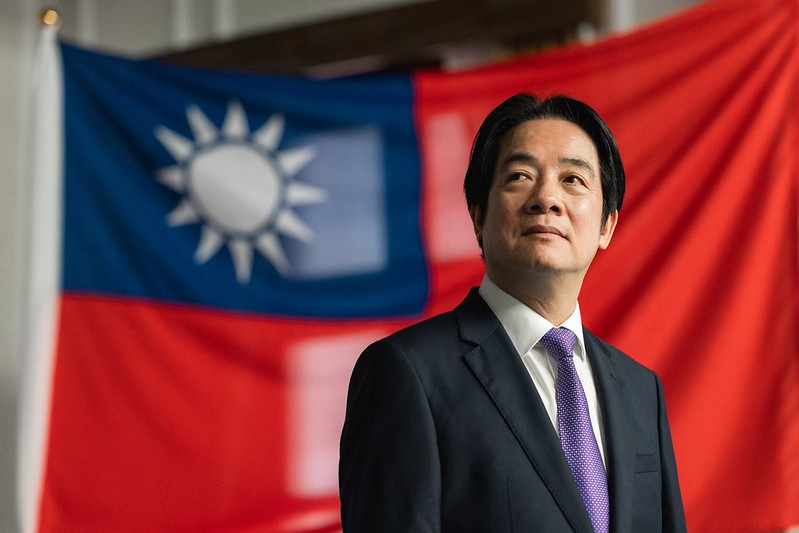
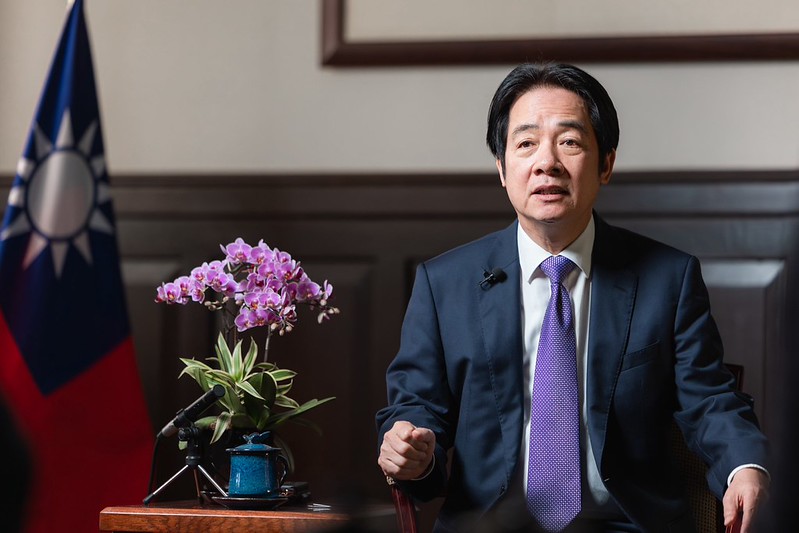
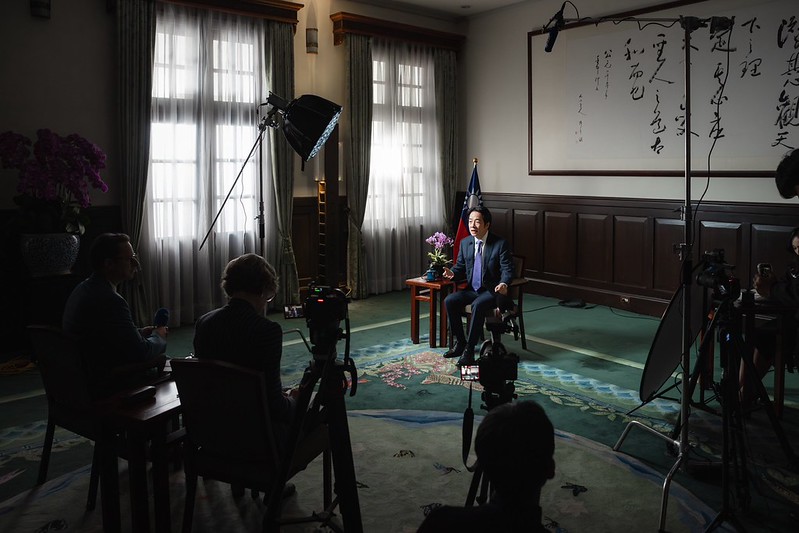
In a recent interview with Agence France-Presse (AFP), President Lai Ching-te responded to questions regarding Taiwan-Europe and Taiwan-United States relations, national defense, cross-strait relations, and the semiconductor industry from AFP Global News Director Philip Chetwynd and Taipei Bureau Chief Allison Jackson. The interview was published by AFP on February 12.
President Lai firstly stated during the interview that as an internationally recognized media outlet, AFP has readers from around the world, and he is honored to accept this interview opportunity so that he can convey Taiwan’s perspective globally. He then expressed hope that when people in the international community consider issues regarding Taiwan, they can understand three facts.
First, the Republic of China and the People’s Republic of China (PRC) are not subordinate to one another. Taiwan is not a part of the PRC, and the PRC does not have the right to annex Taiwan.
Second, Taiwan went through 38 long years of martial law. The people of Taiwan endured sacrifice and hardship to move from authoritarianism to today’s democracy. Consequently, safeguarding Taiwan’s national sovereignty and maintaining its free and democratic system should not be seen as provocations against communist China.
Third, if Taiwan were annexed by China, China’s expansionist ambitions would not stop there. Instead, it would become more aggressive, undermining peace and stability in the Indo-Pacific and the rules-based international order.
When asked to share his views on Taiwan’s ties with Europe and what he thinks Europe can bring to the table in terms of building capacity to defend Taiwan, President Lai stated that on behalf of the people of Taiwan, he wants to thank European countries for their longstanding support, and hopes that they continue to uphold this spirit by standing with Taiwan. The European Union released its Indo-Pacific Strategy in 2021. The policy highlighted cross-strait peace and stability, identifying Taiwan as a key partner. The European Parliament has also passed numerous resolutions and legislation supporting Taiwan in recent years. Notably, on October 25, 2024, it passed a resolution opposing China’s distortion of United Nations General Assembly Resolution 2758, safeguarding Taiwan’s sovereignty. Furthermore, many European countries have dispatched naval vessels to transit the Taiwan Strait. These concrete actions protect a free and open Indo-Pacific.
The president indicated that Taiwan hopes to see more cooperation with Europe in the following areas: First, European countries are implementing the ReArm Europe Plan. Taiwan is also strengthening its national defense capabilities, he said, noting that he has proposed a special defense budget. The president said that moving forward, he would like Taiwan and Europe to enhance cooperation in the defense industry and on defense technology.
Second, Europe is making progress on the AI Continent Action Plan. Taiwan has also launched the Ten Major AI Infrastructure Projects, and is eager to work with Europe on joint development in AI and usher in an era of comprehensive smart transformation.
Third, Europe is Taiwan’s third-largest trading partner and largest source of foreign direct investment. Meanwhile, Taiwan’s investments in Europe over the past four years have surpassed total investments made over the previous four decades. Bilateral economic and trade ties have grown closer. The president expressed hope that Europe will support signing an investment protection agreement, avoidance of double taxation arrangement, and bilateral trade agreement so that economic and trade exchanges between Taiwan and Europe continue to advance.
President Lai indicated that he has long admired European efforts to uphold universal values and their support for Ukraine’s resistance against the Russian invasion. He stated that Taiwan also stands with the Ukrainian people, and sincerely hopes that the Russia-Ukraine war will end soon so that the Ukrainian people will no longer have to suffer the hardships of war. The president said he believes that Europe has the capacity to support Ukraine in its objectives, and is also confident that Europe can continue to devote attention to peace and stability in the Indo-Pacific, which also needs sustained European engagement.
In response to a question on how Taiwan’s government is going to resolve the deadlock on the passage of a US$40 billion defense spending bill, which the opposition parties have blocked 10 times to date, President Lai stated that to highlight Taiwan’s commitment to self-defense and determination to safeguard peace and stability in the Indo-Pacific, he proposed the special defense budget, through which the government aims to build the T-Dome, establish an AI-driven defense network, and further promote Taiwan’s defense industry. This comes in addition to Taiwan’s regular annual defense budget.
The president indicated that the US$40 billion special defense budget covers a period of eight years. Even with this investment, Taiwan’s overall defense spending remains lower than both Japan and the Republic of Korea. Given the state of its economic development, Taiwan is fully capable of funding this special budget. This will first enable the defense budget to exceed 3 percent of GDP, and consequently meet the goal of 5 percent of GDP by 2030. President Lai went on to say that this major defense policy enjoys strong public support. Taiwan is a democracy. The Taiwanese people will not tolerate partisan or ideological divisions that undermine the national interest, he said, expressing confidence that the budget will ultimately pass.
When asked about whether there is a risk that US President Donald Trump will start to lose patience and begin questioning Taiwan’s commitment to doing more for its own defense as the deadlock drags on, President Lai stated that Taiwan is responsible for safeguarding itself, and speaking as president and commander-in-chief, proposing this special budget is a clear demonstration of that resolve. He reiterated that the government will enhance communication with opposition parties and the public. In a democratic society, every political party is ultimately accountable to the people, he said, so he is therefore confident that this budget will win their support.
Regarding how he interprets recent changes at the top of China’s military with regard to Taiwan’s security, President Lai noted that China has a military force of roughly 2 million personnel and around 40 full generals, yet only two are currently in active posts. He said that this is indeed an unusual situation, and the reasons behind these significant changes within the People’s Liberation Army (PLA) and their impact on combat readiness will require further observation before any firm conclusions can be drawn. Taiwan will continue to closely monitor developments within the PLA, and expects that the international community will do the same. Most importantly, Taiwan must keep strengthening its own defenses, enhancing economic resilience, and standing shoulder to shoulder with like-minded partners to build deterrence. Whether internal changes within China’s military translate into greater risks for Taiwan ultimately depends on Taiwan’s own defense preparedness and on the credibility of deterrence it builds together with its partners – that is the key.
President Lai was also asked to share his thoughts on the talk surrounding the date of 2027 for Chinese preparedness in terms of its capacity to invade Taiwan, and whether that date concerns him or impacts his thinking given the changes taking place in China. In response, the president stated that there has been much speculation in the international community about whether China will be ready to invade Taiwan by 2027. Such discussions underscore the reality that China’s threats against Taiwan remain persistent and their ambitions to annex Taiwan have not changed. He said that as commander-in-chief, entrusted with the responsibility for the country’s defense, specific dates are not his primary concern. What matters more is that Taiwan must make the best preparations for a worst-case scenario. We must have the capability to deter China’s aggression at any time. We want to ensure that, for China, there is never a day that is a good day to invade Taiwan. This is the best guarantee of Taiwan’s security and the peace and stability in the Indo-Pacific.
Regarding Chinese President Xi Jinping’s phone call the previous week with President Trump, in which he was understood to have warned President Trump to be cautious about arms sales to Taiwan, President Lai was asked if it could potentially jeopardize future arms sales. President Lai responded that Taiwan has always paid close attention to interactions between the US and China, and holds open channels of communication with the US. He said he believes that dialogue between President Trump and President Xi has sustained four constants in the trilateral relationship between Taiwan, the US, and China.
First, the Republic of China and the People’s Republic of China are not subordinate to one another. Taiwan is not part of the PRC. These facts remain unchanged. Second, under the Taiwan Relations Act and Six Assurances, the US commitment to Taiwan and the strength of the bilateral relationship remain rock-solid. Third, the US National Security Strategy calls for collective defense and burden-sharing amongst partners and allies to jointly uphold peace and stability in the Indo-Pacific – this has not changed. Fourth, cooperation between Taiwan and the US has continued to expand. Taiwan has confidence in itself, confidence in the US, and confidence in the Taiwan-US relationship.
President Lai was then asked if he thinks Taiwan and the question of trade could be on the agenda for the upcoming Xi-Trump talks, and if he thinks that Taiwan could be a bargaining chip in the trade dispute between the US and China. He was also asked whether, with regard to Venezuela, he is concerned that the US could lose interest in Taiwan’s part of the world as it focuses on places such as Greenland and areas in the Western hemisphere. In response, President Lai stated that Taiwan will never be any country’s bargaining chip. Taiwan’s future can only be decided by the 23 million people of Taiwan, and we have confidence in ourselves. Taiwan welcomes and supports any dialogue and cooperation that helps preserve the status quo and avoids dangerous unilateral actions. In the context of US-China trade competition, China seeks far more from the US than the US does from China. There is no need for the United States to frame Taiwan as a bargaining chip in any discussions with China. President Lai said he believes that President Trump is undertaking a difficult peace-building effort, which entails safeguarding US interests and deterring Chinese expansionism in the short term, while seeking peace and stability in the Indo-Pacific in the long-term. These efforts are of critical importance to every country in the region.
President Lai indicated that Taiwan and Venezuela are fundamentally different countries. Taiwan is a vibrant democracy with a strong economy, and actively participates in global initiatives that demonstrate to the world that it is a force for good. Situated in the first island chain in the Indo-Pacific, Taiwan also plays a crucial role in maintaining peace and stability in the region. This is why recent G7 leaders’ summits have repeatedly emphasized that peace and stability in the Taiwan Strait are essential to global security and prosperity.
The president stated that for the US, the situation in Venezuela has not come at the expense of their focus on Indo-Pacific affairs. In fact, the most recent US National Security Strategy makes its four priorities clear. The first is ensuring the security of the American homeland, with the recent operations in Venezuela a part of this. Second, it calls for shifting greater strategic focus to the Indo-Pacific to preserve peace and stability, with the objective of deterring China’s expansionism. Third, the report calls for greater collective defense and burden-sharing amongst Indo-Pacific partners. And the fourth, it seeks to reindustrialize the US. In other words, the National Security Strategy identifies the Indo-Pacific region as a clear focus. The US will not withdraw from the Indo-Pacific nor allow China to displace its role in the Western Pacific.
The interview then touched upon US Commerce Secretary Howard Lutnick’s statement that the Trump administration’s objective is to bring 40 percent of Taiwan’s entire semiconductor supply chain and production to US soil so that the US can be self-sufficient, which the interviewer noted has raised alarm in Taiwan about the threat to the so-called “Silicon Shield.” In response to the question of what motivation the US would have to defend Taiwan against China if it does not need Taiwan’s semiconductors, President Lai answered that long before Taiwan’s Silicon Shield became widely recognized, the US has supported Taiwan under the Taiwan Relations Act and the Six Assurances. These commitments have endured for decades.
He said that in recent years, G7 leaders have repeatedly affirmed that peace and stability across the Taiwan Strait are essential to global security and prosperity. No country should be allowed to change the status quo by force or coercion. Taiwan’s security is directly linked to stability in the Taiwan Strait and peace in the Indo-Pacific. Without a stable Indo-Pacific, the interests of the United States and Europe would inevitably be affected as well.
The president went on to say that in recent years, political leaders in Japan have increasingly emphasized that “a contingency for Taiwan is a contingency for Japan,” and what affects Japan will, in turn, affect the United States. If Taiwan were to be annexed, the next countries under threat would be Japan, the Philippines, and others in the Indo-Pacific region, with repercussions eventually reaching the Americas and Europe. In this changing world, nations belong to a global community – a situation in any one country would inevitably impact another.
In a follow-up question regarding how he can ensure that Taiwan remains indispensable in the global semiconductor supply chain, President Lai responded that as long as Taiwan’s semiconductor industry maintains its centers for research and development, the most advanced manufacturing processes, and the largest production capacity, it will continue to play an indispensable strategic role in the global semiconductor supply chain. At the same time, while the semiconductor industry is one of Taiwan’s strengths, it is also Taiwan’s responsibility to contribute to global economic prosperity.
The president stated that the semiconductor industry operates as an integrated ecosystem. The US leads in research and design capabilities, and has a vast market; Japan has materials and equipment; the Netherlands produces advanced manufacturing tools; the Republic of Korea has strengths in memory chip production; and Taiwan specializes in wafer fabrication. No single country in this supply chain can be missing. For this reason, the Taiwanese government supports the semiconductor industry’s investments in Japan, the US, and Europe. Taiwan hopes that as the world enters the next era of intelligent technologies, it can leverage its semiconductor industry to further contribute to global development.