

News & activities
 News releases
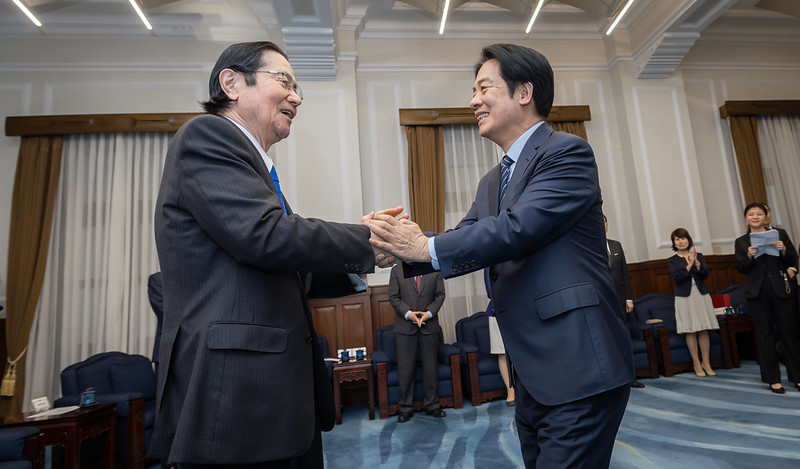
At the 2025 APEC Economic Leaders’ Meeting (AELM) in Korea that concluded at noon on November 1 (local time), Senior Advisor to the President and Chairman of Taiwania Capital Management Corporation Lin Hsin-i served as Taiwan’s leader’s representative. Leader’s Representative Lin participated in the full meeting and shared Taiwan’s contributions to the global economic system, successfully completing the mission entrusted to him by President Lai Ching-te.
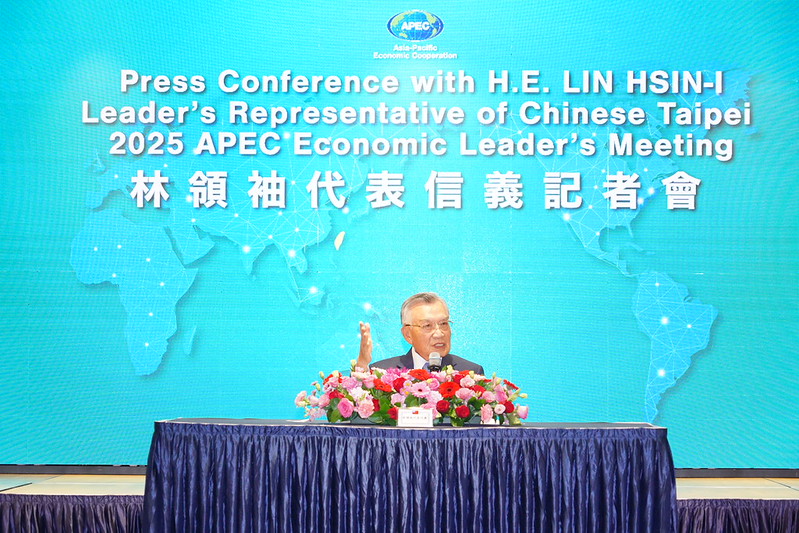
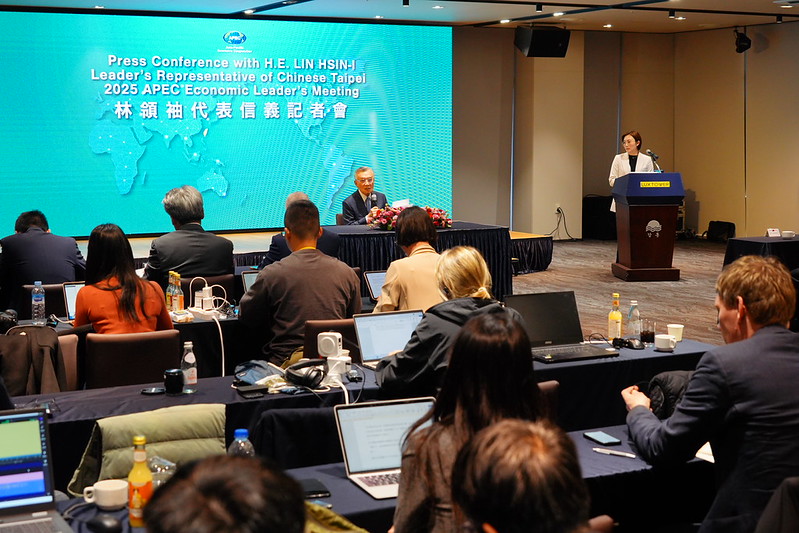
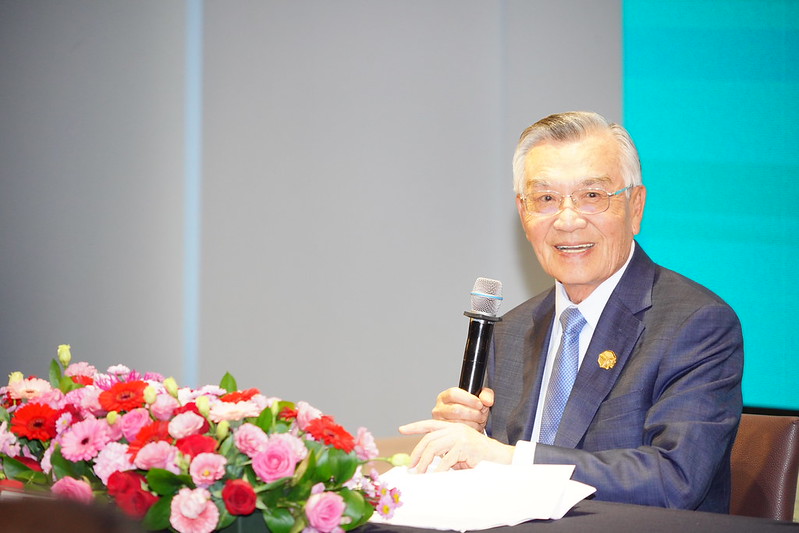
On the afternoon of the same day, Leader’s Representative Lin convened an international press conference in Gyeongju, Korea, in which he explained the APEC meeting process and outcomes, and responded to questions from reporters. In remarks, Leader’s Representative Lin first thanked the members of the media for their hard work conducting interviews and filing reports over the past few days. He then thanked everyone who accompanied the delegation throughout the trip and witnessed the important interactions during this year’s AELM.
Leader’s Representative Lin stated that this year, as is customary, APEC held two formal AELMs and a working lunch with APEC Business Advisory Council (ABAC) representatives. The priorities set by Korea for this year’s APEC were “Connect, Innovate, Prosper,“ he said, and the meeting agenda also revolved around exploring the challenges stemming from AI and demographic changes. He pointed out that Korea also included culture and fashion industry development in the scope of discussions, with topics including how APEC can engage in cooperation to promote trade and investment amidst increasing global uncertainty, and especially how to promote cooperation between the public and private sectors. Meeting discussions also focused on ways to deal with emerging trends such as the profound impacts from AI’s rapid evolution and demographic changes.
Leader’s Representative Lin indicated that the focus of his statement at the meeting was that in the face of economic uncertainty, in addition to increasing the autonomy and economic security of its industries, each economy must simultaneously maintain open international trade practices and global market vitality. Therefore, he concluded, governments must create a stable, transparent, and predictable economic and trade environment, and jointly assist enterprises in building resilience amid changing circumstances so that they can confidently make long-term investments and promote innovation.
Leader’s Representative Lin also shared Taiwan’s experience in developing semiconductor supply chains, which are the result of government policy guidance in planning industry development and the joint efforts of the private sector, including the establishment of clusters, R&D teams, tax incentives, and talent cultivation. He noted that many member economies were extremely interested in the highly developed and comprehensive nature of Taiwan’s semiconductor industry.
In discussing the challenges from rapid demographic changes facing many Asia-Pacific economies, Leader’s Representative Lin also shared Taiwan’s human-centered solutions aided by technology. He gave the example of the “AI and the Aging Economy” project promoted by ABAC representative and Acer Chairman Jason Chen (陳俊聖) which uses AI to create a facial expression recognition model that is up to 86% accurate, and can detect early-stage dementia. He provided another example with Quanta Computer Chief Technology Officer Ted Chang’s (張嘉淵) “Daily Plus: Empowering AI to Create Inclusive Smart Healthcare” project, which has also been widely praised, as it empowers medical staff without engineering or technical backgrounds to use AI while promoting open-source AI localization and cross-border training. This project, he added, has been running for three years, and interest is high among all member economies, with 18 participating this year.
Leader’s Representative Lin pointed out that, in addressing the disaster risks associated with climate change, applying AI to develop high-precision meteorological models has increased the resolution of meteorological forecasts from 25 kilometers to 2 kilometers. When Typhoon Gaemi struck last year, he added, the AI model clearly depicted the typhoon’s structure, improved forecast accuracy, and facilitated advance deployments by local governments, significantly reducing disaster losses and demonstrating the power of technology to protect human life and the economy. Many member economies are also very interested in this technology, he underlined.
Leader’s Representative Lin emphasized that Taiwan attends APEC not only to participate in this important international economic and trade meeting, but also because it gives Taiwan an important stage on which it can raise its global visibility. He said that through APEC meetings and numerous bilateral exchanges, they demonstrated Taiwan’s contributions to the global economic system while accomplishing the three major tasks assigned to him by President Lai.
When asked by the media about his overall assessment of this trip, and whether he would agree to continue to serve as the representative next year if asked by President Lai, Leader’s Representative Lin responded that no one can give himself grades for his own performance, as the grades are given by the teacher. For this meeting, he said, he gave his all just like everyone else, and did not think about other issues.
Regarding whether he had observed any change in the degree of attention the international community is giving Taiwan throughout the course of his participation in APEC, Leader’s Representative Lin pointed out that he also participated in the AELM in Busan, Korea, 20 years ago, and that this year’s issues are somewhat different from those at that time. Because everyone is now focused on AI, population issues, and the application and governance of AI technology, he feels that Taiwan is getting more attention. During the meeting, he said, he also cited some concrete examples to let other economies know what Taiwan has done, noting that the leaders of other economies were quite interested and that some even asked detailed questions about how the government should cooperate with the business community. He explained that Taiwan has the Industrial Technology Research Institute (ITRI) and many technology industries; National Science and Technology Council (NSTC) Minister Wu Cheng-wen is also a semiconductor expert, and National Tsing Hua and Chiao Tung universities are also capable of cultivating professionals.
Leader’s Representative Lin said that the increased international attention on Taiwan is the result of everyone’s efforts over the past few years, and that it also highlights Taiwan’s contributions to APEC. He stated the three tasks assigned to him by President Lai: first, that Taiwan is committed to strengthening economic resilience and that it hopes to cooperate with other countries to promote regional economic and trade development; second, that Taiwan is willing to share its experience in pioneering industries and promote cooperation between the public and private sectors to help respond to global challenges; and third, that Taiwan is accelerating the development of human-centered AI to help realize APEC’s common vision. The delegation presented each of these propositions, one by one, he said, and while many AI applications are still in the development stage, we are willing to share our experience with other economies.
Regarding bilateral talks during the meeting, Leader’s Representative Lin said that “talks” can be defined in many ways, and because there are different formats, there is no way to calculate the exact number of talks that were held. He said they had hoped to have opportunities during this meeting to engage in bilateral talks with other member economies, but sometimes such talks could not be arranged due to scheduling issues for both parties. Among those talks, he pointed out, the 40-minute meeting with US Secretary of the Treasury Scott Bessent covered a wide range of topics, he said, including technological cooperation and supply chain security. He noted that Secretary Bessent showed great interest and patience in discussing the development process of Taiwan’s semiconductor industry, and wanted to understand how Taiwan established high-tech clusters and the historical context of their development. He added that before yesterday’s meeting, Leader’s Representative Lin also greeted Japanese Prime Minister Takaichi Sanae, congratulated her on taking office as prime minister, and held talks with her. It was mutually understood, he noted, that the issues under discussion will be disclosed at an appropriate time in the future.
Responding to a question on whether Korea’s stated ambitions in the field of AI pose a threat to Taiwan’s international standing in the high-tech industry and how to view the prospects for cooperation amid the competitive yet collaborative relationship between Taiwan and Korea, Leader’s Representative Lin noted that each country is making efforts on this front. He said that the melding of tradition and creativity in Korea’s performance at yesterday’s APEC gala dinner was in line with the “Connect, Innovate, Prosper” priorities of APEC 2025. He went on to note that Taiwan and Korea already engage in extensive collaboration in high-tech sectors, both playing pivotal, complementary roles across the ICT value chain. Taiwan, he said, has comprehensive and highly efficient industrial ecosystems in such fields as semiconductor manufacturing, packaging, and testing as well as cloud services and AI hardware; Korea, he noted, has world-leading strengths in memory, systems integration, and end-user consumer products. He highlighted that combining our respective strengths makes our regional supply chains more resilient and stable, and provides a foundation for bilateral cooperation. Looking to the future, he said, we welcome exploration of additional collaborative opportunities for bilateral cooperation on this basis so that we can jointly face global supply chain challenges.
NSTC Minister Wu elaborated on this, saying that the semiconductor industries of Taiwan and Korea play key roles in supply chains for global democracies, and have long engaged in cooperation. Nvidia’s collaboration with Korea, he said, will not have any adverse impact on Taiwan, because investments in Korea will create customers for Taiwan. He explained that such investments benefit development in both countries, since when Korea builds factories for AI, it will need to buy chips made by Taiwan Semiconductor Manufacturing Company, and it will also buy Korean-made memory hardware. That is why Taiwan and Korea are cooperative partners, he said.
In response to questions from reporters about interactions between Leader’s Representative Lin and China’s President Xi Jinping, and whether there are any concerns regarding next year’s APEC 2026 proceedings in Shenzhen, China, Ministry of Foreign Affairs Department of International Organizations Director General Jonathan C.Y. Sun (孫儉元) stated that equal participation of all member economies is a core principle of APEC. He added that this is an important reason why APEC is able to operate smoothly and amicably. After China last year announced its intention to host APEC 2026, he continued, Taiwan raised questions with China regarding guarantees for Taiwan’s right to equal participation and whether our personnel could be assured of their personal safety while in China to attend the proceedings, and demanded that China make assurances regarding these matters. He explained that such concerns are shared by many like-minded countries, and that in November of last year, in cooperation with such countries, Taiwan called on China to issue written assurances. Ever since the Informal Senior Officials’ Meeting (ISOM) that was held in December of last year, he said, Taiwan has kept in contact under the APEC framework with relevant parties to demand that China honor its commitments by ensuring that Taiwan is able to smoothly attend the proceedings and by further ensuring the personal security of all our personnel.
Asked a question regarding a reference to the Free Trade Area of the Asia Pacific (FTAAP) agenda in the APEC Leaders’ Declaration, Minister without Portfolio of the Executive Yuan Yang Jen-ni (楊珍妮) explained that the FTAAP agenda was discussed at the APEC Concluding Senior Officials’ Meeting and the APEC Ministerial Meeting (AMM). The FTAAP is a goal, she said, and it is hoped that after everyone has discussed individual issues they can integrate them in the future. She said that efforts are underway to determine whether emerging 21st-century issues such as the environment and labor can be included.
Members of the press also asked about interactions between NSTC Minister Wu and US Secretary of State Marco Rubio. Minister Wu responded that they spoke with each other at the AMM gala dinner, and he felt confident that a friendly communication of that sort will definitely have a positive impact moving forward as the two sides seek to establish semiconductor supply chain cooperation and jointly develop bilateral economic and people-to-people exchanges.
When asked whether the subject of tariffs came up during the meeting with US Treasury Secretary Bessent, Minister Yang stated that the APEC meetings are mainly for discussing issues related to APEC and the development of bilateral economic and trade relations. She mentioned that Vice Premier Cheng Li-chiun (鄭麗君) said in a statement recently that the Taiwan-US tariff negotiation team is currently discussing Taiwan-US supply chain cooperation, and that it hopes to obtain reciprocal tariff rate reductions without stacking and to secure preferential treatment related to Section 232 of the US Trade Expansion Act. After the two sides have reached consensus, she said, they can proceed to the concluding meeting to finalize a Taiwan-US trade agreement. Minister Yang expressed confidence that after APEC the two sides will continue working to finalize an agreement.