
News & activities
 News releases
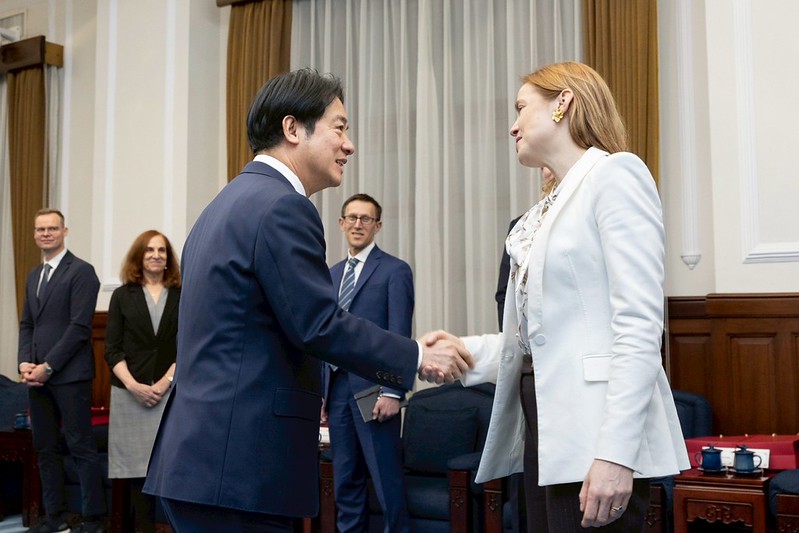
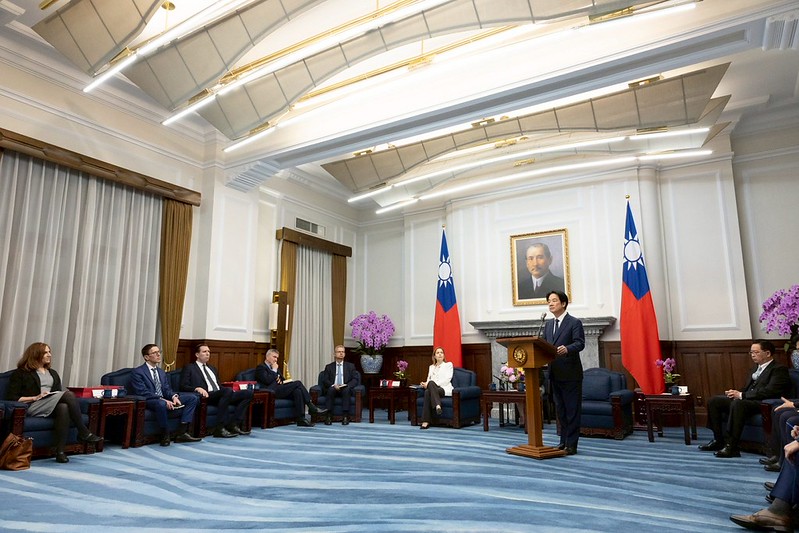
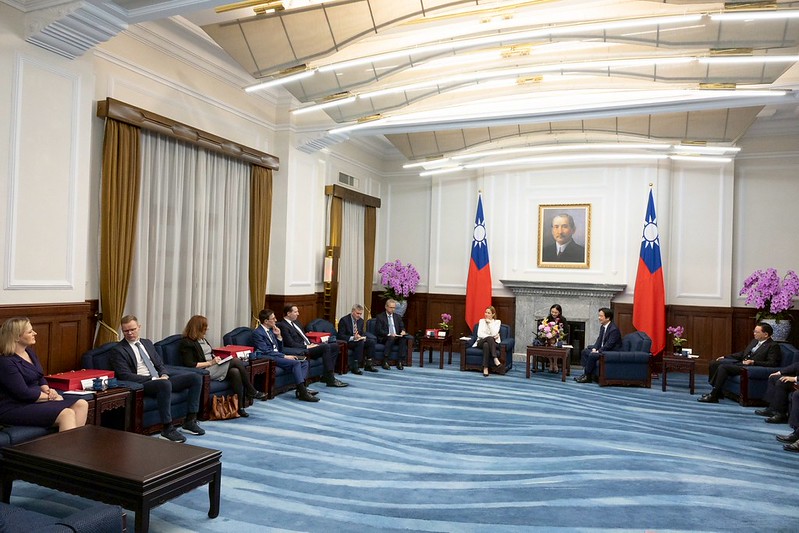
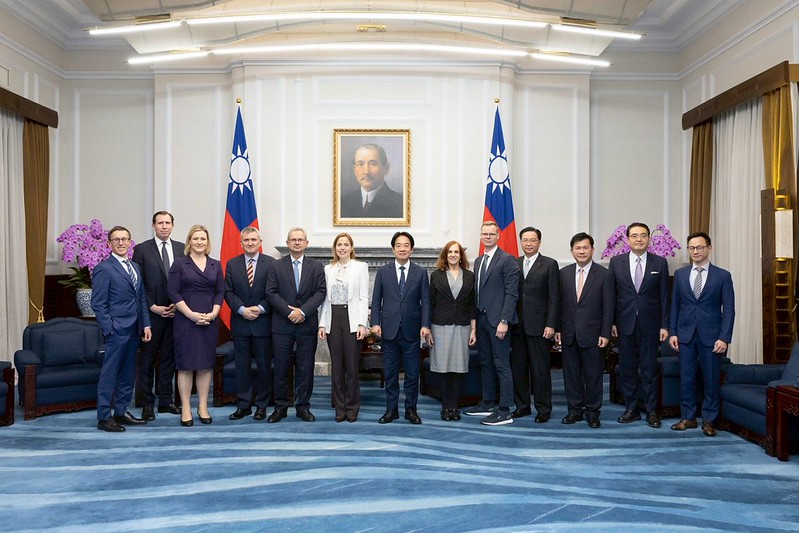
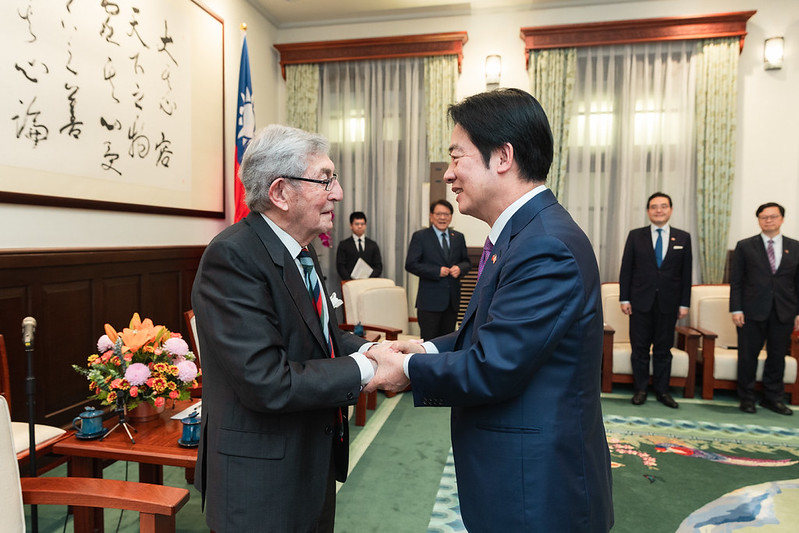
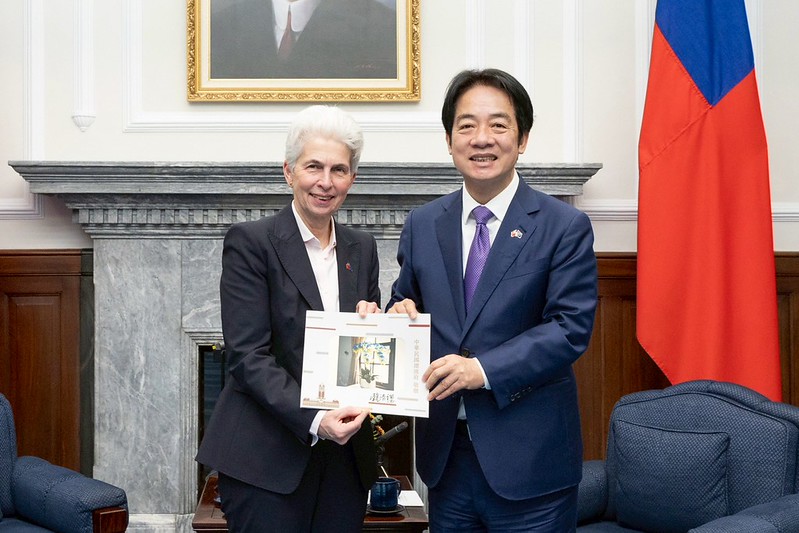
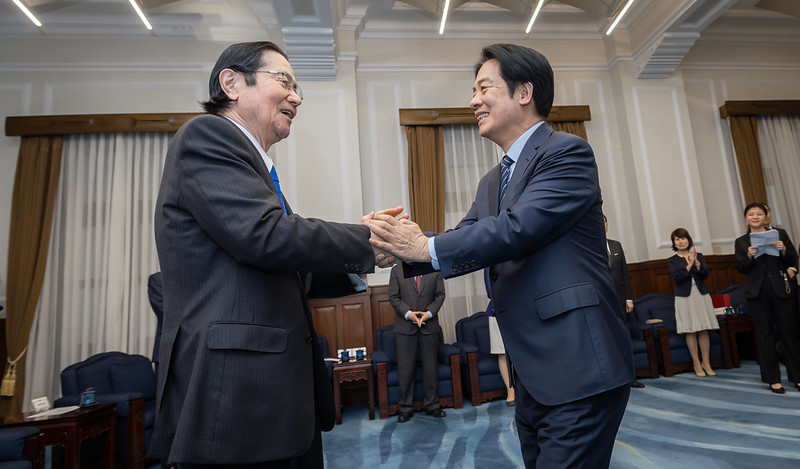
On the afternoon of January 21, President Lai Ching-te met with a transatlantic delegation from the German Marshall Fund (GMF). In remarks, President Lai expressed thanks to partners in the United States and European Union for their long-time support of Taiwan, which highlights the joint commitment to facing global challenges. The president pointed out that Taiwan is continuing to increase its defense spending and enhance its self-defense capabilities, and that it is building the T-Dome advanced air defense system and adopting high tech and AI to bolster its defense industry. He also expressed hope for continuing to deepen Taiwan-US and Taiwan-Europe cooperation in such areas as security, trade and the economy, and technology to maintain peace and stability across the Taiwan Strait and in the region.
A translation of President Lai’s remarks follows:
First, I would like to extend a warm welcome to GMF President Alexandra de Hoop Scheffer as she leads this transatlantic delegation to Taiwan. Our guests today are good friends who have long followed Taiwan-related issues. I thank you all for visiting. Your presence demonstrates support for Taiwan among our partners in the US and Europe and highlights our joint commitment to facing global challenges. I also want to thank the GMF for its long-term efforts in facilitating transatlantic cooperation, for its staunch backing of democratic values, and for continuing to deepen understanding of Taiwan’s security situation and international participation throughout the US and Europe. Just this month, the GMF released a major report detailing the massive price China would pay – economically, militarily, socially, and internationally – if it were to start a war with Taiwan. The report also emphasized that the international community must show its ability and determination to counter China’s military actions.
I believe that democracies must unite and work together, harnessing their collective wisdom and strength, to resist the expansion of authoritarianism and jointly safeguard the values of freedom and democracy. For this reason, Taiwan will continue to enhance its self-defense capabilities and step up cooperation with democratic partners as it seeks to maintain regional peace and stability.
Taiwan’s defense spending will surpass 3 percent of GDP this year, and that figure will reach 5 percent by 2030. We have also proposed a US$40 billion special defense budget which will be put toward building the T-Dome advanced air defense system and adopting high tech and AI to bolster Taiwan’s defense industry.
At the end of last year, US President Donald Trump’s administration announced the sale to Taiwan of a US$11.1 billion military package. And its latest National Security Strategy notes that the US is taking as its goal preserving military overmatch to deter conflict across the Taiwan Strait. The European Union’s European External Action Service also released a statement after China’s military exercises around Taiwan at the end of last year, reiterating the importance of peace and stability across the Taiwan Strait for regional and global security and prosperity. I am sincerely grateful for all of these actions.
I would also like to point out that in addition to military cooperation, tariff negotiations between Taiwan and the US have concluded. We look forward to continuing to utilize the Economic Prosperity Partnership Dialogue and other mechanisms to deepen Taiwan-US cooperation in such fields as supply chains, digital trade, and science and technology. In addition, Taiwan’s investments in Europe over the past four years have already surpassed our total investments over the previous four decades. Moving forward, Taiwan will continue to expand collaboration with European countries in such industries as semiconductors, AI, and information and communications technology, while also boosting cooperation on supply chain resilience. I hope that our guests will continue to support Taiwan in deepening connections with European nations.
Lastly, I want to thank you all once again for visiting Taiwan. I hope that, going forward, we can join hands in advancing democracy, peace, and prosperity around the world. I wish you a successful and rewarding visit.
President de Hoop Scheffer then delivered remarks, saying that they have an exceptional delegation comprising American, French, German, and British members – all steadfast allies of Taiwan. She stated that this year in particular, their focus is on security, defense, and tech innovation, because these are the areas in which the US, European allies, and Taiwan need to boost their cooperation and partnership.
President de Hoop Scheffer stated that they are here for two main purposes: the first is that many of the delegation members, being in Taiwan for the first time, want to better understand the dynamics that are shaping and reshaping Taiwan and the Indo-Pacific region; and the second is to strengthen transatlantic cooperation on and with Taiwan, which is in the GMF’s DNA and mission.
President de Hoop Scheffer also indicated that they pay much attention to all of the issues just mentioned by President Lai in his remarks, saying that they think of those issues in terms of intersections, including intersections across sectors – because one cannot dissociate national security from economic security and even tech innovation. And Taiwan, she emphasized, crystallizes many of these intersections.
President de Hoop Scheffer elaborated, saying that it is also the intersections across geographies. The Euro-Atlantic theater cannot be dissociated from the Indo-Pacific theater, she said, and so what they have been doing with their Indo-Pacific transatlantic programs is also thinking of the lessons learned from the war in Ukraine for this part of the world. Finally, she noted, it is the intersections between domestic politics and foreign policy, explaining that this is being carried out in the connection among societal resilience, defense, and security. She added that the connection between societal resilience and defense is something that many European countries have been experiencing within the context of the war in Ukraine, because at the end of the day, deterrence will rely on societal resilience.
President de Hoop Scheffer then concluded with three short remarks. The first, she said, is that the security of the Indo-Pacific and the stability of the Taiwan Strait are absolutely central to transatlantic security and global security, adding that it is about economic resilience, global supply chains, and deterrence. She said that what we have seen over recent years is an increasing commitment from the US and European allies. The second is that there is a deep understanding that this is not just a regional issue; it is a global issue, and it is a question also of credibility of our alliance and alliances as a whole. And the third, she said, is how to strengthen our partnership on key issues – economic security, critical infrastructure, cybersecurity, and tech-defense innovation. In closing, she said they very much look forward to strengthening the partnership with Taiwan.
The delegation also included former NATO Supreme Allied Commander Transformation General Denis Mercier, former NATO Deputy Supreme Allied Commander Europe General James Everard, University of Texas at Austin Senior Fellow for National Security Law Marik A. String, GMF Senior Vice President for Global Power Shifts Daniel Kliman, and Managing Director of the GMF Indo-Pacific Program Bonnie Glaser.