
To the central content area
:::
:::

News & activities

News releases

2021-03-30
President Tsai meets Palau President Surangel Whipps Jr.

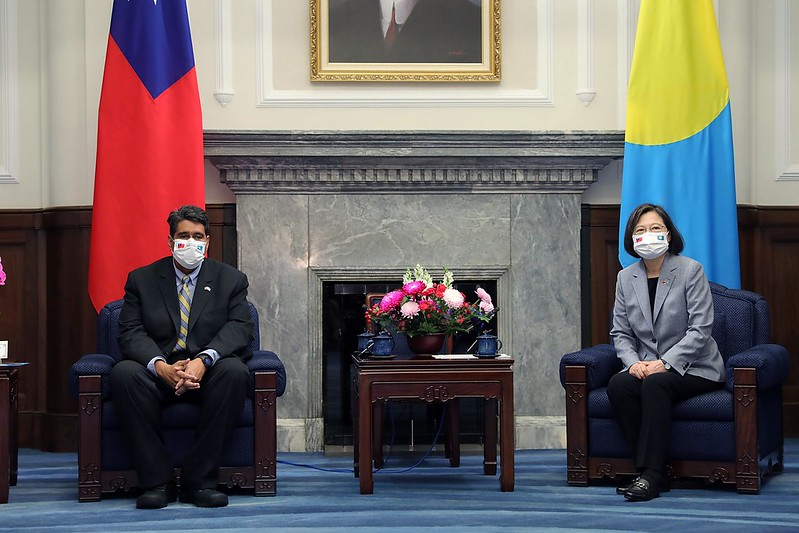
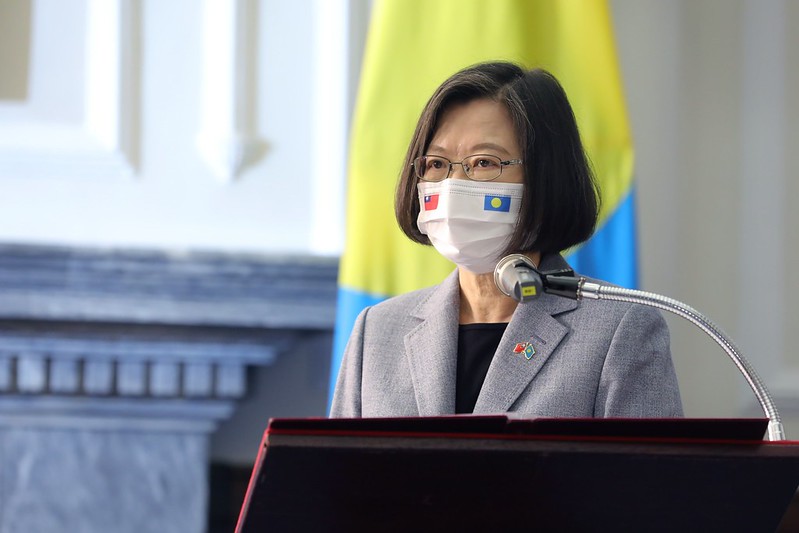
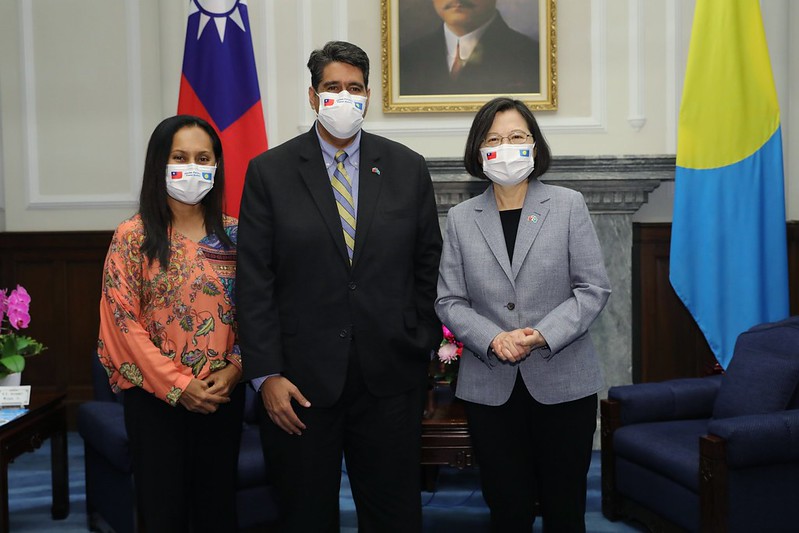
On the afternoon of March 30, President Tsai Ing-wen met with Palau President Surangel Whipps Jr. and First Lady Valerie Whipps at the Presidential Office in Taipei, and welcomed the forthcoming launch of the Taiwan-Palau travel bubble as a historic moment for cooperation between the two countries. President Tsai expressed confidence that the launch of the travel bubble would show the world that safe travel is possible during this stage of the pandemic, and said she looks forward to maintaining close bilateral ties in the post-pandemic era as Taiwan and Palau build a better future together.

A translation of President Tsai's remarks follows:

I would like to extend a warm welcome to President Whipps, First Lady Whipps, and the delegation from Palau. This is President Whipps' first trip abroad since taking office, as well as the first time that Taiwan has received a foreign head of state since the outbreak of the COVID-19 pandemic.

President Whipps, allow me to congratulate you once again on your election, and let me also note that this is a historic moment for cooperation between the Republic of China (Taiwan) and the Republic of Palau.

The day after tomorrow, April 1, will mark the opening of the Taiwan-Palau travel bubble. Amid the challenges posed by the pandemic, this model for a safe travel corridor is being closely watched not just by the people of our two countries, but by the entire world.

As you pointed out, President Whipps, it is Taiwanese travelers who are being given the exclusive opportunity to visit Palau. And we know that many people in Taiwan have been looking forward to visiting your country.

I would like to take this opportunity to thank you for your commitment to strengthening Taiwan-Palau ties. Minister of Foreign Affairs Joseph Wu (吳釗燮) told me how you led efforts to set up this travel bubble by personally chairing meetings to promote the plan and inviting officials from our Embassy in Palau to discuss planning.

We discussed arrangements for a travel bubble when we spoke via video call in January. I am very pleased that just two months later, we are here receiving you and your delegation in Taiwan.

Your itinerary in Taiwan has included a tourism promotion event as well as a number of exchanges with local businesses. These events help draw Taiwanese public attention to Palau and the beauty of your nation.

I understand that you have a specific goal—to increase the number of Taiwanese visiting Palau to 100,000 per year. I believe that with the launch of this travel bubble, we will make a big step toward that goal, while also showing the world that safe travel is possible during this stage of the pandemic.

I can personally recommend Palau as a tourist destination. I visited Palau not long ago, and was deeply impressed by its ocean views, traditional culture, and commitment to environmental protection. I strongly encourage Taiwanese to visit Palau, and look forward to going there again myself.

Of course, even as we promote tourism, we must remain on guard against the pandemic. Over the past year, our countries have been united in our work to combat the spread of COVID-19. Both the public and private sectors in Taiwan have donated medical resources to Palau, and a medical team from Shin Kong Wu Ho-Su Memorial Hospital has assisted Palau in maintaining its impressive record of zero confirmed cases.

From disease prevention to tourism, our cooperation highlights the long-standing mutual trust between our countries, on which we have built a reliable model for cooperation. Looking forward, I know that we will continue to enjoy further success in our exchanges in medicine, energy, education, maritime security, and Austronesian culture.

President Whipps, the gift I will present to you today is a symbol of that trust and cooperation—a traditional knife used by members of Taiwan's indigenous Paiwan tribe to share food and forge mutual bonds. It is my hope that in the post-pandemic era, Taiwan and Palau will enjoy even closer ties as we create a better future together.

In closing, let me once again welcome President Whipps, First Lady Whipps, and the members of the Palauan delegation to Taiwan. I wish you all a smooth and fruitful visit.

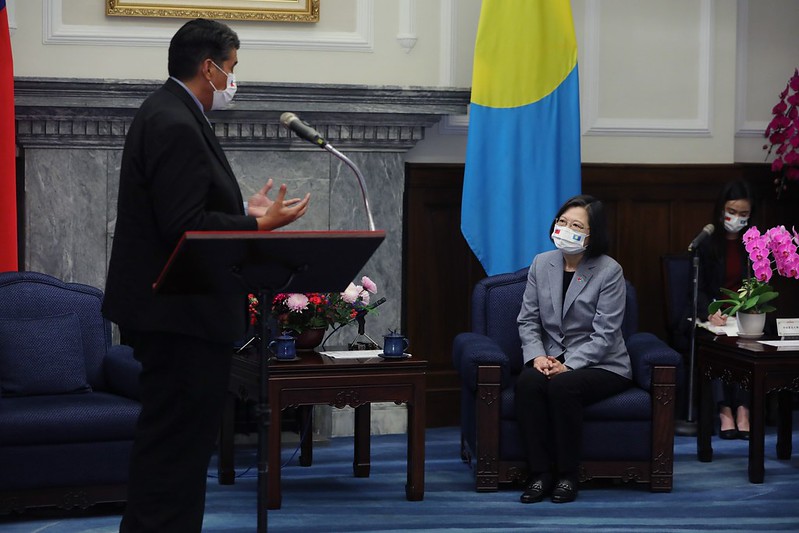
President Whipps then delivered the following remarks:

Madame President Tsai, members of the cabinet and distinguished guests: On behalf of our delegation, I would like to say thank you for the gracious hospitality that has been shown from when we stepped off the plane until now, and I am sure it will continue until we leave. We feel at home here, and we feel very honored and very privileged to be allowed to come into the country during this pandemic to begin what we have been working on for so long. I would like to say that your ambassador in Palau has been working very hard, along with Minister Wu and all of the members of your cabinet, to make sure that this is possible.

I would like to congratulate your government and the people of Taiwan for the success that you have in keeping your country COVID safe. I would say COVID free, because really most of the cases came from outside. So, we look at it as though we are the same.

We have been very fortunate in Palau to look up to you and follow the model that you have, and have had very strict quarantine requirements. To some extent people at home think they are a bit excessive, but it is the safety of the people that has always come first. And I think that goes to show the values that both our countries have––that people must come first. We have to take care of their lives, we have to keep them safe.

Opening up this sterile corridor is all about opening with care and being safe. We know that what we are doing will cause some inconvenience. It is not going to be exactly like travel before. However, we ask for people’s patience, because it is about safety. As we continue to move forward, that will only improve.

This also has to do with trust. I think most importantly having Minister Wu attend the inauguration ceremony helped build confidence in our people. Having the CDC (Taiwan Centers for Disease Control) team come to Palau and see what we have been doing in Palau helped build that confidence.

I hope that our visit here also helps the people here build their confidence that Palau is truly COVID free, and they can see that it will be just like travelling between Kaohsiung and Taipei. That should be our ultimate goal.

We have been very fortunate. What has also helped us in Palau is our partnership with the United States. The US has been able to put us on their vaccine distribution list, so beginning in January, shortly before we talked, I got my first shot and then got my second shot right after the inauguration. So, as of the time we left, 50 percent of the people in Palau had already received their first shot. We hope in the next couple weeks, 50 percent will have already received their second shot. We are well on our way toward herd immunity, and I think that is also what is giving the people in Palau the confidence to welcome the people of Taiwan, even though we are COVID free.

In the past few weeks, a team from the US has helped us with analysis. And President Tsai, I would like to share one of the statistics from that analysis: if we have this travel corridor with Taiwan, the chance of one COVID-19 case coming from Taiwan to Palau is one in four million. So, that is a very low chance of getting COVID-19. And that is because of what you have done here and demonstrated to the world. By having this corridor we can demonstrate to the world how two COVID safe and COVID free countries can work together and increase people-to-people exchanges.

Most importantly for Palau, we have gotten a shot in our arm with the vaccine; by allowing the tourists to come in, you give us a shot in the arm for our economy. That is very important because, as you know, many of our people are out of work because we depend on tourism.

Secondly, and probably more important than that, by allowing regular flights to Palau, we will be able to bring patients to Taiwan. Thank you for allowing us to continue these charter flights and helping us get ready for them. Through the charter flights, we have been sending patients to Taiwan, but in limited numbers, because they are stuck here for a month waiting for the next flight. It is heartbreaking when the people on the committee have to decide who goes and who does not go. By allowing regular flights, people that need critical care can come. In fact, over the past ten years, since we have had this medical program, over 3,000 patients have come for treatment in Taiwan, and this is an important part of our care for our people. So opening up this travel corridor helps us take care of our people and save and extend the lives of those that are very much in need of medical treatment.

Madame President, I would also like to say that this past year has taught us a lot. In particular, I would like to talk about ways that we have innovated to try combat the virus. It was with the help of Taiwan that we got our first PCR machines, and have been able to test and make sure that nobody has the virus. But before that, we had to get the infectious control box shipped to Palau. And there was no way to get it because it was too heavy for aircraft, so it had to be shipped on a fishing boat. But it got there, and that is the amazing part of this story.

Opening up this travel corridor, we had some questions of how exactly we are going to do it. And at the very last hour, we asked if we could request PCR testing at the airport before the passengers board the plane. Thank you for allowing us to do that. I think that raises confidence, because although we can do testing in Palau, we trust you to do it here, and if there is a case, the plane coming to Palau will be sterile. There is no chance of anything coming into Palau. So, we appreciate those challenges that we have had and how we have worked together to solve them. We will continue growing and expanding this special relationship we have.

Our relationship has continued for a long time. It actually began before our country became independent by having your agricultural mission in Palau help us develop our agriculture sector. Furthermore, you have continued with this. And from when we signed our diplomatic relationship 22 years ago until now, you have helped us with infrastructure development, education, healthcare and more importantly, brought our cultures closer together to realize that what we share as Austronesian countries are the same values of freedom and democracy. But at the same time, we also share the importance we place on our environment and our culture, and that we need to protect it and take care of it for generations to come.

When we talked in January, I was very excited that we could get the travel bubble going and I am so excited that it is finally happening. We believe it is time, and this special travel corridor can only strengthen the relationship we have and enhance it, and further bring our peoples closer together. And the good news I just heard is that the first flight is already full, and I hope every flight after that is full. Maybe we need to increase our cap of 110 passengers. We also need to increase the number of airlines and flights coming into Palau, because hopefully now we have so many people who want to come that we need to make sure our doors are open and ready to accept them.

So I want to welcome all of the people from Taiwan to come and visit, and enjoy time under the sea and above the sea, and enjoy our culture and have fun, because Palau should be about having fun. I especially look forward to your visit, Madame President, in the near future, because as we discussed, I hope that you will be coming soon.

In January I received the vaccine to show my people in Palau that it is safe. We should move forward. We got on the first flight to Taiwan to prove to our people back home that Taiwan is safe. So thank you again, and we look forward to receiving all of you as guests in our country.

Also in attendance at the meeting were Palau Senate Vice President Kerai Mariur, House of Delegates Health, Social and Cultural Affairs Committee Chairwoman Vicky Ngiratkakl-Kanai, Senate Foreign Affairs Committee Chairman Mason Whipps, and Ambassador to the ROC (Taiwan) Dilmei Louisa Olkeriil.
Related News
Details
2025-12-05
President Lai meets NCAFP delegation
On the morning of December 5, President Lai Ching-te met with a delegation from the National Committee on American Foreign Policy (NCAFP). In remarks, the president stated that Taiwan and the United States are important strategic and trade partners, share ideals and values, and are deepening exchanges and collaboration. He emphasized that last week, Taiwan proposed an eight-year, US$40 billion supplementary defense budget for significant military procurement from the US, indigenous defense, and substantial reinforcement of Taiwan’s asymmetric capabilities. The president said that Taiwan will continue to reform national defense and actively enhance whole-of-society defense and resilience, and will also support Taiwan-US industrial engagement and deepen cooperation with the US and other like-minded democracies, upholding the values of freedom and democracy and our way of life. A translation of President Lai’s remarks follows: I warmly welcome Ambassador Susan M. Elliott as she leads another delegation to Taiwan. Ambassador Elliott has a doctorate in nursing science, while I started out as a physician. I am delighted that we have this opportunity to discuss the health and sustainable development of democracy. The NCAFP has always been highly valued internationally as a think tank and platform for exchanges. And over many years, through symposiums and research reports drawing attention to the Taiwan Strait situation, the committee has advanced international understanding of Taiwan. Many members of the delegation with us today have deep connections to Taiwan. I would like to thank you for affirming and supporting Taiwan’s determination to uphold democratic values. Situated on the Indo-Pacific’s first island chain, Taiwan is a mature democracy, a responsible security partner, and an important part of global governance. Maintaining peace and stability in the Indo-Pacific and advancing prosperous global development are Taiwan’s unwavering goals. Recently, however, China has continued to threaten Taiwan and other countries in the region through such tactics as military intimidation, gray-zone oppression, economic coercion, and diplomatic suppression. It aims to alter the cross-strait status quo and challenge Indo-Pacific security and the global order. In the face of expanding authoritarianism, we understand very clearly that only unity can help us weather these challenges, and only strength can bring peace. For this reason, Taiwan is committed to acting responsibly by continuing to bolster our national defense capabilities and demonstrating our resolve to defend ourselves. Just last week, we proposed an eight-year, US$40 billion supplementary defense budget for significant military procurement from the US, indigenous defense, and substantial reinforcement of Taiwan’s asymmetric capabilities. Meanwhile, defense spending, as it is defined by NATO, will exceed 3 percent of GDP next year, and is expected to reach 5 percent of GDP by 2030. Taiwan will continue to reform national defense and actively enhance whole-of-society defense and resilience. We will support Taiwan-US industrial engagement and deepen cooperation with the US and other like-minded democracies, upholding the values of freedom and democracy and our way of life. I would like to thank successive US administrations for supporting and fulfilling their commitment to Taiwan in accordance with the Taiwan Relations Act and the Six Assurances. I also thank the US Congress for long demonstrating bipartisan support for Taiwan. The recent passage in the Senate and House of the Taiwan Assurance Implementation Act – just signed into law by President Donald Trump – is a prime example of this. Taiwan and the US are important strategic and trade partners. Through our shared ideals and values, deepening exchanges and collaboration, and expanding mutual benefits and interests, we are the best of partners. In closing, I once again welcome you all to Taiwan and thank you for sharing your insights into deepening Taiwan-US relations. Ambassador Elliott then delivered remarks, thanking President Lai for his warm welcome and hospitality. She noted that the NCAFP has visited Taiwan many times over the past two decades as part of their annual visit to Asia. While the delegation is in Taiwan, she said, they hope to discuss issues of common interest between both countries, including regional security, prosperity, and the relationship between Taiwan and the American people. Ambassador Elliott concluded her remarks by saying that the delegation looks forward to productive discussions and to spending the next few days in the beautiful city of Taipei. The delegation also included NCAFP Director of the Forum on Asia-Pacific Security Susan A. Thornton, Distinguished Fellow at the Stimson Center Karl Winfrid Eikenberry, and President of the Pacific Century Institute Raymond F. Burghardt.
Details
2025-12-04
President Lai attends opening of Taiwan Medical Association’s International Symposium on Transforming Healthcare  
On the morning of December 4, President Lai Ching-te attended the opening of the Taiwan Medical Association (TMA)’s International Symposium on Transforming Healthcare – Universal Health Coverage, AI, Green Healthcare and Collaborative Healthcare System. In remarks, President Lai stated that creating a Healthy Taiwan is one of the nation’s major policy goals, and that the government will continue to actively participate in global health governance, expand medical technology exchanges, promote the development of smart healthcare, build consensus on medical ethics, and develop resilient healthcare in the context of climate change. The president said that these efforts aim to keep Taiwanese healthcare current and our people healthy, and that Taiwan is ready and willing to make even greater contributions to the world. A transcript of President Lai’s remarks follows: The World Medical Association (WMA) is one of the world’s leading professional organizations for healthcare. With 118 constituent members, it is profoundly influential in international healthcare ethics, empowerment for the healthcare community, and global health policy. Taiwan is honored to co-host this 2025 Open Expert Meeting with the WMA. We welcome our distinguished guests from around the world, and wish you all fruitful discussions. I would also like to acknowledge the WMA’s long-time support for Taiwan. In 2021, it formally passed a resolution supporting Taiwan’s participation in the World Health Assembly (WHA) and World Health Organization. And every year before the WHA, it issues a public statement in support of Taiwan. For this, I want to express deepest thanks on behalf of the people of Taiwan. I also want to thank the TMA for continuing to increase Taiwan’s visibility in healthcare and expand our global links through international cooperation. These efforts help the world recognize Taiwan’s professional excellence, future-oriented approach, and humanitarian values in the field. As a physician myself, I understand how important a strong healthcare system is for our people, national security, and social resilience. With challenges such as an aging population, the growing burden of chronic diseases, and epidemic threat, creating a Healthy Taiwan is one of our major policy goals. We must take steps to advance and transform healthcare. Our policies aim to keep Taiwanese healthcare current and our people healthy. First, we initiated a healthcare policy transformation, using digital technology and AI to build a smart health system for all ages and settings, offering early warnings and timely intervention. This will help Taiwan shift from a healthcare model focused on disease treatment to one focused on prevention and health promotion. The era of AI is here, so we are also leading ten new AI infrastructure initiatives. With enhanced AI, cybersecurity, and data governance, we are establishing a national cybersecurity system for healthcare, promoting medical information exchange standards, and setting up a verification and accountability system for AI applications. This will help us build a secure, interconnected, and trustworthy smart healthcare environment. Our applications of AI have already shown promising initial results in areas from international epidemic monitoring, the My Health Bank personal health records service, and home-based care, to telemedicine, assistive technology, and our primary care platform. In view of the global trend toward net-zero emissions, our government has already begun to discuss incorporating sustainable development into hospital accreditation, and is proactively assisting medical institutions with saving energy, net zero, and green transformation. Many of us here are invested in the use of health databases and biobanks, which are crucial to advancing the biotech industry. In recent years, Taiwan has been working on legal amendments to support this sector. Our National Infectious Diseases Bank, which will be completed next year, will help further promote cooperation and exchanges in biotech between Taiwan and other countries. We will continue to actively participate in global health governance and work with the WMA to expand medical technology exchanges, promote the development of smart healthcare, build consensus on medical ethics, and develop resilient healthcare in the context of climate change. I would like to once again thank you all for supporting Taiwan and promoting deeper cooperation between Taiwan and the international community. Taiwan is happy to share our experience with the world, conduct joint research, and invest in and train talent. We are ready and willing to stand with the international community in the face of global health challenges, and make even greater contributions to the world. Let’s keep working together for a brighter future. I wish everyone good health and success in all your endeavors. Thank you. Also in attendance at the event were WMA President Jacqueline Kitulu, Council Chair Jack Resneck, Jr., and Secretary General Otmar Kloiber.  
Details
2025-12-03
Presidential Office thanks US President Trump for signing Taiwan Assurance Implementation Act  
The Presidential Office extends its sincere appreciation to United States President Donald Trump, who on December 2 (US EST) formally signed the Taiwan Assurance Implementation Act, which stipulates that the US Secretary of State shall conduct a review of the Department of State’s guidance that governs relations with Taiwan, including related documents, and reissue such guidance not less than every five years, as well as submit an updated report to Congress not later than 90 days after completing the review. Presidential Office Spokesperson Karen Kuo (郭雅慧) stated that the entry into force of the Taiwan Assurance Implementation Act carries great significance in that it affirms the value of US interaction with Taiwan, supports closer Taiwan-US relations, and stands as a firm symbol of our shared values of democracy, freedom, and respect for human rights. Spokesperson Kuo also indicated that in addition to Taiwan and the US sharing the fundamental values of freedom and democracy, a robust Taiwan-US relationship is a cornerstone for maintaining peace and stability in the Indo-Pacific region. Going forward, Taiwan will continue to maintain close contact with the US, deepen our partnerships across many sectors, and serve as a steady force for global prosperity and development. As a responsible member of the international community, Taiwan will work hand in hand with the US and other like-minded countries in the region to ensure peace, prosperity, and stable development in the Indo-Pacific.  
Details
2025-11-26
President Lai pens Washington Post article on boosting defense spending to protect Taiwan’s democracy  
On November 25, an op-ed penned by President Lai Ching-te entitled “I will boost defense spending to protect our democracy” was published by The Washington Post, explaining to a global audience Taiwan’s firm resolve to strengthen its self-defense capabilities. The article also notes that Taiwan’s government will continue to boost military investment and recently introduced a historic US$40 billion supplementary defense budget, underscoring its commitment to defending Taiwan’s democracy. In addition to investing in the national defense industry and cutting-edge technologies, Taiwan is accelerating the development of the T-Dome, a multilayered, integrated defense system designed to protect Taiwan from PLA missiles, rockets, drones, and combat aircraft. Taiwan will also expand cooperation with like-minded countries to support a shared deterrence architecture across the Indo-Pacific. Furthermore, Taiwan will broaden coordination both domestically and with international partners, and improve collaboration between government, military, and civic groups so that society can better respond to disasters, both manmade and natural. The president emphasized that Taiwan and the United States share the conviction of peace through strength, and that Taiwan will ensure its sovereignty, democracy, and freedom are defended through robust, decisive action. The following is the full text of President Lai’s article: For more than four decades, the enduring foundations laid by the 1979 Taiwan Relations Act and reinforced by President Ronald Reagan’s Six Assurances have guided Taiwan and the United States in jointly upholding peace and stability across the Taiwan Strait. Together, we have recognized that safeguarding freedom and prosperity in the Indo-Pacific requires clarity and strength. Today, these principles remain as vital as ever. The People’s Republic of China’s unprecedented military buildup, combined with intensifying provocations in the Taiwan Strait, East and South China Seas and across the Indo-Pacific, have highlighted the fragility of peace in the region. Beijing’s willingness to alter the status quo by force has become increasingly evident. We are grateful that President Donald Trump has made clear the importance of American leadership around the world. The international community is safer today because of the Trump administration’s pursuit of peace through strength. A strong and engaged America remains a cornerstone for global stability, keeping potential conflict at bay. Taiwan is equally committed to keeping the Indo-Pacific region safe. Despite record People’s Liberation Army incursions into Taiwan’s vicinity — and military drills probing past what is known as the First Island Chain, extending from Japan to the Philippine archipelago — Taiwan has remained steadfast, acting with firm resolve against the threats and challenges faced. To further make good on our commitments, I am significantly increasing Taiwan’s defense budget. In response to growing pressure from Beijing, our defense spending, which has already doubled in recent years, is expected to rise to 3.3 percent of gross domestic product by next year. I am committed to lifting this baseline to 5 percent by 2030, representing the largest sustained military investment in Taiwan’s modern history. As part of this effort, my government will introduce a historic $40 billion supplementary defense budget, an investment that underscores our commitment to defending Taiwan’s democracy. This landmark package will not only fund significant new arms acquisitions from the United States, but also vastly enhance Taiwan’s asymmetrical capabilities. In doing so, we aim to bolster deterrence by inserting greater costs and uncertainties into Beijing’s decision-making on the use of force. My message here is clear: Taiwan’s dedication to peace and stability is unwavering. No country will be more determined in safeguarding Taiwan’s future than our own. Looking forward, we will also invest in cutting-edge technologies and expand Taiwan’s defense industrial base. Partnering with like-minded countries, we will leverage Taiwan’s manufacturing strengths to reinforce defense supply chains, accelerate the deployment of advanced systems and rapidly respond to emerging threats — all while creating new jobs at home and abroad. As part of this, I am accelerating the development of ‘T-Dome,’ a multilayered, integrated defense system designed to protect Taiwan from PLA missiles, rockets, drones, and combat aircraft. Together with other AI-driven and unmanned platforms, these capabilities bring us closer to the vision of an unassailable Taiwan, safeguarded by innovation and technology. Furthermore, we will broaden coordination both domestically and with international partners. Last year, we established a top-level Whole-of-Society Defense Resilience Committee, improving collaboration between government, military, and civic groups so that our society can better respond to disasters, both manmade and natural. These preparations will continue to intensify. We will continue to pursue closer security ties with trusted partners and allies. We are grateful that the international community has continued to speak out forcefully for peace across the Taiwan Strait. Recent statements from Japan, the U.S., Europe, South Korea, Australia, New Zealand and the Group of Seven have all contributed to deterrence in the region. We will further cooperate across maritime, cybersecurity, resilience and other domains that support a shared deterrence architecture across the Indo-Pacific. Cross-strait stability is best served when we heighten the costs of military escalation, while minimizing the threshold of de-escalation. The risks of conflict must always outweigh the price for peace. This is underscored by the pace of our defense reforms and my firm determination to uphold the cross-strait status quo. While we will continue to pursue opportunities for cross-strait dialogue, with the understanding that our democracy and freedom remain nonnegotiable, we remain grounded by more than wishful thinking, as some have suggested. We will ensure that Taiwan’s security and sovereignty are defended not just by rhetoric but through robust, decisive action. Both presidents Trump and Reagan have understood the significance of peace through strength. Standing on the front lines of democracy, this is a lesson we live by each and every day. While there is much at stake, Taiwan’s resolve has never been stronger. Working together with America and like-minded democracies, we are confident that peace will prevail.
Details
2025-11-25
President Lai meets Eswatini House of Assembly Speaker Jabulani Mabuza
On the morning of November 25, President Lai Ching-te met with a delegation led by Speaker of the House of Assembly Jabulani Mabuza of the Kingdom of Eswatini. In remarks, President Lai thanked Eswatini for speaking out in support of Taiwan at international forums over the years. The president noted that cooperation between Taiwan and Eswatini has been fruitful in areas such as agriculture, public health, education, women’s empowerment, and renewable energy. He expressed hope that we will continue working together to make Eswatini an important base for linking Taiwan with African markets, creating even more opportunities for cooperation and spurring progress and prosperity in our nations and around the world. A translation of President Lai’s remarks follows: I extend a warm welcome to Speaker Mabuza, who is leading a delegation to Taiwan after his last visit in 2018, and also to the members of the House of Assembly, who are here for the first time. Your presence is a demonstration of Eswatini’s strong support for Taiwan and a sign that diplomatic ties between our countries continue to deepen. On behalf of the people of Taiwan, I would like to express my gratitude to you all. I also want to thank Speaker Mabuza for signing an economic cooperation agreement with Taiwan on behalf of the government of Eswatini when he visited in 2018 in his capacity as minister of commerce, industry and trade. The agreement laid a solid foundation for bilateral economic and trade interactions. I am confident that this visit will give Speaker Mabuza and the delegation a more comprehensive understanding of Taiwan and create greater opportunities for bilateral exchanges and collaboration. Over the past few years, cooperation between Taiwan and Eswatini has been fruitful in areas such as agriculture, public health, education, women’s empowerment, and renewable energy. In particular, our two countries are working together to build a strategic oil reserve facility, which will not only enhance Eswatini’s energy security but also advance its sustainable development. Eswatini is Taiwan’s key ally in Africa. Home to a stable investment environment and an outstanding talent pool, Eswatini is also an important member of the Southern African Customs Union and the African Continental Free Trade Area. Taiwan sees enormous potential for further developing the partnership with Eswatini. Moving forward, we will continue to encourage more companies in Taiwan to expand their global presence and market worldwide, and make Eswatini an important base for linking Taiwan with African markets. This will create even more opportunities for cooperation. On behalf of the people of Taiwan, I would also like to express heartfelt thanks to Eswatini for speaking out in support of Taiwan at international forums over the years. At this year’s United Nations General Assembly, His Majesty King Mswati III called to end the misinterpretation of UNGA Resolution 2758 and include Taiwan so that the UN can fulfill its mandate that no country is left behind. This staunch backing gives Taiwan additional strength to collaborate and deepen partnerships with Eswatini and other like-minded countries. I look forward, with the efforts of our esteemed guests, to continued development, spurring progress and prosperity in our nations and around the world. In closing, I once again thank Speaker Mabuza for leading this delegation to Taiwan. Please convey greetings from Taiwan to the king and queen mother. I wish you all a smooth and successful visit. Speaker Mabuza then delivered remarks, saying that it is his singular honor for him to stand here today as the speaker of the Kingdom of Eswatini. He then conveyed warm greetings from His Majesty King Mswati III and the Indlovukazi and the people of Eswatini, extending their sincerest appreciation for the unwavering support and friendship that Taiwan has consistently demonstrated towards their nation. He remarked that their visit to Taiwan has been a remarkable journey filled with insightful meetings, enriching cultural exchanges, and a deepened understanding of Taiwan’s remarkable achievements in various fields. He noted that they are particularly impressed by Taiwan’s technological advancement, vibrant democracy, commitment to social welfare, and environmental sustainability, adding that these are qualities they admire and aspire to emulate in their own development endeavors in Eswatini. Speaker Mabuza said that President Lai’s leadership and vision for Taiwan’s future are truly inspiring, and that the emphasis on innovation, education, and people-centered policies resonates deeply with their own national aspirations. He stated that as we navigate the challenges of our time, from climate change to economic inequality, they believe our nations can learn from each other and work together to find solutions that benefit not just our peoples, but the global community at large. Speaker Mabuza pointed out that diplomatic relations between our two countries are a testament to our shared values of sovereignty, mutual respect, and cooperation. He stated that Eswatini cherishes the strong bonds we have forged over the years and is committed to further strengthening those ties. Whether through economic partnership, cultural exchanges, or collaborative efforts in areas such as healthcare and technology, he said, they see vast potential for growth and mutual benefit.  Speaker Mabuza expressed hope of continuing our fruitful relationship and exploring new avenues of cooperation so that together, we can build a brighter future for our citizens and contribute positively to regional and global peace and prosperity. In closing, the speaker once again thanked Taiwan for the warm hospitality and for being a steadfast friend to the Kingdom of Eswatini. The delegation also included House of Assembly Members Lindiwe Mamba, Joseph Souza, Jabulane M. Simelane, and Allen Vilane.
Details
2025-12-04
President Lai interviewed by The New York Times DealBook Summit
In a recent interview via videoconference with The New York Times for its DealBook Summit, President Lai Ching-te responded to questions from host Andrew Ross Sorkin on topics including Taiwan’s national defense, cross-strait relations, Taiwan-US relations, the Russia-Ukraine war, and the semiconductor industry. The interview was broadcast in the early morning of December 4. The DealBook Summit is a major annual event held by The New York Times aimed at facilitating dialogue among leaders from various sectors and sharing their insights and analyses on international affairs. This year’s summit was held on December 3 (US EST) in New York, and included such speakers as Israeli Prime Minister Benjamin Netanyahu, United States Treasury Secretary Scott Bessent, California Governor Gavin Newsom, Palantir CEO Alex Karp, and Turning Point USA CEO and Chair of the Board Erika Kirk. The following is the full text of the interview: Q: Here’s where I want to start the conversation. You’ve just announced this past week that you’re introducing a US$40 billion special budget for military spending to buy more weapons from the US to try to deter China from invading Taiwan. What indicators, and perhaps new indicators, are you looking at that shows an increased threat to Taiwan? President Lai: We can see that China’s military drills targeted at Taiwan are becoming increasingly frequent and intense. They have even moved beyond the first island chain into the second, affecting the wider Indo-Pacific region. At the same time, China’s united front influence campaigns against Taiwan are also becoming more serious. In order to safeguard national security and fulfill our responsibility to maintain peace and stability across the Taiwan Strait, we have announced this special defense budget. We believe that peace is priceless, and war has no winners. While we aspire to peace, we cannot harbor illusions about it. Peace must be secured through strength. This is why we are increasing our defense budget and strengthening our national defense capabilities, while also cutting back our economic dependence on China. This includes improving our economic resilience. In 2010, 83.8 percent of Taiwan’s outbound investment went to China; last year, that figure had dropped to around 7 percent. We are also working side-by-side with other democracies to reinforce deterrence. Robust preparations are the best way to avoid war and achieve peace. Q: Let me ask you this: President Xi has said that his goal for China’s military is to be capable of taking Taiwan by force by 2027. You said that Beijing is accelerating these preparations for an attempted invasion. So what do you think China’s timeline is now? President Lai: We must ensure the best possible preparations for the worst-case scenarios. Whatever timeline the PLA may have, Taiwan’s fundamental principle is that we must be ready first – this is our basic principle. I also want to use this opportunity to reiterate to the international community that Taiwan will do everything necessary to protect itself and to safeguard regional peace and stability. We are grateful to the international community, including the G7, the president of the United States, Japan’s political leaders, and many others for their interest in cross-strait peace and emphasizing that stability in the Taiwan Strait is essential to global security and prosperity. Their shared position greatly contributes to stability in Taiwan and peace in the region. We hope Taiwan can continue working with the international community to uphold the rules-based international order. Q: Well, let me ask you about that because, Mr. President, last week you said the relationship between Taiwan and the US is rock-solid. How confident are you that the United States, and in particular President Trump, would come to the aid of Taiwan if China were to invade? President Lai: Although Taiwan and the United States do not have official diplomatic relations, Taiwan is deeply grateful to the US Congress for passing the Taiwan Relations Act and to President Ronald Reagan for the Six Assurances. For decades, successive US administrations and both parties in Congress have strongly supported Taiwan based on this foundation. Our relationship truly is rock-solid. Since President Trump took office, cooperation with Taiwan has not only continued but even expanded. We look forward to working with the United States through tariff negotiations – not only to help address their trade deficit, but also to deepen bilateral economic relations and strengthen our friendship. Q: We’ve all been watching what’s been happening play out in Ukraine between Ukraine and Russia. And there have been questions inside Ukraine about the support that the United States has provided or not in terms of how this ultimately gets settled. How do you view what’s happening in Ukraine right now and the role that the US is playing there? President Lai: Taiwan stands with the people of Ukraine. We hope this irrational and illegitimate war will be over as soon as possible so that the Ukrainian people will no longer have to suffer. However, in ending this war, we also hope that Ukraine’s national dignity and the well-being of its people will be respected, and future conflict will be prevented. Q: You talked about trade earlier. When you talk about the relationship between the US and Taiwan, one of the reasons that Taiwan is so valuable, such a strategic asset – and President Trump talks about it this way about Taiwan – is because of semiconductors. And one of the things that he says is that he hopes that the US is going to be manufacturing 40 to 50 percent of all semiconductors in the next couple of years with your help. Does that make Taiwan more valuable ultimately to the US or do you worry at all that it makes it less valuable to the US? President Lai: Taiwan’s semiconductor industry plays a crucial role, especially as we enter the future AI era. But I want to emphasize, with humility, that Taiwan’s semiconductor sector is a global asset. The industry functions as an ecosystem: the US excels in R&D, design, and has the world’s largest market; Japan provides materials and equipment; the Netherlands makes advanced lithography systems; Taiwan specializes in logic chip manufacturing; and Korea leads in flash memory chips. In other words, semiconductors are a global ecosystem – it requires worldwide cooperation to be effective. This is why our government supports TSMC and other Taiwanese semiconductor firms as they invest in the US, Japan, Europe, or wherever they believe is needed. This contributes to global progress and prosperity. As a result, we remain supportive as President Trump seeks investments from Taiwanese semiconductor companies and suppliers in the US. We hope Taiwan can support the reindustrialization of the US. President Trump wants the US to become the world center for AI, and we are willing to assist in this. As I said earlier, we hope Taiwan-US tariff negotiations will not only help reduce the US trade deficit, but also deepen bilateral economic cooperation, further integrate Taiwan’s industries with the American economic structure, and strengthen the Taiwan-US relationship. This will contribute to global prosperity and development. Q: Do you think that President Trump’s timeline, this idea that 40 to 50 percent of all semiconductors could be manufactured in the United States in the next two or three years, is realistic? President Lai: We understand President Trump’s sense of urgency; he wants the United States to maintain an edge in global competition. Whether this target of 40 to 50 percent can be achieved within this timeframe depends not only on Taiwan’s support but also on the US government’s ability to facilitate land acquisition, water and electricity supply, workforce and talent development, and investment incentives. If the US government manages to do this well and effectively, then this goal becomes much more achievable. Q: There’s a big debate in the United States right now about whether companies like Nvidia should be allowed to sell their most advanced chips to China. And there has not been a real answer yet here in the US. I’m curious what you think about that. Do you think that the most advanced chips should be allowed to be exported to China? President Lai: As Taiwan’s president, it would not be appropriate for me to comment on US domestic policy. But I can share an experience: Around the year 2000, Taiwan faced a similar debate about whether our advanced chip manufacturing capabilities should move to mainland China. There was an extensive and thorough discussion across society and among different political parties. The consensus was that it would be unwise and should not happen. Looking back, that decision was correct. Had Taiwan allowed its most advanced manufacturing to relocate to China, Taiwan would not be what it is today. Q: Final question for you. Your economy is red hot right now, in large part because of the AI boom. It’s a two-part question. I wonder whether you’re worried about an AI boom being an AI bubble. And I’m also curious how you think about the Chinese economy today and how that relates to how President Xi even views Taiwan, and when and if it would consider either invading or, through using the gray zone, trying to effectively cut off or control Taiwan. President Lai: There are many different views in the tech and economic communities. Some say AI could become a bubble; others say it may not. As a political leader, I believe the AI era will bring greater convenience to people’s lives, stimulate economic development, and contribute to global prosperity. That is why we must take steps to prevent AI from becoming a bubble. In other words, leaders around the world – especially those from countries with AI-related industries – should work together and take necessary measures to ensure AI develops sustainably and has a soft landing, so that it can drive long-term global growth. China’s economy is indeed struggling. Taiwan’s growth rate this year is projected to reach 7.37 percent, while international financial institutions estimate China’s growth to be only a little above 4 percent. We sincerely hope that as China faces economic pressures, President Xi Jinping will focus not on territorial expansion but on improving the well-being of the Chinese people. Taiwan is willing to help and to cooperate in addressing these economic challenges.
Go Top