
Details
2021-11-13
Presidential Office holds press conference following 2021 APEC meetings
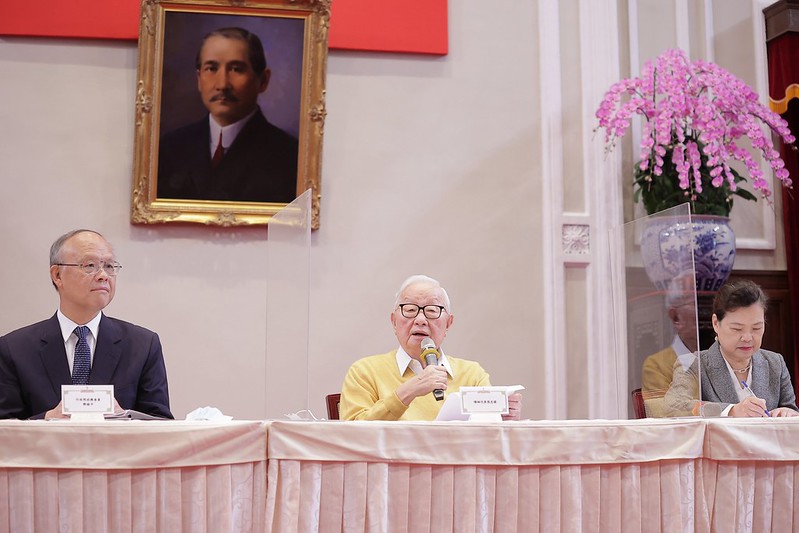
On the morning of November 13, the Presidential Office held a press conference on the 2021 APEC meetings, including the APEC Economic Leaders' Meeting (AELM) and Ministerial Meetings. Joined by Minister without Portfolio John C. C. Deng (鄧振中), Minister of Economic Affairs Wang Mei-hua (王美花), National Security Council Deputy Secretary-General Hsu Szu-chien (徐斯儉), and Director-General Sharon S. N. Wu (吳尚年) of the Ministry of Foreign Affairs' Department of International Organizations as Senior Official for APEC, Leader's Representative Dr. Morris Chang (張忠謀) briefed the public on the results of this year's APEC meetings and responded to questions from the media.
Dr. Chang discussed the remarks he delivered at the previous day's AELM, a full transcript of which follows:
Prime Minister [Jacinda] Ardern has encouraged us to respond to the question of "How can we work together to accelerate the economic recovery from COVID-19?" Chinese Taipei will respond as follows:
First, COVID-19 is not over yet. The world, including APEC, is still struggling toward what we may consider to be a valid signpost that COVID-19 is behind us: namely, free travel again, without restrictions and quarantines. To get to that signpost, the best medical advice appears to be: sufficiently broad vaccination coverage among the world population. Getting back to APEC, some members do not have enough vaccines while others have surpluses and/or are manufacturers. We believe that the latter should make it easy for the former to obtain sufficient vaccines and implement broad vaccination coverage.
On behalf of Chinese Taipei, I am happy to report that, while I expressed some concern in our special session in July about our vaccine adequacy, that concern has now eased somewhat due to generous donations by the US and Japan, and by several local enterprises and institutions. Also, as perhaps one of the most successful APEC members to control the severity of the pandemic outbreak through digital tools so far, Chinese Taipei repeats our willingness to help other members by sharing our experience with them.
Once we have reached the signpost of free travel, it means we have conquered, or at least neutralized COVID-19. What remains to be our main challenge? Free trade--free trade that is only subject to vital national security needs.
APEC members have thrived during the past several decades through free trade. Chinese Taipei is concerned that, recently, "free trade" seems to carry more conditions and qualifications than it used to. We believe most of those conditions and qualifications are counterproductive. We earnestly believe that free trade, subject to only vital national security needs, is the broad avenue to supply chain resiliency and robust prosperity for each and every APEC member.
Speaking of supply chain resiliency, the recent semiconductor supply bottleneck has often been brought up. The chip shortage is a culmination of an original underestimation of demand, natural disaster, logistical jams, and digital demand spikes.
While a shortage of any critical component is a serious problem, a free market, which includes free trade and free competition, is still the best solution. In fact, the greatly stepped-up building of chip manufacturing capacity in response to the recent chip shortage, is testimony to our belief that the free market is the best solution to shortage or excess problems.
Regional economic integration brings our economic and trade relations closer. Chinese Taipei believes that our economic development depends importantly on APEC regional prosperity. Therefore, we believe in supporting initiatives that deepen economic integration, promote high standards on trade-related rules, and help improve the livelihoods of our people across the Asia-Pacific.
Because of these beliefs, we have applied to join the CPTPP (Comprehensive and Progressive Agreement for Trans-Pacific Partnership), a comprehensive agreement that could generate momentum for the development of the region – liberalizing trade and investment while promoting sustainable growth. Chinese Taipei plays an irreplaceable role in the global high-tech supply chain. We also have a highly transparent market economy, and are able and willing to respect the CPTPP's high standards.
Finally, we thank New Zealand for overcoming all the challenges this year and successfully hosting all the APEC meetings. We believe that the achievements in this year's priority areas will lay the groundwork for the APEC agenda in the future.
We also thank and support the United States' and Peru's offers to host APEC in 2023 and 2024, respectively. We also look forward to the APEC meetings to be hosted by Thailand next year.
Dr. Chang further stated that at this year's AELM, APEC members focused on two important issues, the first of which was vaccines. He said that countries with a vaccine surplus outlined how many doses they have donated and how many they will donate in the future, and noted that APEC members without enough vaccines voiced complaints. Dr. Chang said that Chinese Taipei lies somewhere in the middle, and that while we are not in a position to donate vaccines, the shortage he mentioned in July seems to have eased.
The second issue of common concern, Dr. Chang said, was economic recovery and the question of how to use technology and digitalization to revive our economies in an inclusive way, so that the resulting economic prosperity is not limited to only a minority of people. Other issues discussed included sustainability and climate change.
Dr. Chang then answered questions from the media.
Asked whether other APEC members had responded to his statement during the AELM expressing our desire to join the CPTPP and citing Taiwan's competitive advantages, Dr. Chang said that AELM participants delivered their statements in alphabetical order, with no time allotted in the agenda for responses.
He added that, in regard to our CPTPP accession, he had made clear in his remarks that Chinese Taipei plays an irreplaceable role in global high-tech supply chains, has a highly transparent market economy, and is willing and able to respect the CPTPP's high standards, all of which are strong qualifications for entry.
Dr. Chang was also asked if China had expressed goodwill or sought to clarify its previously stated position that, in order to participate in mechanisms for economic cooperation, Taiwan or Chinese Taipei must do so under the "one China principle." Dr. Chang responded in the negative, saying that China did not bring up the "one China principle" in the meeting.
Dr. Chang was further asked if other leaders had expressed concern about chip shortages or had discussed related issues with him. Dr. Chang responded that none of the other leaders had broached the topic, and that he was the only one to mention it, adding that he brought it up only as a good example of why the free market is the best solution to shortages or oversupply problems. Regarding the chip shortage, Dr. Chang said that, in a free-market environment, the private sector can quickly ramp up production capacity before any government takes action.
Dr. Chang also referred to his statement during the AELM that free trade seems to carry more conditions and qualifications than it used to, citing the US as a longtime free trade advocate which has now suddenly added conditions requiring more domestic production of semiconductors and integrated circuits.
Details
2021-11-01
Presidential Office thanks US for second COVID-19 vaccine donation
In response to the United States' second donation of COVID-19 vaccines to Taiwan, which comprised 1.5 million Moderna doses and arrived around noon on November 1, Presidential Office Spokesperson Xavier Chang (張惇涵) stated that the Presidential Office sincerely thanks the United States government for once again taking concrete action to support Taiwan. Noting that the US has to date donated a total of 4 million COVID-19 vaccine doses to Taiwan, Spokesperson Chang said this latest donation reflects a virtuous cycle of cooperation between democratic partners in our fight against the pandemic, shows that the Taiwan-US friendship is flourishing in the spirit of "real friends, real progress," and highlights that US government support for Taiwan is rock-solid.
Spokesperson Chang noted that this past June, when Taiwan was facing a serious challenge from the pandemic, the US government acted quickly to donate 2.5 million vaccine doses, which helped Taiwan significantly in overcoming that challenge. During her visit to Taiwan that month, US Senator Tammy Duckworth declared that the US would not let Taiwan "stand alone," a remark which deeply touched the people of Taiwan. As US President Joe Biden said, vaccines are the product of the power of democracy and scientific ingenuity; the US government's move to again extend a helping hand demonstrates a firm belief in democratic values and that Taiwan is not alone.
Spokesperson Chang also noted that, thanks to the tireless work of Taiwan's pandemic response professionals, the togetherness of our people, and continued assistance from our democratic partners, Taiwan gradually emerged from the outbreak of COVID-19 earlier this year, which has been effectively brought under control. To date, over 70% of people in Taiwan have received at least one vaccine shot, and over 30% have received two. The spokesperson again expressed sincere gratitude to the US government for its timely vaccine donations, and said that inspections of this shipment will proceed quickly so that the doses can be distributed and administered via Taiwan's vaccination program.
Spokesperson Chang reiterated that the Presidential Office is deeply thankful to the members of Taiwan's diplomatic corps as well as all others on both sides who were involved in facilitating the prompt delivery of these vaccines. Taiwan and the US are steadfast partners who share the same values, and we are convinced that Taiwan-US cooperation can overcome the challenges of the pandemic and contribute to global public health. Taiwan will continue to deepen all facets of its cooperative partnership with the US, as we work together to maintain regional peace and stability and promote prosperity and development.
Details
2021-10-28
Presidential Office thanks Japan for sixth donation of COVID-19 vaccines
Responding to Japan's sixth donation of AstraZeneca COVID-19 vaccines, which comprised 300,000 doses and arrived in Taiwan on the morning of October 27, Presidential Office Spokesperson Xavier Chang (張惇涵) stated that the Presidential Office once again expresses heartfelt and sincere thanks to the Japanese government. Spokesperson Chang noted that Japan has donated a total of more than 4.2 million COVID-19 vaccine doses to Taiwan over six shipments, demonstrating our genuine friendship.
Spokesperson Chang stated that the "friendship vaccines" donated by the Japanese government have contributed substantially to raising overall vaccination coverage in Taiwan and better protecting our society. The people of Taiwan have been deeply moved by these vaccine donations, which reflect the resolute friendship between Taiwan and Japan and are a testament to the enduring virtuous cycle of mutual support between our countries.
Spokesperson Chang said that the Presidential Office once again expresses sincere thanks to our diplomatic personnel and all others who contributed to this effort. The spokesperson added that Taiwan and Japan are steadfast partners who share common values, and that we will continue to strengthen our bilateral cooperation to enhance the well-being of our peoples, while upholding peace and stability and promoting prosperity and development in the region. Spokesperson Chang emphasized the government's belief that, through continued cooperation, Taiwan and Japan will overcome the challenges posed by the COVID-19 pandemic and be a positive force for global public health.
Details
2021-09-26
Presidential Office thanks Slovakia for expanded vaccine donation
Responding to the September 26 arrival of 160,000 AstraZeneca COVID-19 vaccine doses donated by Slovakia, Presidential Office Spokesperson Xavier Chang (張惇涵) said that the Presidential Office is sincerely thankful to the government of Slovakia for its support for Taiwan. Spokesperson Chang stated that Slovakia's decision to increase its originally announced donation of 10,000 doses to 160,000 highlights the close friendship Taiwan and Slovakia have maintained in our joint efforts to fight the COVID-19 pandemic. The people and government of Taiwan are deeply grateful for Slovakia's assistance.
Spokesperson Chang noted that since the outbreak of the pandemic last year, Taiwan and Slovakia have cooperated closely to fight the spread of COVID-19. Our central government, the Kaohsiung City government, and Taiwan's private sector have donated 700,000 face masks to Slovakia, and Slovakia last year became the first European Union member to include Taiwan on a "green list" for international travelers. This year, moreover, the Foreign Affairs Committee of Slovakia's National Council passed a resolution supporting Taiwan's participation in the World Health Assembly. Spokesperson Chang added that as the world continues to fight COVID-19, these actions reflect a virtuous cycle of mutual support between fellow democracies.
Spokesperson Chang pointed out that Taiwan's friendly ties with countries in Central and Eastern Europe have continued to deepen throughout the fight against COVID-19, with Lithuania, the Czech Republic, Poland, and Slovakia having donated a combined total of more than 840,000 vaccine doses to Taiwan. Their assistance has greatly increased Taiwan's vaccination coverage and helped protect Taiwanese society from COVID-19, stated Spokesperson Chang, who said that the Presidential Office again extends its deepest gratitude to Taiwan's diplomatic team and everyone else who helped facilitate the prompt delivery of these vaccines.
Spokesperson Chang further noted that the Taiwan government's recently announced trade and investment delegation to Eastern Europe is scheduled to visit Slovakia in October, and has received an enthusiastic response from the industrial sector. Building on an already robust foundation, Taiwan and Slovakia will continue to enhance our cooperative partnership across a range of fields, said Spokesperson Chang, adding that we firmly believe that Taiwan will continue to expand and deepen its friendly ties with the nations of Central and Eastern Europe, overcoming the pandemic together and acting as force for good in the world.
Details
2021-09-07
Presidential Office thanks Japan for fourth COVID-19 vaccine donation
In response to Japan's fourth donation of AstraZeneca COVID-19 vaccine doses, which arrived in Taiwan on the afternoon of September 7, Presidential Office Spokesperson Xavier Chang (張惇涵) said that the Presidential Office is again sincerely grateful for Japan's timely and continued assistance. Including today's shipment of 64,000 doses, the Japanese government has now donated over 3.4 million vaccine doses to Taiwan.
Spokesperson Chang said that doses from Japan's three previous donations have already been distributed for use in our domestic vaccine drive, significantly boosting Taiwan's vaccination coverage and helping to protect Taiwanese society from COVID-19. The Japanese government has once again extended a helping hand to Taiwan, even as the international community continues to face a serious pandemic, as global vaccine supplies remain limited, and as AstraZeneca vaccines are being administered to the Japanese public. Japan's assistance reflects the sincere friendship between Taiwan and Japan, and has deeply touched the people of Taiwan.
Spokesperson Chang added that the Presidential Office would like to once again express sincere thanks to our diplomatic team and everyone else who helped facilitate this donation, and further expressed confidence that Taiwan and Japan will overcome the challenges of the pandemic through mutual cooperation and assistance. Taiwan will continue to expand its wide-ranging partnership with Japan on this strong foundation, working together to promote regional peace, stability, development, and prosperity while jointly contributing to global health and welfare.
Details
2025-12-04
President Lai interviewed by The New York Times DealBook Summit
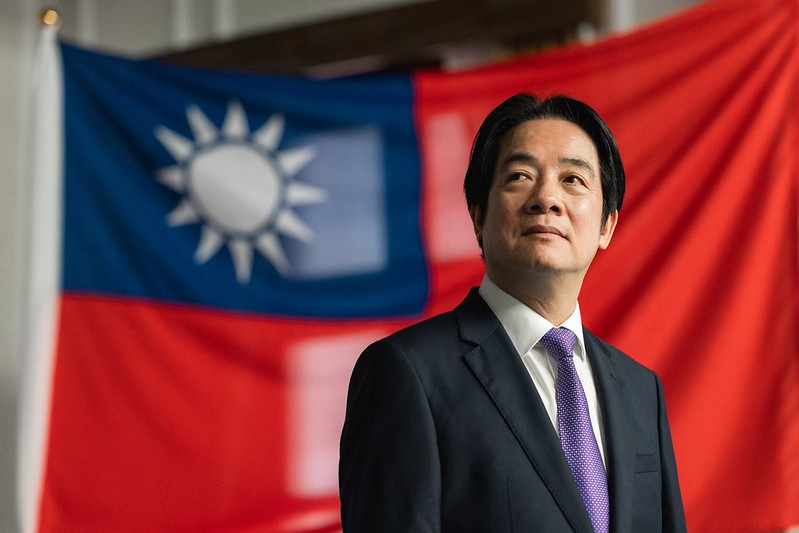
In a recent interview via videoconference with The New York Times for its DealBook Summit, President Lai Ching-te responded to questions from host Andrew Ross Sorkin on topics including Taiwan’s national defense, cross-strait relations, Taiwan-US relations, the Russia-Ukraine war, and the semiconductor industry. The interview was broadcast in the early morning of December 4.
The DealBook Summit is a major annual event held by The New York Times aimed at facilitating dialogue among leaders from various sectors and sharing their insights and analyses on international affairs. This year’s summit was held on December 3 (US EST) in New York, and included such speakers as Israeli Prime Minister Benjamin Netanyahu, United States Treasury Secretary Scott Bessent, California Governor Gavin Newsom, Palantir CEO Alex Karp, and Turning Point USA CEO and Chair of the Board Erika Kirk.
The following is the full text of the interview:
Q: Here’s where I want to start the conversation. You’ve just announced this past week that you’re introducing a US$40 billion special budget for military spending to buy more weapons from the US to try to deter China from invading Taiwan. What indicators, and perhaps new indicators, are you looking at that shows an increased threat to Taiwan?
President Lai: We can see that China’s military drills targeted at Taiwan are becoming increasingly frequent and intense. They have even moved beyond the first island chain into the second, affecting the wider Indo-Pacific region. At the same time, China’s united front influence campaigns against Taiwan are also becoming more serious. In order to safeguard national security and fulfill our responsibility to maintain peace and stability across the Taiwan Strait, we have announced this special defense budget.
We believe that peace is priceless, and war has no winners. While we aspire to peace, we cannot harbor illusions about it. Peace must be secured through strength. This is why we are increasing our defense budget and strengthening our national defense capabilities, while also cutting back our economic dependence on China. This includes improving our economic resilience. In 2010, 83.8 percent of Taiwan’s outbound investment went to China; last year, that figure had dropped to around 7 percent. We are also working side-by-side with other democracies to reinforce deterrence. Robust preparations are the best way to avoid war and achieve peace.
Q: Let me ask you this: President Xi has said that his goal for China’s military is to be capable of taking Taiwan by force by 2027. You said that Beijing is accelerating these preparations for an attempted invasion. So what do you think China’s timeline is now?
President Lai: We must ensure the best possible preparations for the worst-case scenarios. Whatever timeline the PLA may have, Taiwan’s fundamental principle is that we must be ready first – this is our basic principle.
I also want to use this opportunity to reiterate to the international community that Taiwan will do everything necessary to protect itself and to safeguard regional peace and stability. We are grateful to the international community, including the G7, the president of the United States, Japan’s political leaders, and many others for their interest in cross-strait peace and emphasizing that stability in the Taiwan Strait is essential to global security and prosperity. Their shared position greatly contributes to stability in Taiwan and peace in the region. We hope Taiwan can continue working with the international community to uphold the rules-based international order.
Q: Well, let me ask you about that because, Mr. President, last week you said the relationship between Taiwan and the US is rock-solid. How confident are you that the United States, and in particular President Trump, would come to the aid of Taiwan if China were to invade?
President Lai: Although Taiwan and the United States do not have official diplomatic relations, Taiwan is deeply grateful to the US Congress for passing the Taiwan Relations Act and to President Ronald Reagan for the Six Assurances. For decades, successive US administrations and both parties in Congress have strongly supported Taiwan based on this foundation. Our relationship truly is rock-solid. Since President Trump took office, cooperation with Taiwan has not only continued but even expanded. We look forward to working with the United States through tariff negotiations – not only to help address their trade deficit, but also to deepen bilateral economic relations and strengthen our friendship.
Q: We’ve all been watching what’s been happening play out in Ukraine between Ukraine and Russia. And there have been questions inside Ukraine about the support that the United States has provided or not in terms of how this ultimately gets settled. How do you view what’s happening in Ukraine right now and the role that the US is playing there?
President Lai: Taiwan stands with the people of Ukraine. We hope this irrational and illegitimate war will be over as soon as possible so that the Ukrainian people will no longer have to suffer. However, in ending this war, we also hope that Ukraine’s national dignity and the well-being of its people will be respected, and future conflict will be prevented.
Q: You talked about trade earlier. When you talk about the relationship between the US and Taiwan, one of the reasons that Taiwan is so valuable, such a strategic asset – and President Trump talks about it this way about Taiwan – is because of semiconductors. And one of the things that he says is that he hopes that the US is going to be manufacturing 40 to 50 percent of all semiconductors in the next couple of years with your help. Does that make Taiwan more valuable ultimately to the US or do you worry at all that it makes it less valuable to the US?
President Lai: Taiwan’s semiconductor industry plays a crucial role, especially as we enter the future AI era. But I want to emphasize, with humility, that Taiwan’s semiconductor sector is a global asset. The industry functions as an ecosystem: the US excels in R&D, design, and has the world’s largest market; Japan provides materials and equipment; the Netherlands makes advanced lithography systems; Taiwan specializes in logic chip manufacturing; and Korea leads in flash memory chips.
In other words, semiconductors are a global ecosystem – it requires worldwide cooperation to be effective. This is why our government supports TSMC and other Taiwanese semiconductor firms as they invest in the US, Japan, Europe, or wherever they believe is needed. This contributes to global progress and prosperity.
As a result, we remain supportive as President Trump seeks investments from Taiwanese semiconductor companies and suppliers in the US. We hope Taiwan can support the reindustrialization of the US. President Trump wants the US to become the world center for AI, and we are willing to assist in this.
As I said earlier, we hope Taiwan-US tariff negotiations will not only help reduce the US trade deficit, but also deepen bilateral economic cooperation, further integrate Taiwan’s industries with the American economic structure, and strengthen the Taiwan-US relationship. This will contribute to global prosperity and development.
Q: Do you think that President Trump’s timeline, this idea that 40 to 50 percent of all semiconductors could be manufactured in the United States in the next two or three years, is realistic?
President Lai: We understand President Trump’s sense of urgency; he wants the United States to maintain an edge in global competition. Whether this target of 40 to 50 percent can be achieved within this timeframe depends not only on Taiwan’s support but also on the US government’s ability to facilitate land acquisition, water and electricity supply, workforce and talent development, and investment incentives. If the US government manages to do this well and effectively, then this goal becomes much more achievable.
Q: There’s a big debate in the United States right now about whether companies like Nvidia should be allowed to sell their most advanced chips to China. And there has not been a real answer yet here in the US. I’m curious what you think about that. Do you think that the most advanced chips should be allowed to be exported to China?
President Lai: As Taiwan’s president, it would not be appropriate for me to comment on US domestic policy. But I can share an experience: Around the year 2000, Taiwan faced a similar debate about whether our advanced chip manufacturing capabilities should move to mainland China. There was an extensive and thorough discussion across society and among different political parties. The consensus was that it would be unwise and should not happen. Looking back, that decision was correct. Had Taiwan allowed its most advanced manufacturing to relocate to China, Taiwan would not be what it is today.
Q: Final question for you. Your economy is red hot right now, in large part because of the AI boom. It’s a two-part question. I wonder whether you’re worried about an AI boom being an AI bubble. And I’m also curious how you think about the Chinese economy today and how that relates to how President Xi even views Taiwan, and when and if it would consider either invading or, through using the gray zone, trying to effectively cut off or control Taiwan.
President Lai: There are many different views in the tech and economic communities. Some say AI could become a bubble; others say it may not. As a political leader, I believe the AI era will bring greater convenience to people’s lives, stimulate economic development, and contribute to global prosperity. That is why we must take steps to prevent AI from becoming a bubble.
In other words, leaders around the world – especially those from countries with AI-related industries – should work together and take necessary measures to ensure AI develops sustainably and has a soft landing, so that it can drive long-term global growth.
China’s economy is indeed struggling. Taiwan’s growth rate this year is projected to reach 7.37 percent, while international financial institutions estimate China’s growth to be only a little above 4 percent. We sincerely hope that as China faces economic pressures, President Xi Jinping will focus not on territorial expansion but on improving the well-being of the Chinese people. Taiwan is willing to help and to cooperate in addressing these economic challenges.